
Geisha Painting
13 œuvresDes œuvres en édition limitée, pensées par l'artiste pour illuminer votre intérieur.
Fait main en AllemagneLivraison offertePrêt à accrocher30 jours pour changer d'avis
-
Add to Wishlist JAPANESE GEISHA PAINTINGDès 89 €
-
Add to Wishlist MODERN GEISHA PAINTINGDès 89 €
-
Add to Wishlist GEISHA LIVING ROOM PAINTINGDès 89 €
-
Add to Wishlist SAMURAI GEISHA PAINTINGDès 89 €
-
Add to Wishlist JAPANESE WOMAN PAINTINGDès 89 €
-
Add to Wishlist JAPANESE GEISHA PAINTINGDès 89 €
-
Add to Wishlist JAPANESE GEISHA PAINTINGDès 89 €
-
Add to Wishlist JAPANESE GEISHA PAINTINGDès 89 €
-
Add to Wishlist GEISHA JAPANDI TABLEDès 89 €
-
Add to Wishlist JAPANESE ZEN WOMAN PAINTINGDès 89 €
-
Add to Wishlist GEISHA PAINTINGDès 89 €
-
Add to Wishlist JAPANESE WOMAN PAINTINGDès 89 €
-
Add to Wishlist JAPANESE WOMAN PAINTINGDès 89 €





Chargement des œuvres suivantes…
Vous avez vu 13 œuvres sur 13


For a long time, the geisha has been one of the most misunderstood figures in Japanese culture by the Western imagination. She has been mistaken for what she was not, reduced to clichés, and depicted in every conceivable way. Yet, in the reality of both ancient and modern Japan, the geisha embodies something far more demanding: the complete mastery of a set of traditional arts (dance, music, tea ceremony, conversation, calligraphy) serving an aesthetic refinement that can only be appreciated with a little patience. It is this true geisha, guardian of centuries-old cultural heritage, that our geisha paintings seek to represent with the finesse she deserves.
Our gallery brings together a precise selection of compositions inspired by this emblematic figure of Kyoto, printed on premium canvas and glossy plexiglass in our workshop in Germany. Intimate portraits of maiko in embroidered kimonos, silhouettes draped in the light of a tea garden, scenes of nocturnal ceremonies under the lanterns of the Gion district: each painting in the collection captures a different facet of this unique Japanese elegance, which has fascinated Western painters from Whistler and Van Gogh to contemporary artists.
The geisha: a total art form carried by exceptional women
The word itself illuminates the function. Geisha literally means "person of art" or "art practitioner", composed of the kanji 芸 (gei, art) and 者 (sha, person). Sometimes in Kyoto, which remains the historical capital of this tradition, they are called geiko. A geisha is not a woman of pleasure: she is an accomplished artist who has spent between five and ten years learning shamisen, classical Japanese dance, the tea ceremony according to the path of chadō, ikebana floral arrangement, calligraphy, and the art of learned conversation. Her clients, traditionally men from Japanese high society, pay to attend a performance where every gesture, every silence, every inclination of the head follows a millennium-old protocol.
The journey begins at a very young age. The apprentice, called maiko, lives in an okiya, a geisha house, under the authority of an okāsan (house mother) and accompanied by an onēsan (older sister) who is herself a confirmed geisha. This system of apprenticeship by filiation, inherited from the Edo period, continues today almost unchanged in Kyoto's hanamachi. Gion, Pontochō, Miyagawa-chō, Kamishichiken, Gion-Higashi: these five historic districts still form the living heart of the tradition. Understanding this deep cultural dimension allows us to look at a geisha painting as more than just a decorative orientalist image. It is this more accurate perspective that our collection seeks to promote.
The main styles of geisha paintings in our gallery
Eight main compositions structure our selection, each exploring a different facet of the subject. Here are the main categories.
The intimate portrait: the geisha seen up close
This is probably the most moving category in the collection. Tight framing on the face, downcast or contemplative gaze, detail of traditional makeup (the white foundation oshiroi, the red beni applied to the lips, the black outline of the eye). These compositions prioritize psychology over decor, inner life over outward appearance. The palette often leans towards neutrals enhanced with touches of red and black: pale skin, ebony hair, kimono in dark or burgundy tones. These paintings are particularly suitable for adult bedrooms, dressing rooms, and refined feminine spaces where they create a discreet but magnetic presence.
The maiko in embroidered kimono: the splendor of apprenticeship
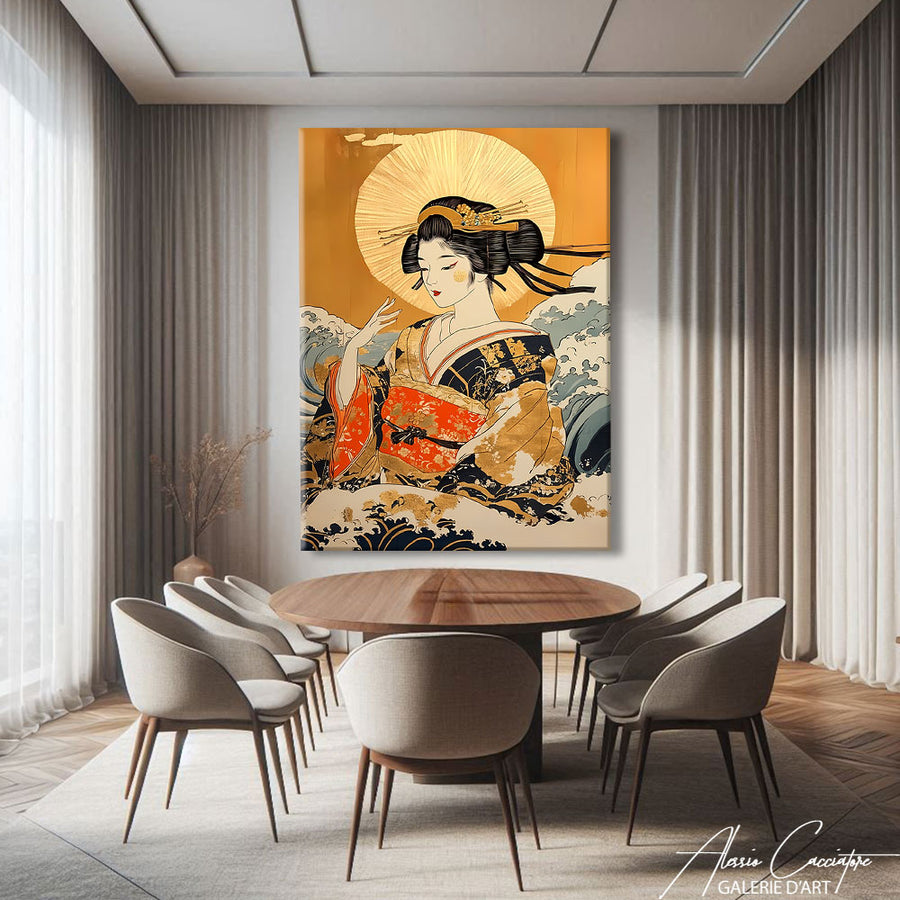
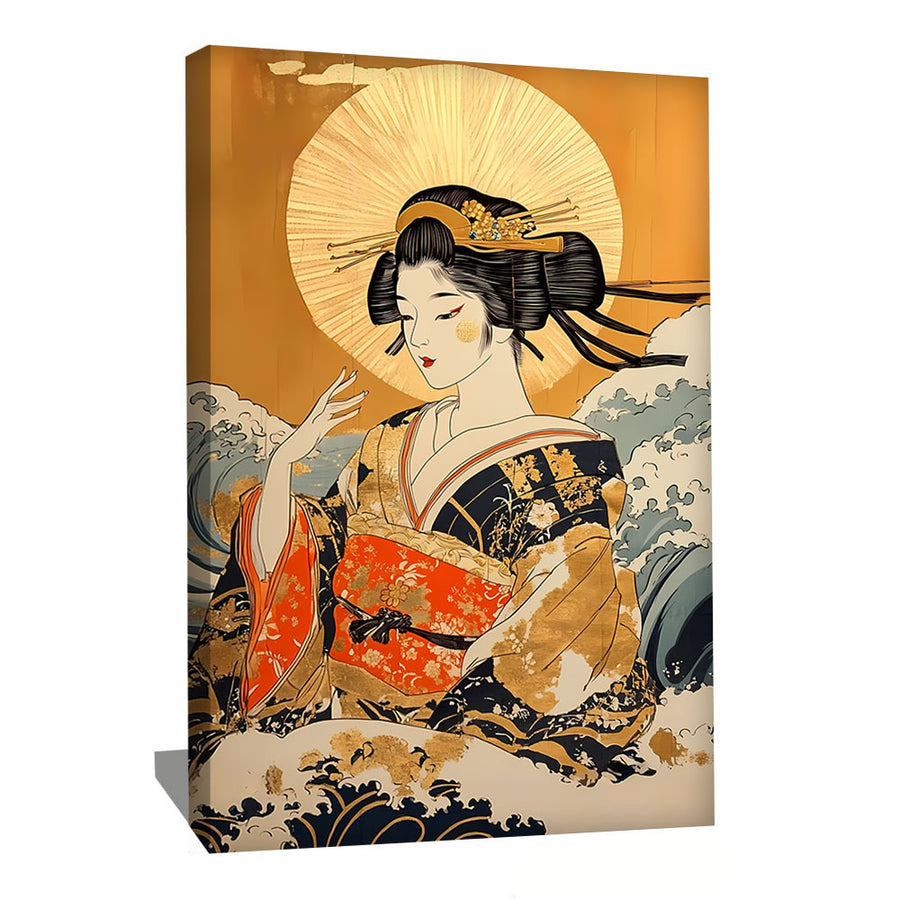
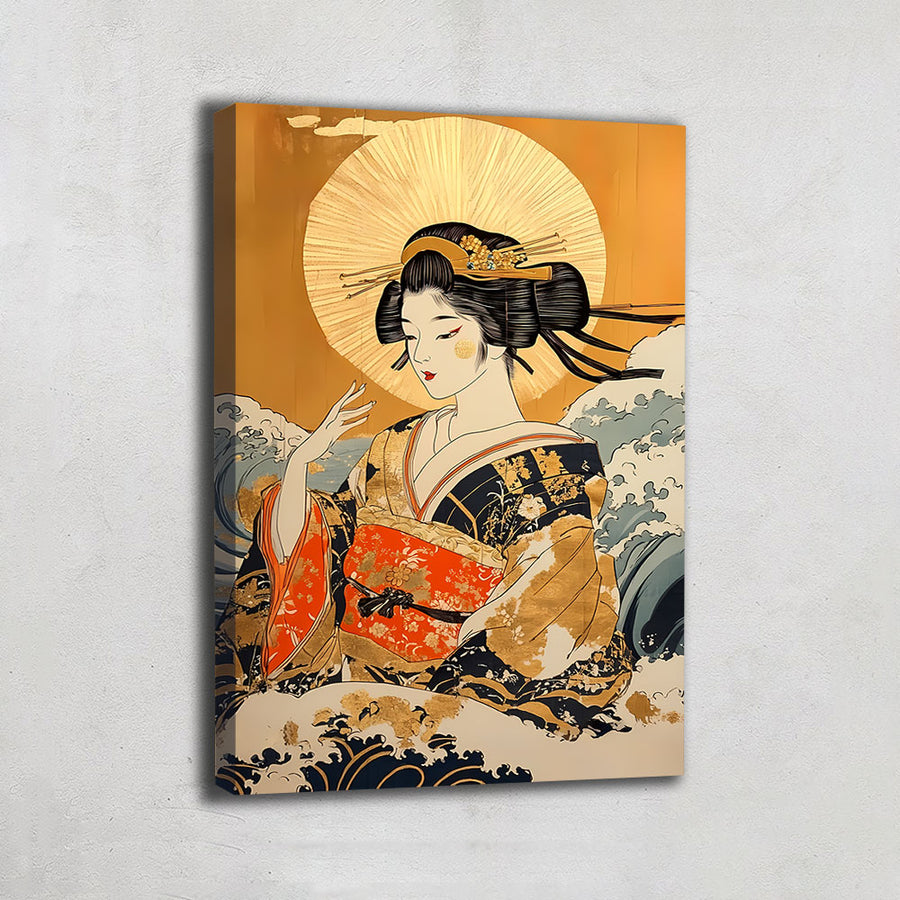
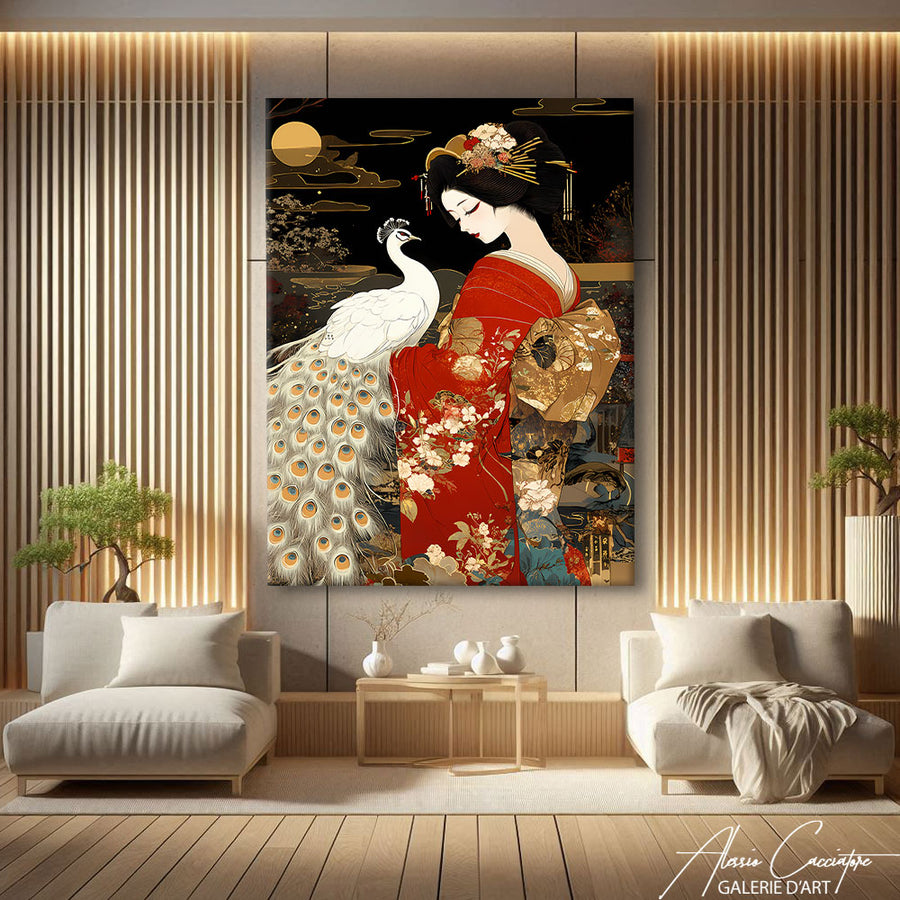
The apprentice geisha wears much more colorful and elaborate outfits than her experienced older sister. This is one of the paradoxes of the system: the younger one is in training, the more outwardly lavish she appears. Long sleeves that almost touch the ground, a high obi edged with gold, floral ornaments in the hairstyle (the famous kanzashi), striking makeup that highlights youth. Our compositions featuring maiko play on this visual richness. Dazzling palette: deep reds, embroidered golds, emerald greens, indigo blues, sakura pinks. These paintings find their place in elegant living rooms and formal dining rooms. To explore the broader world of Japanese clothing.
The geisha in her setting: scenes of neighborhoods and gardens
More narrative, these compositions place the geisha in her cultural environment: paved alleys of Pontochō at dusk, paper lanterns of Gion at nightfall, a moss garden traversed by a path of Japanese stepping stones, a tea pavilion reflected in a pond. The female figure becomes an element of a larger tableau that celebrates the entirety of Kyoto culture. This approach is particularly successful in panoramic or large formats, where the decor can breathe.
Modern and contemporary geisha
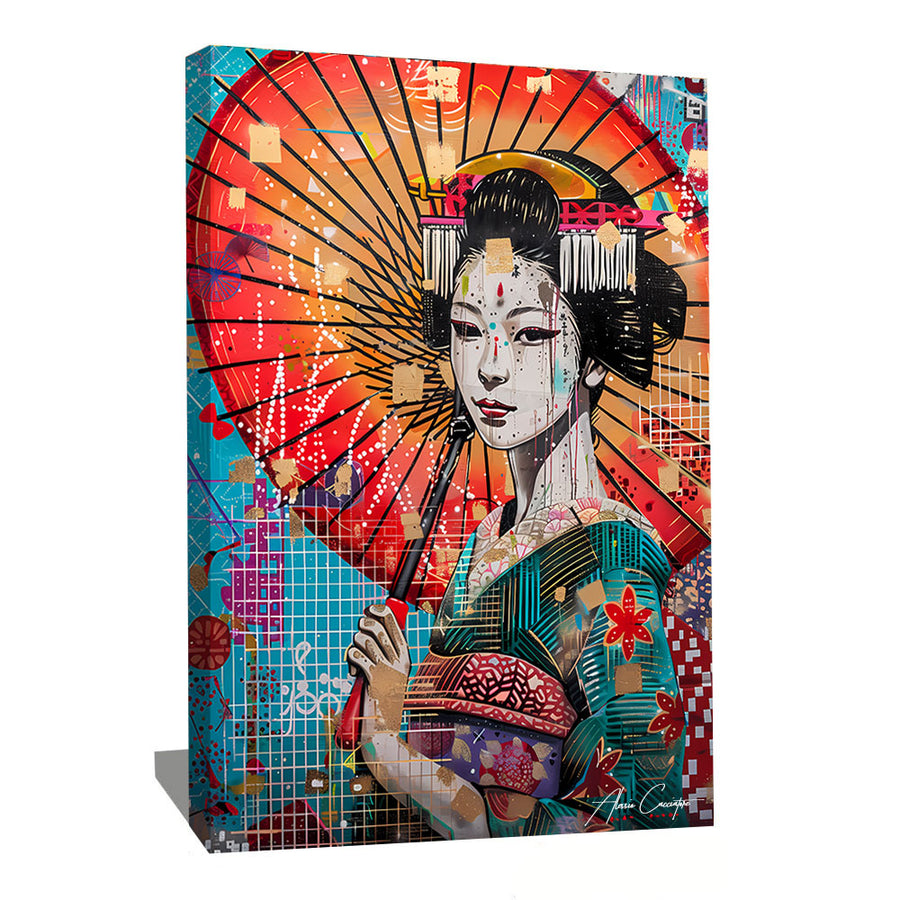
For lovers of contemporary art, we offer more modern interpretations of the motif. Clean lines reminiscent of line art, neutral beige or gold backgrounds that fit into the Japandi aesthetic, desaturated palettes that transform the portrait into near-abstraction. These compositions embrace a decorative modernity that naturally fits into contemporary design interiors without sacrificing the cultural dimension of the subject.
The geisha and the samurai: the meeting of two figures from ancient Japan
A unique category in our collection: compositions that juxtapose the two great figures of the traditional Japanese imagination. The warrior and the artist, strength and refinement, codified masculinity and codified femininity. These paintings tell an entire story in a single image and are particularly suitable for offices, libraries of Japanese culture enthusiasts, and living rooms that desire a strong narrative composition.
Black and white geisha: graphic elegance
Inspired by traditional sumi-e (Japanese ink painting) techniques and contemporary monochrome portraiture, these compositions depict the geisha without using color. The rendering plays on the purity of the line, the sculptural quality of the face, the drape of the kimono, the geometry of the hairstyle. These paintings fit admirably into minimalist, Scandinavian, and industrial interiors where they bring a cultural dimension without breaking the overall chromatic sobriety.
Geisha under the cherry blossoms: the iconic motif
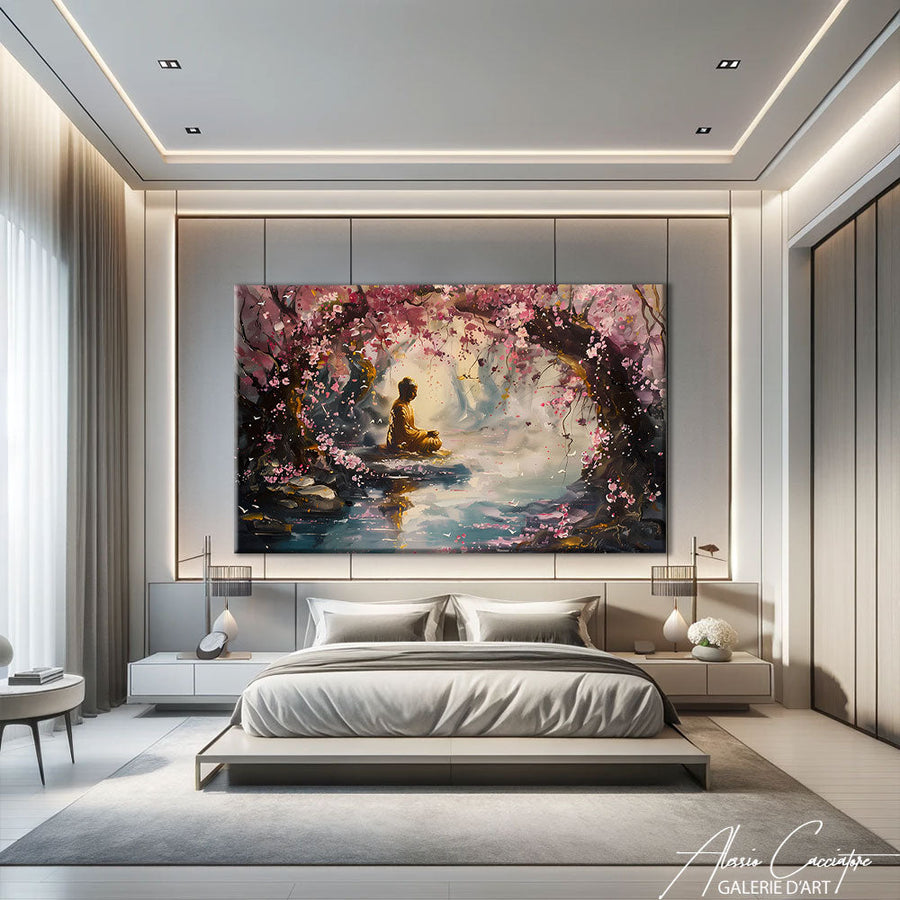
The association of the geisha and the sakura is one of the most famous images in all of Japanese iconography. The two subjects echo each other: ephemeral beauty of the cherry tree, codified and preserved beauty of the artist. Our compositions on this theme play on a palette of powdery pink, off-white, and cinnabar red. They naturally find their place in adult bedrooms and romantic feminine spaces. Also see our Japanese cherry blossom paintings.
Symbolism and imagination: what your choice says
Choosing a geisha painting for your interior evokes a rich imagery worth unfolding.
Refinement as a way of life
Beyond the image, the geisha embodies a certain idea of elegance: one that does not rush, takes its time, and prefers the right gesture over the spectacular gesture. For those who appreciate this aesthetic of daily refinement (a well-prepared tea, a beautifully set table, carefully chosen lighting), the geisha painting becomes a perfectly consistent wall signature. It reminds us, in the intimate space, that beauty is cultivated over time.
Mastery and artistic discipline
A geisha is not born what she is: she becomes it, through years of practice. This dimension of disciplined effort in service of art particularly touches people who themselves practice a demanding discipline (music, dance, precision sport, artisanal craft). The geisha painting then silently reminds us that excellence is a journey, not a destination.
Codified femininity and rediscovered dignity
The geisha offers a representation of femininity radically different from the dominant models in contemporary Western imagery. No frontal seduction, no unveiling, no loud demands: a femininity expressed through code, restraint, and mastery. For many of our clients, this counter-model is profoundly reassuring. It suggests that there are other ways to be a woman than those imposed on us daily.
Attachment to a journey or a culture
For those who have visited Kyoto, who have caught a glimpse of a real geiko going to an appointment in an alley of Gion at dusk, who have attended a traditional performance, the geisha painting becomes a precious memory anchor. It keeps alive the experience of encountering an ancient culture and makes it present daily in the domestic space.
Choosing your palette: the colors of the geisha portrait
The palette of the geisha painting varies considerably depending on the subject and style chosen. Here are the main tones in our selection.
Cinnabar red and deep black: the emblematic palette
This is probably the most iconic combination. The red of made-up lips, the red of formal kimonos, the red of lacquered screens, contrasts with the absolute black of hair and face shadows. This dramatic palette works admirably in hushed living rooms, wood-paneled libraries, and spaces that embrace a strong visual presence.
Sakura pink and powdery white: the soft version
For portraits associated with cherry blossoms or for more tender compositions. Pale pink, off-white, ivory, golden beige, sometimes enhanced with a touch of soft green or turquoise. This more poetic palette suits adult bedrooms, dressing rooms, and rooms where a calm but refined atmosphere is desired.
Gold, burgundy, and indigo: the splendor of the maiko
For compositions featuring apprentices in ceremonial attire. Gold of the embroidery, deep burgundy of the kimono, indigo of traditional fabrics, emerald green of the ornaments. This rich palette evokes the grandeur of major performances and is suitable for formal living rooms and reception dining rooms.
Black and white with a colored accent: graphic sobriety
For those who like refined portraits without chromatic extravagance. Mainly monochrome compositions with a single accent: lipstick in a sepia portrait, a flower in the hairstyle of a black silhouette, a golden cord on a gray kimono. This controlled approach integrates into more contemporary and minimalist interiors.
Neutral and desaturated tones: the Japandi palette
For contemporary reinterpretations of the motif. Beige, taupe, soft gray, off-white, sometimes enhanced with a matte black or discreet gold. This stripped-down tone transforms the traditional portrait into an almost graphic composition, perfectly suited to minimalist design interiors.
Geisha painting: for which room in your home?
The geisha portrait is probably one of the most versatile subjects in terms of decorative use. Here are our recommendations.
For the adult bedroom: intimacy and refinement
This is undoubtedly the room where the geisha finds her most natural place. Her introspective character, contemplative dimension, and chromatic restraint make her an ideal subject for this resting space. Favor intimate portraits in 80x60 cm format above the headboard, or vertical compositions on the side wall. Avoid overly saturated compositions that could disturb sleep quality. The sakura and soft cinnabar red palette is particularly suitable for this space.
For the living room: creating a refined atmosphere
Above the sofa, a large geisha painting in 120x80 cm format or an oriental triptych immediately becomes the visual signature of the room. Here, favor narrative compositions (scenes of Gion, tea garden, maiko in ceremony) that can carry the dimension of the large format. Combine with a few consistent accessories to create a universe: black lacquer, raku pottery, dark wood.
For the dressing room and boudoir: celebrating the feminine ritual
A particular but particularly successful case: the geisha portrait in a dressing room or boudoir. The geisha represents, after all, the absolute embodiment of the ritual of feminine adornment: meticulous makeup, hair styled for hours, choice of outfit according to context. Hanging her portrait in the space where one performs these daily rituals creates a powerful silent dialogue.
For the dining room: refined conviviality
Tea ceremony scenes or maiko in formal kimonos work admirably in a dining room. They create an atmosphere of a carefully set table, slow meals, and ritualized conviviality. A large painting above the sideboard or opposite the table immediately sets the tone.
For the feminine office and home office
For a professional office or home workspace, the geisha brings a unique inspiring presence: that of a woman who has mastered her art through discipline and patience. Favor intimate portraits with a focused gaze, in a compact format (60x40 or 80x60 cm). The motivational effect is subtle but real.
For the entrance and hallway: creating a cultural signature
Vertical format, profile portrait or draped silhouette, controlled palette: the entrance is one of the places where the geisha painting best displays its immediate evocative power. Your guest understands from the threshold that they are entering a world where cultural refinement has its place.
Format and dimensions: composing with the portrait
The geisha portrait lends itself particularly well to certain formats. Here are our recommendations.
Compact format (60x40 cm): ideal for intimate portraits with tight framing, details of hairstyles or makeup, and minimalist compositions. Particularly successful in a series of three complementary portraits (e.g., three different maiko, or three seasons of the same geisha) to create a coherent gallery.
Medium format (80x60 cm): the versatile size. Suitable for all subjects, from classic portraits to narrative compositions. Above a dressing table, a chest of drawers, or as a decorative accent in an adult bedroom. The format that best interacts with furniture without dominating the room.
Large format (120x80 cm): the centerpiece. Particularly suitable for narrative scenes (geisha in her garden, Gion alley at dusk), full-length portraits, and compositions with strong visual impact. Above a sofa or on a large living room wall.
Oriental triptych: perfect configuration for Kyoto scenes. Three panels that form a panoramic view of the Gion district, or three moments of an apprentice's day (morning preparation, afternoon lessons, evening performance). The narrative effect is immediately cinematic.
Vertical format: essential for full-length portraits, draped silhouettes, and compositions where the verticality of the kimono structures the image. Particularly successful in a narrow hallway or between two pieces of furniture.
Premium canvas or glossy plexiglass: choosing the right medium
All our geisha paintings are available in two versions, and the choice has a real impact on the rendering of these compositions where the work on skin tones and textiles is particularly important.
Premium canvas print
Our canvas is hand-stretched over a 2 cm thick FSC-certified spruce wood frame. On geisha portraits, the matte and slightly granular texture of the canvas subtly recalls the traditional washi paper on which Edo-era portraits were painted. It gently softens contrasts and gives pale skin tones a particular, almost tactile, depth. The matte texture also respects the meditative quality of the subject.
We recommend canvas for the majority of geisha portraits, especially intimate compositions, Japandi neutral palettes, and traditional narrative scenes. It is the medium that most naturally dialogues with the spirit of the subject.
Glossy plexiglass print
Plexiglass remains relevant for compositions where the rich chromaticism of formal kimonos needs to fully burst forth: maiko with golden embroidery, geisha in burgundy and indigo kimonos, scenes of Gion under colorful lanterns. Its smooth, glossy finish reveals every nuance of the fabrics and gives the composition an almost luminous effect. Its resistance to humidity also makes it the mandatory choice for bathrooms and damp spaces.
In both cases, our prints use odorless and solvent-free ink, safe even in a child's bedroom. The printing technology we use preserves contrasts and color fidelity for several decades. Each painting is delivered ready to hang, hanging system included.
How to integrate a geisha painting into an existing decor
The geisha portrait interacts with more decorative styles than one might think. Here are some ideas depending on your environment.
With a traditional Japanese interior
This is the most obvious pairing. Dark wood, shoji screen, tatami, raku pottery, low and minimalist furniture: the geisha painting completes the ensemble in perfect coherence. Favor classic portraits or narrative scenes that extend the visual universe. To go further into this aesthetic, explore our Japanese collection.
With a contemporary and minimalist interior
Against an off-white or taupe wall, in a clean space with sharp lines, a geisha portrait in a Japandi composition or monochrome becomes the cultural focal point that warms the architectural purity. Favor neutral and desaturated palettes that interact with the overall sobriety of the room.
For a classic or Haussmannian interior
19th-century orientalism profoundly influenced bourgeois French interiors: Whistler painting models in kimonos, Van Gogh copying Hiroshige prints, Monet creating a Japanese garden in Giverny. A geisha painting in a Haussmannian apartment with moldings and parquet flooring revives this tradition. Opt for classic portraits with a rich palette.
For a bohemian or ethnic chic interior
The decoration enthusiast who collects items from travels (Berber rug, Moroccan lantern, Mexican ceramics) will find a geisha portrait to be an ideal companion for their cosmopolitan world. The Japanese figure dialogues admirably with other strong cultural iconographies, provided one balances it well and doesn't overcrowd the space.
For an Art Deco and Roaring Twenties interior
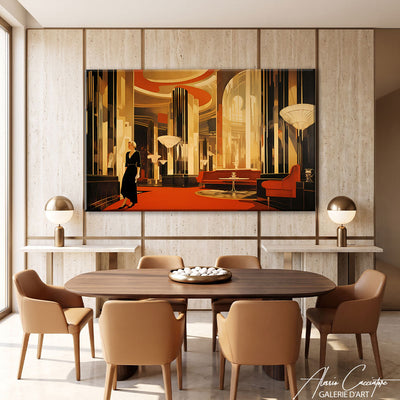
A rarer but magnificent combination: the geisha profoundly inspired Art Deco artists (Erté, Tamara de Lempicka in certain works, Vogue illustrators of the 1920s). A geisha portrait in a pronounced Art Deco interior creates a coherent historical dialogue. Opt for compositions predominantly featuring gold, burgundy, and black.
Frequently asked questions about geisha paintings
What is the difference between a geisha, a maiko, and an oiran?
A geisha (or geiko in Kyoto) is an accomplished artist, after five to ten years of training. A maiko is an apprentice, usually aged 15 to 20, recognizable by her more colorful kimono, long sleeves, and more pronounced makeup. An oiran, sometimes confused with a geisha in the Western imagination, belonged to another now-disappeared tradition: she was a high-ranking courtesan from the Yoshiwara district in Edo (former Tokyo), with a very different social function from that of a geisha. Our paintings exclusively depict geishas and maikos.
Are all your geisha paintings prints or original paintings?
They are high-definition prints on premium canvas or glossy plexiglass, manufactured in our workshop in Germany. We do not sell original hand-painted works. Our compositions are designed, reworked, and printed with gallery quality, but the medium remains a print, which allows us to offer such a level of work at an accessible price.
Is a geisha painting suitable as a gift?
An excellent gift choice, especially for Japanese culture enthusiasts, travelers who have stayed in Kyoto, practitioners of traditional arts (calligraphy, ikebana, tea ceremony), or simply those who appreciate the aesthetics of feminine refinement. The 80x60 cm canvas format remains the best compromise between visual impact and ease of transport.
Does the geisha still exist in Japan today?
Yes, and it's important to remember: the geisha tradition is not a dead historical heritage. Around 250 geikos and maikos currently work in Kyoto, mainly in the Gion and Pontochō districts. This living tradition also explains the difficulty in accurately representing the geisha: one must respect both the historical heritage and contemporary reality.
Which composition to choose for an adult bedroom?
For the bedroom, opt for intimate portraits with a contemplative gaze, in a neutral palette or soft sakura pink. Avoid overly saturated compositions (maiko in very colorful kimonos, Gion scenes under lanterns) which can disrupt sleep quality. The 80x60 cm canvas format is generally the most harmonious choice for this resting space.
At what height should a geisha portrait be hung?
The classic rule: center the painting approximately 1.50 meters from the floor, which corresponds to average eye level. For portraits where the geisha's gaze is important, pay attention to the direction of this gaze: it's better if it naturally meets that of the viewer entering the room, rather than looking down at the floor or up at the ceiling.
Are your paintings delivered ready to hang?
Yes. The canvas is delivered stretched on its frame with the hanging hooks already attached to the back. The plexiglass comes with its invisible mounting system. In both cases, you can hang it in less than five minutes.
How to care for a printed canvas or plexiglass painting?
A dry or slightly damp cloth is sufficient for both surfaces. Avoid abrasive chemical products and direct, prolonged exposure to sunlight to preserve color fidelity, particularly cinnabar reds and embroidered golds, which are most sensitive to UV rays.
Questions fréquentes
Quels sont les délais de livraison ?
La livraison est offerte dans le monde entier, sous 4 à 7 jours. Vous pouvez suivre votre colis à tout moment depuis la page « Suivre le colis ».
Le tableau est-il prêt à accrocher ?
Oui, le système d'accroche est inclus. Les toiles sont tendues sur un châssis en bois d'épicéa de 2 cm (4 cm en option) et les plexiglas sont livrés avec des rails d'accroche en aluminium invisibles.
Toile ou plexiglas : quelle différence ?
La toile est une vraie toile tendue sur un châssis en bois. Le plexiglas est incassable, protégé des rayures et du vieillissement, et travaillé à la main par nos artisans en Allemagne.
Puis-je retourner mon tableau ?
Oui, vous avez 30 jours pour changer d'avis : contactez-nous par e-mail ou par le chat. Et si votre œuvre arrive abîmée, nous la réimprimons, sans retour à faire.
Livraison offerte sous 4 à 7 jours
Fabriqué à la main en Allemagne
30 jours pour changer d'avis