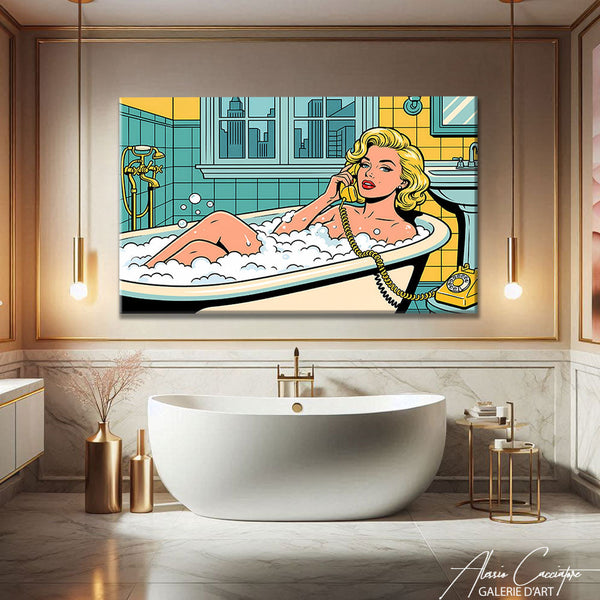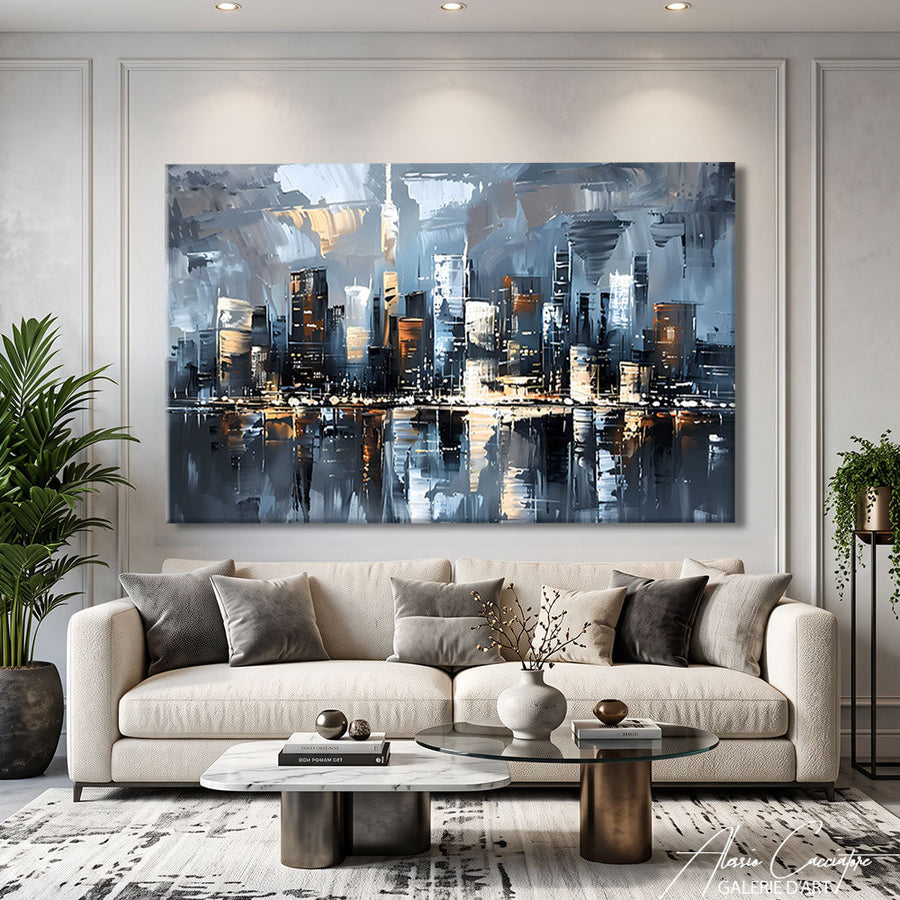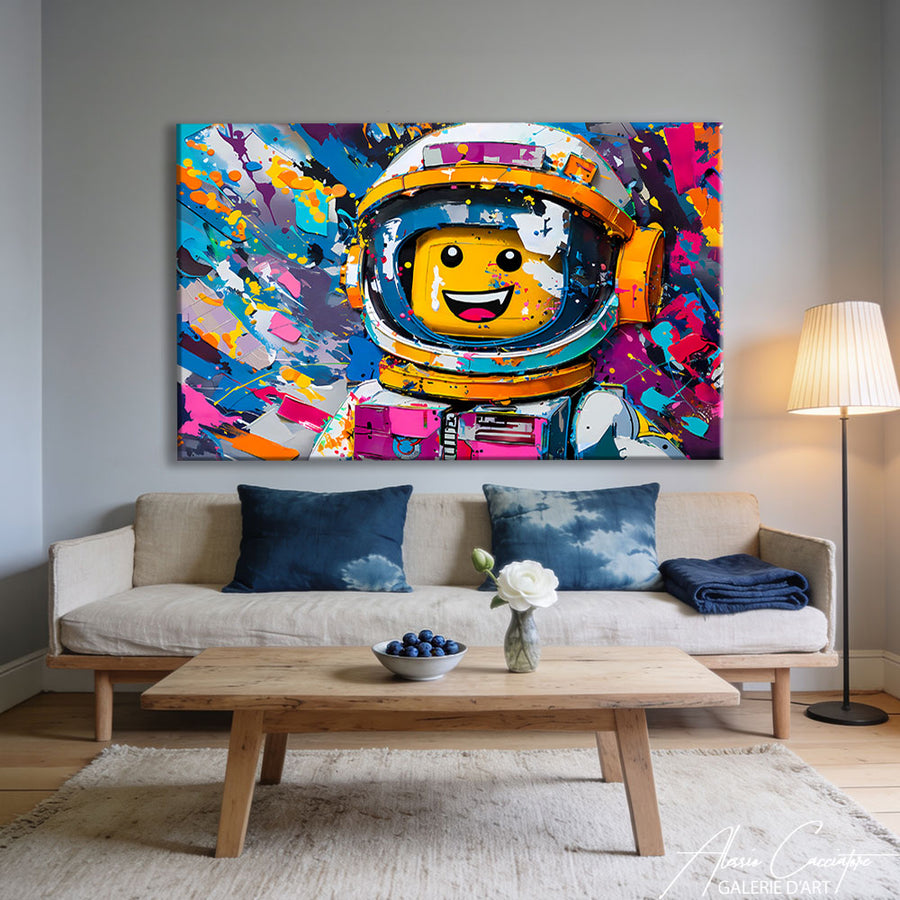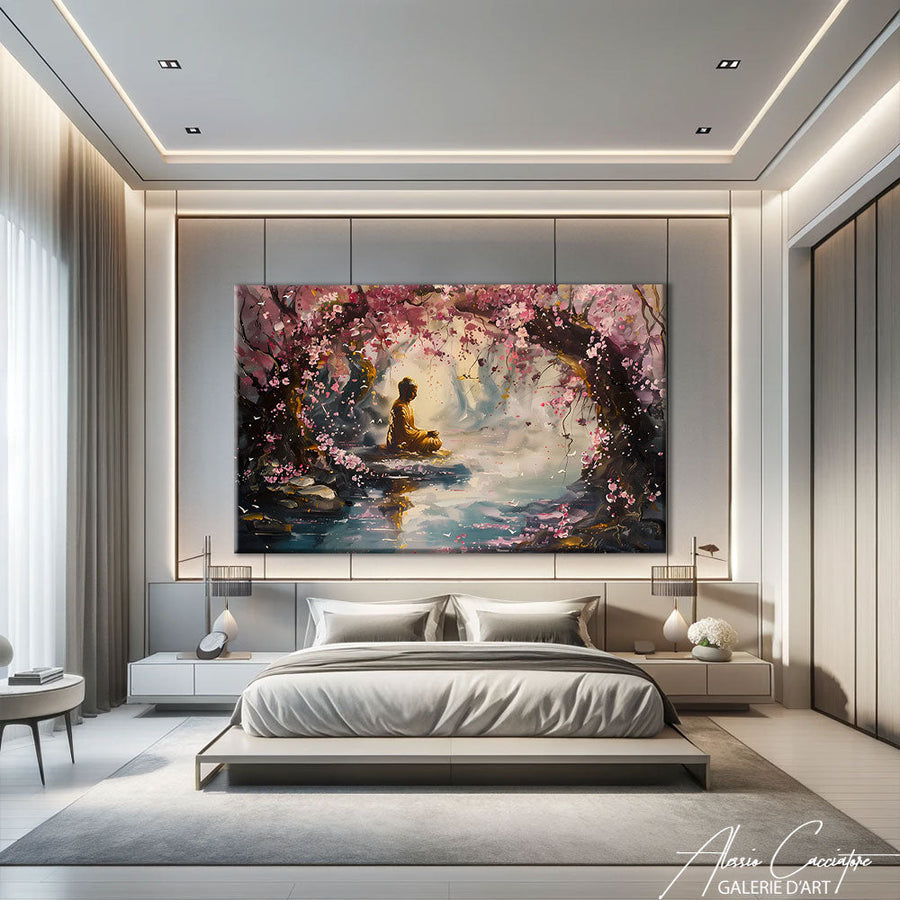

You have finally found the perfect canvas, it is hung at the right height… and yet, when evening comes, it disappears into the shadows or is overwhelmed by an overly white ceiling light. This is the most overlooked aspect of wall decoration: picture lighting. In galleries, we sometimes spend more time adjusting the light than hanging the artworks, because it is what reveals the colors, texture, and depth. At home, a few simple rules are enough: here is our method, backed by figures.
The 3 golden rules of good picture lighting
Before talking about equipment, remember three principles. They apply to a small canvas in a hallway as well as a large piece in the living room chosen from our collection of wall art.
- Light the artwork, not the wall. The beam should cover the picture and extend by no more than ten centimeters at most. A beam that is too wide dilutes the effect; a beam that is too narrow creates a bright circle in the middle of the canvas.
- Aim for about 3 times the ambient light. For the eye to be naturally drawn to it, the picture must be significantly brighter than the rest of the wall, without being dazzling. Beyond 5 times, the effect becomes theatrical and tiring.
- Approach at an angle, never from the front. Frontal light flattens colors and causes reflections; light that is too grazing only illuminates the top. The right compromise is around 30°, which we will return to below.
Which light to choose: LED, color temperature, and CRI
LED, without hesitation
Forget halogen: it heats up, consumes energy, and emits UV rays that dull pigments over the years. A quality LED produces almost no UV or heat near the artwork, making it the only sensible option for a canvas stretched on a frame that you plan to keep for a long time.
CRI: the figure no one looks at
The color rendering index (CRI) measures the fidelity of colors under a lamp, on a scale of 100. Most budget bulbs hover around 80: reds look dull, skin tones grayish. For a picture, demand a CRI of 90 or higher, ideally 95.
Color temperature
- 2700 K (warm white): cozy bedrooms and living rooms, canvases with warm, ochre, golden, terracotta tones.
- 3000 K (neutral warm white): our default setting. It suits most palettes without yellowing whites.
- 3500 to 4000 K (neutral white): black and white artworks, blues, greens, graphic and contemporary styles, offices.
Important rule: keep the same temperature for the picture and the room's ambient lighting. A 4000 K spotlight in a living room lit at 2700 K creates a bluish patch that looks like it came out of a shop window.
Where to place the spotlight? The 30° rule explained with figures
The museum standard is simple: the beam must hit the center of the picture at an angle of about 30° from the vertical. At this angle, any reflection goes toward the floor instead of back into the viewer's eyes, and the shadow of the frame at the bottom of the artwork remains minimal. For large formats (over 120 cm high), go up to 35° to prevent the bottom from being under-lit.
In practical terms, the distance between the ceiling spotlight and the wall is calculated as follows: (ceiling height − height of the center of the picture) × 0.58. The center of a canvas is generally located between 145 and 155 cm from the floor, as we explain in our article on the right hanging height room by room. A few guidelines:
- 2.40 m ceiling: spotlight about 50 cm from the wall.
- 2.50 m ceiling: spotlight about 55 to 60 cm from the wall.
- 2.80 m ceiling: spotlight about 75 cm from the wall.
- 3.00 m ceiling (Haussmannian): spotlight about 85 cm from the wall.
Regarding beam spread, think about the size of the artwork. At a distance of just over one meter, a 24° spotlight illuminates an area of about 50 cm in diameter, a 36° spotlight about 75 cm, a 60° spotlight about 1.30 m. For a 100 × 70 cm canvas, two slightly spaced 36° spotlights provide a more even result than a single wide beam.

Spotlight, track, wall light, or reading light: which device for which picture?
The adjustable recessed or surface-mounted spotlight
The cleanest solution if you are redoing a ceiling. Choose an adjustable model (at least 30° of tilt), otherwise the 30° rule is impossible to apply.
The track: the freedom to change your mind
It is our favorite for a living room or a wall with several pictures. A single electrical point is enough, the spotlights can slide and be reoriented if you change the canvas or format.
The picture light (reading light)
Fixed above the frame, it adds a very elegant classic touch, perfect in a library, an entryway, or a bedroom. Its width should be about half to two-thirds of that of the picture. Limitation: the light is grazing, it mainly illuminates the top of a large canvas; reserve it for formats under 80 cm high.
The plexiglass case
A picture protected by an acrylic panel gains depth and color brilliance, but it reflects more light. Two rules: strictly respect the angle of 30 to 35°, and never install a spotlight facing the artwork or a floor lamp in the line of sight. Our selection of plexiglass pictures clearly shows what this finish brings under well-adjusted lighting. The canvas stretched on a frame, matte, is much more forgiving.
Room by room: our recommended settings
The living room
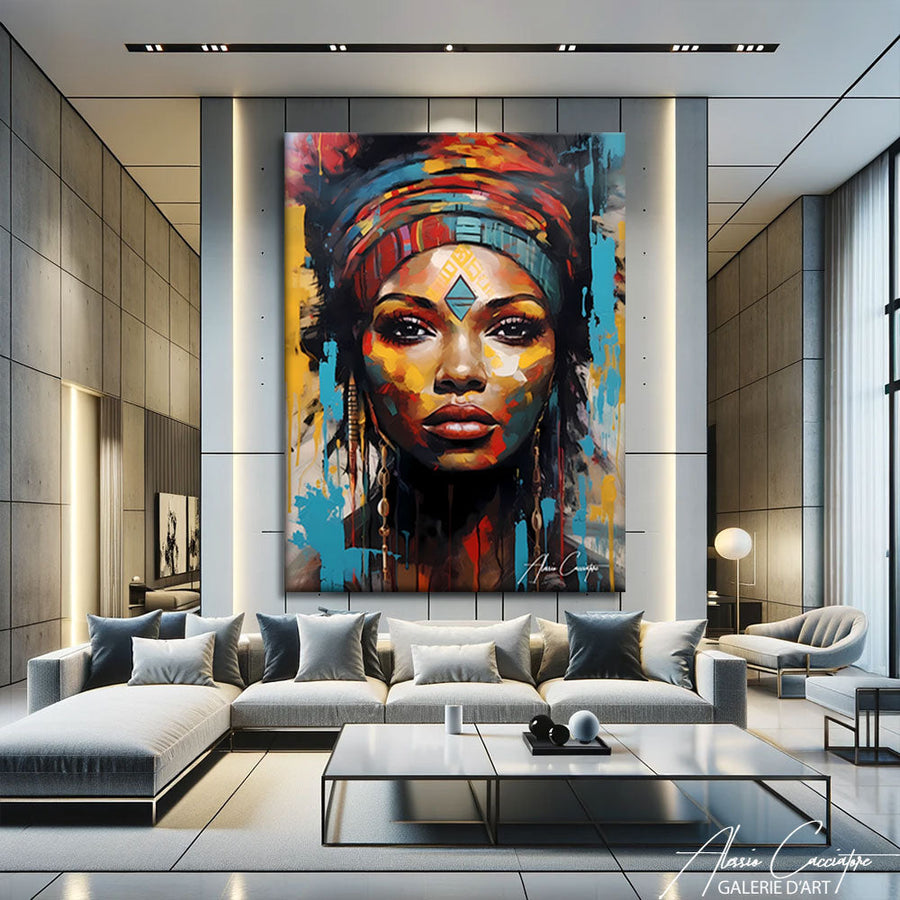
The picture above the sofa is the centerpiece: track or adjustable 3000 K spotlights, CRI 90+, and above all, a dimmer. During the day, natural light is enough if the artwork is on a wall perpendicular to the window; avoid the wall facing the bay window, where reflections and direct sunlight cause problems.
The bedroom
Here, we look for softness: 2700 K, moderate intensity, dimmer essential. Indirect ceiling lighting (light cove) combined with two bedside lamps is often enough for a canvas above the bed.

The dining room
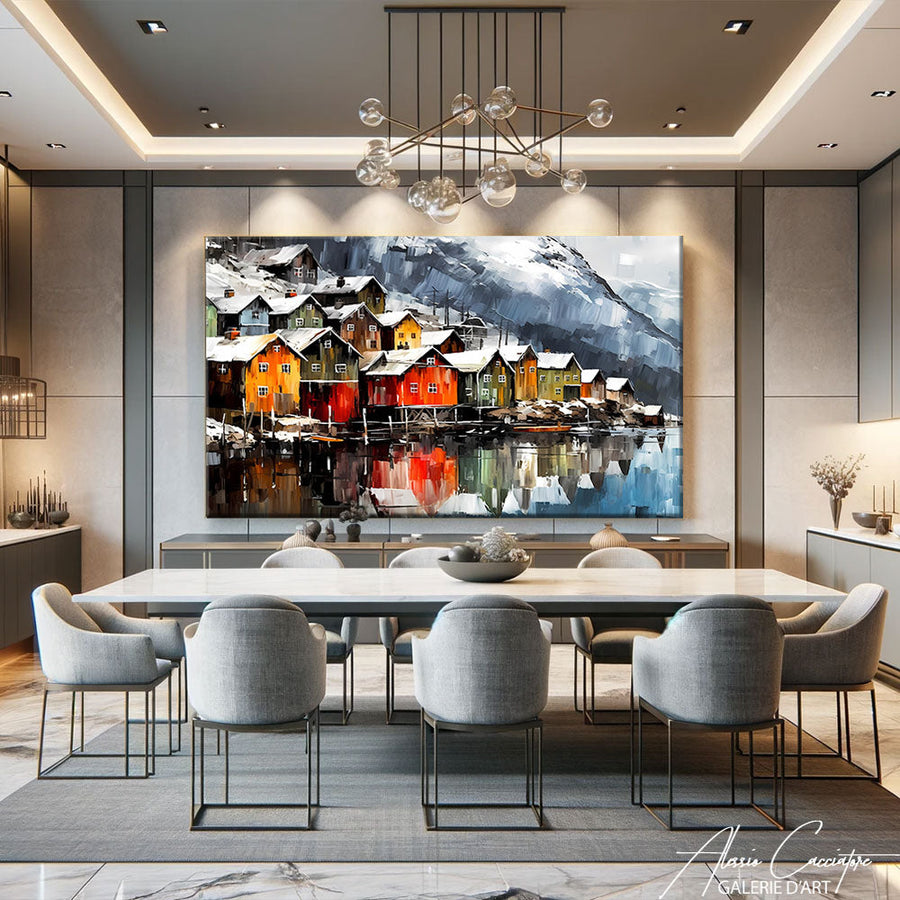
Common mistake: relying on the pendant light. It illuminates the table, not the wall, and leaves the picture in the shadows at dinner time. Add one or two spotlights aimed at the artwork, at the same temperature as the pendant light, set lower than it.

The entryway and hallway
Often dark passageways: a picture light or a spotlight with a motion sensor works wonders. A narrow beam (24°) on a vertical canvas creates a real gallery effect right from the door.
The mistakes that overwhelm or damage a picture
- The spotlight right above the artwork: light too grazing, top burnt, bottom in the shadows, and cast shadow from the frame.
- Direct sunlight: even just a few hours a day, UV rays fade colors in a few years. It is also the first enemy of maintenance, along with dust, which we talk about in our guide on how to properly clean a picture.
- Bulbs with a CRI of 80: save a few euros, dull colors for years.
- Mixing temperatures: 2700 K on the ceiling, 4000 K on the picture, and the room loses all coherence.
- Too much power: an overexposed picture loses its nuances. With LEDs, 5 to 8 W per spotlight is generally enough for a medium canvas.
FAQ: lighting a picture at home
Can you light a picture without doing electrical work?
Yes. There are rechargeable battery-powered picture lights, with remote control and timer, as well as clip-on or floor spotlights aimed at the artwork. Simply check the CRI (minimum 90) and color temperature before buying.
Should a picture be lit permanently?
No. Turn it on when the room is occupied, especially in the evening. An LED does not damage the canvas, but occasional lighting maintains the staging effect.
What light for a black and white picture?
Rather 3500 to 4000 K, which preserves crisp whites and deep blacks. At 2700 K, whites turn cream and the artwork loses its graphic contrast.
In summary
- LED with a CRI ≥ 90, never halogen or direct sunlight.
- 3000 K by default, 2700 K for warm atmospheres, 3500 to 4000 K for black and white and cool palettes.
- Angle of 30° (35° for large formats): spotlight about 55 to 60 cm from the wall under a 2.50 m ceiling.
- A picture about 3 times brighter than the room, with a dimmer.
- Track for flexibility, picture light for medium formats, strict angle for plexiglass.