
Virgin Mary Painting: Baroque, Renaissance | Alessio Cacciatore

Painting of the Virgin Mary
Des oeuvres en édition limitée pensées par l'artiste pour illuminer votre intérieur
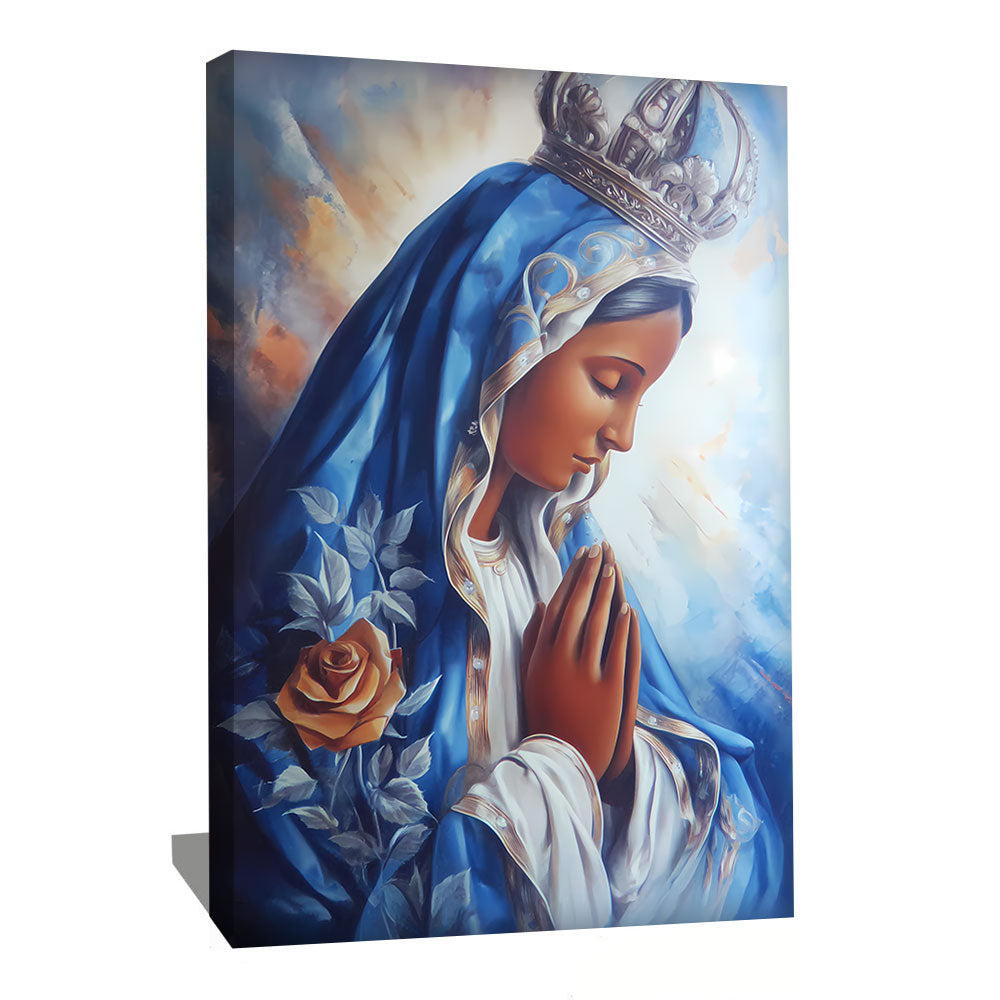
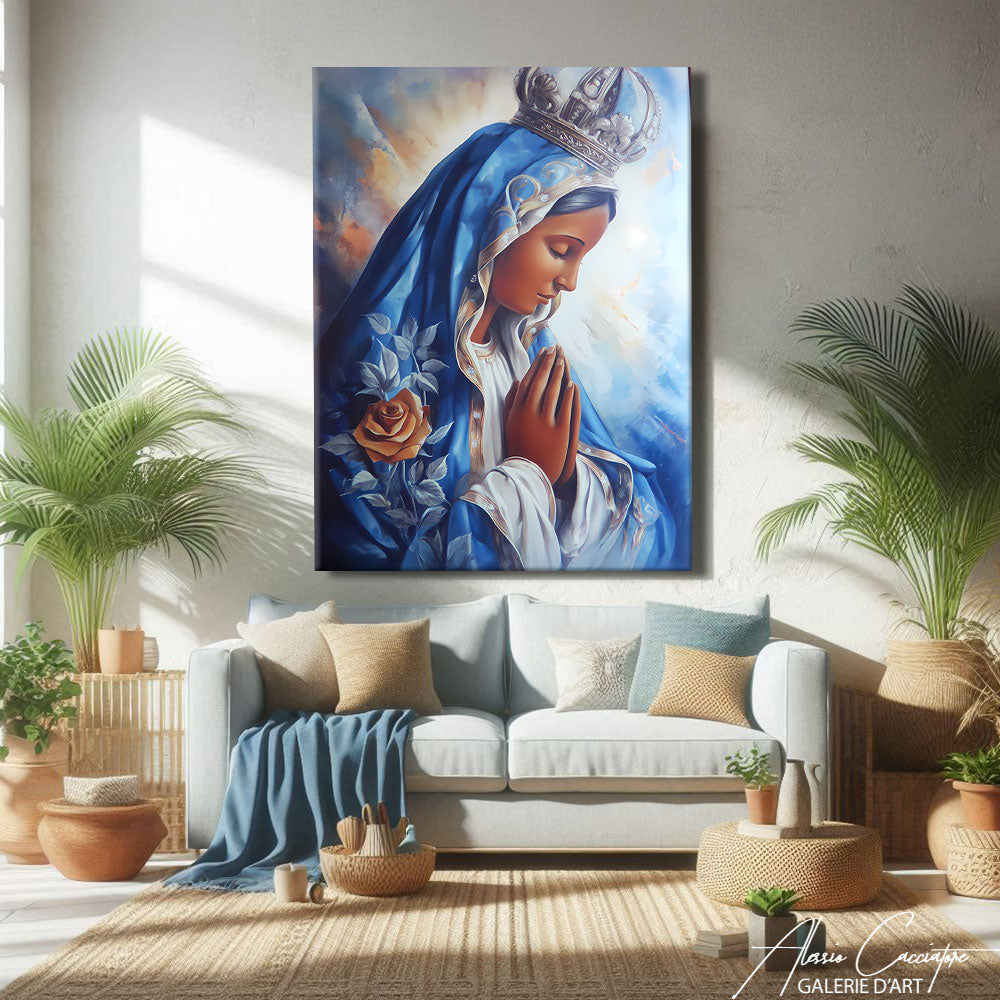
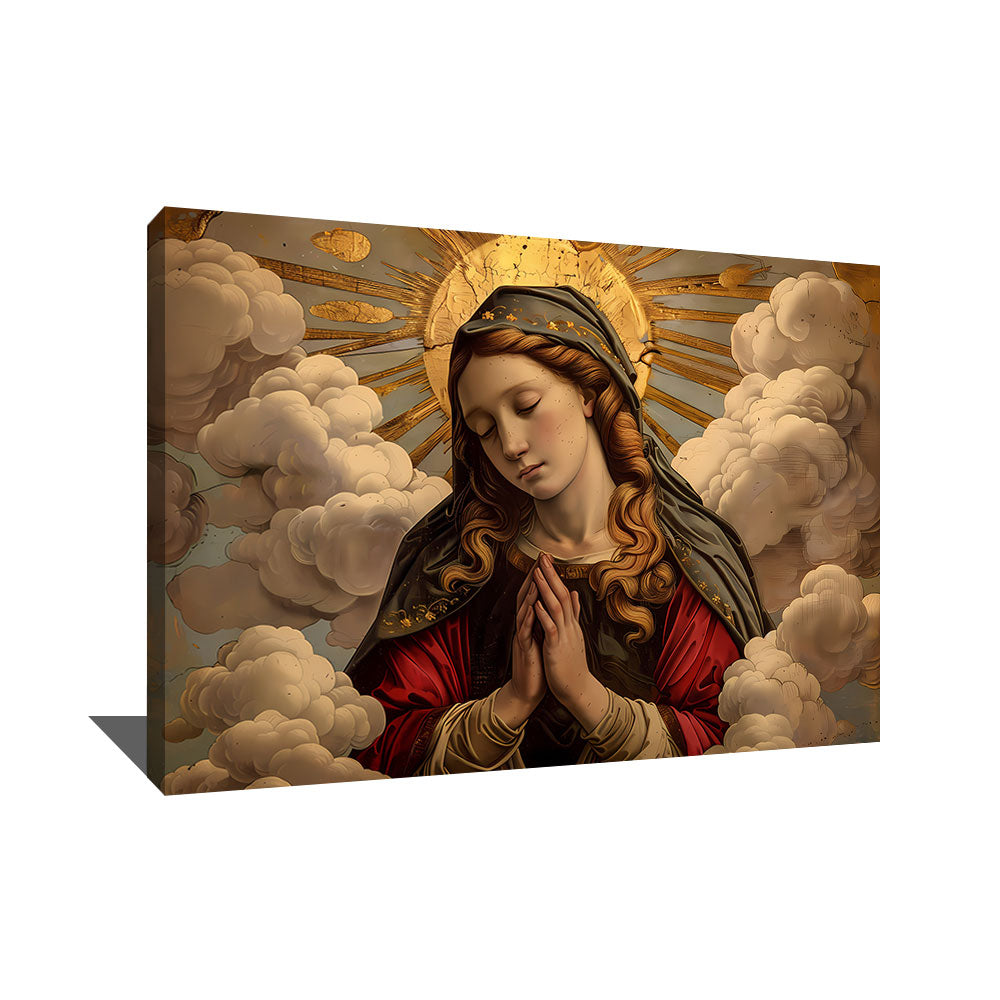

No figure has been more represented in the history of Western painting than the Virgin Mary. From Giotto to Cimabue, from Raphael to Botticelli, from Leonardo da Vinci to Caravaggio, from the Flemish Primitives to the Spanish Baroque masters, from Byzantine icons to Marc Chagall's contemporary Virgins: Mary traverses twenty centuries of Western Christian art without ever being exhausted by artists. Each generation has painted her in its own way, each school has lent her its face, each century has redefined her iconography. This permanence says something essential about the place of the Mother of Christ in Western spirituality, culture, and art. Our Virgin Mary paintings are part of this long tradition, translated into a contemporary domestic format that allows everyone to welcome this familiar presence into their home.
Our gallery brings together a precise selection of Marian compositions printed on premium canvas and brilliant plexiglass in our workshop in Germany. Madonnas inspired by the great masters of the Italian Renaissance, Baroque Virgins with flamboyant drapery, more refined modern representations, scenes of divine maternity where Mary holds the Child Jesus: each painting in the collection pays homage to this tutelary figure with the respect she has inspired for two millennia.
The Virgin Mary in the history of Western art
The representation of Mary began very early in Christian art. The earliest known frescoes, in the Catacombs of Priscilla in Rome, date from the 2nd century. From Byzantine art, iconographic conventions were established: the Theotokos (Mother of God) with the Child, the Hodegitria (she who shows the way), the Eleousa (the Virgin of tenderness). These archetypes crossed the entire Middle Ages and inspired all Western iconography up to the present day.
With the Italian Renaissance, Mary became the quintessential subject for the greatest painters. Raphael painted more than forty different versions, including the famous Sistine Madonna and the Madonna del Granduca. Leonardo da Vinci composed The Virgin of the Rocks, Botticelli his Madonna of the Magnificat, Michelangelo his Pietà in sculpture. The Baroque then opened a new dramatic dimension: Caravaggio revolutionized the Death of the Virgin, Murillo developed an entire school around the Sevillian Immaculate Conceptions, Rubens painted Marys with sumptuous drapery. In the 19th and 20th centuries, the figure modernized without disappearing: Marc Chagall offered dreamlike versions, Rouault Virgins with black outlines like stained glass, Salvador Dalí his famous Madonna of Port Lligat. This rich artistic lineage is precisely the ground from which our contemporary compositions draw their inspiration.
The great styles of Virgin Mary paintings in our gallery
Our collection covers the entire stylistic amplitude of the subject, from classical inspirations to modern reinterpretations. Here are the main families.
The Renaissance Madonna: sweetness and Italian perfection
Inspired by the masters of the Italian Quattrocento and Cinquecento (15th and 16th centuries), these compositions adopt the visual codes that defined the representation of Mary for centuries: oval face with regular features, blue veil covering the hair, red dress underneath (the traditional Catholic chromatic symbolism), gaze inclined towards the Child, Italian landscape in the background. The palette plays on deep blues, garnet reds, discreet golds, soft beige skin tones. These paintings are particularly suitable for classic interiors, cocooning-inspired bedrooms, and cozy living rooms. To explore this aesthetic beyond the Marian subject, see our Renaissance collection.
The Baroque Virgin: sumptuous drapery and dramatic emotion
The Baroque gave Marian iconography some of its most moving pages. Majestic draperies that undulate like wind, gazes raised to the sky in a mystical impulse, crowns of stars around the head, angels surrounding the composition. The palette is more contrasted than in the Renaissance: deep blacks, flamboyant golds, saturated blues, blood reds. These compositions, full of intensity, are suitable for formal living rooms, entrances that want a strong visual signature, and spaces for personal meditation. To go further in this stylistic vein, see our Baroque collection.
The Modern and Contemporary Virgin
For lovers of contemporary religious art, we offer more current reinterpretations of the Marian figure. Refined compositions that reduce Mary to her essential lines, desaturated palettes that depart from traditional color to explore monochrome or soft pastel, cinematic framing inspired by photography. These paintings fit naturally into designer interiors that want to affirm a faith or spiritual attachment without falling into traditional church decor.
The Virgin and Child: divine motherhood
Probably the most represented sub-theme of all Marian iconography. Mary holds the Christ Child, either in a tender attitude (Eleousa, cheeks touching), or in a solemn attitude (Mary presents the Child frontally to the viewer), or in an intimate scene (breastfeeding, playing, sleeping). This universal maternal dimension speaks far beyond the Catholic circle: it evokes motherhood itself, protection, unconditional love. Particularly chosen for children's rooms, master bedrooms, and family spaces.
The Immaculate Conception and the Assumption
Two Catholic dogmas that have given rise to particularly rich iconography. The Immaculate Conception (Mary conceived without original sin) generally shows the Virgin standing on a crescent moon, surrounded by angels, dressed in white and blue, sometimes crowned with stars. The Assumption (Mary elevated to heaven) depicts her in an ascending movement, lifted by angels or carried on clouds. These monumental compositions are suitable for large spaces and reception rooms.
Our Lady of Sorrows and the Pietà
Mary at the foot of the Cross, Mary holding the body of her son taken down from the Cross: these dramatic representations of the Mater Dolorosa belong to the great spiritual tradition of compassion. They are not sad in the trivial sense, but deeply imbued with a dignity that touches all who have experienced grief. For people on a spiritual journey or facing trials, these paintings have a particular comforting presence.
Our Lady of Guadalupe, Fatima, Lourdes: Marian apparitions
Beyond classical European iconography, Catholicism has seen the birth of many local Marian devotions linked to famous apparitions. Our Lady of Guadalupe (Mexico, 1531), Our Lady of Lourdes (France, 1858), Our Lady of Fatima (Portugal, 1917): each has its own particular iconography, colors, and postures. These compositions particularly speak to people who have completed a pilgrimage or have a personal devotion to one of these Marian titles.
The Black and White Virgin: graphic sobriety
For those who like religious iconography without chromatic extravagance. Mainly monochrome composition, sometimes enhanced with a single color accent (a blue on the veil, a gold on the halo, a red on the lips). This graphic approach is suitable for contemporary and minimalist interiors that wish to maintain a discreet but assertive Marian presence.
Symbolism and imagery: what your choice says
Choosing a Virgin Mary painting for your interior is never a trivial act. This image evokes a rich imaginary that deserves to be unfolded, whether one is deeply religious or simply attached to this figure for cultural or aesthetic reasons.
Faith lived daily
For practicing Catholics, the Virgin Mary painting is above all an object of personal devotion. Mary occupies a place in Catholic spirituality as a mediator, a protective mother, an intercessor with her Son. To have a representation of the Virgin in one's home is to integrate this Marian presence into daily life, to remember this watchful tenderness every day. Many of our Catholic clients place their painting in a specific corner, sometimes accompanied by a candle, a rosary, an icon.
Cultural and family heritage
Even for people who no longer practice, or who are not practicing at all, the figure of Mary remains deeply linked to family and cultural memory. The grandmother who prayed in front of the statuette of the Virgin, the pilgrimage to Lourdes or Our Lady of Loreto made in childhood, the painting in the grandmother's room. The Virgin Mary painting is then an act of silent transmission, a fidelity to a heritage that goes beyond the strictly religious question.
Protection and consolation
Regardless of questions of faith, the Virgin Mary remains in the Western imagination the tutelary figure par excellence: the one to whom one turns in difficulty, the one who consoles, the one who protects her own. Many of our clients choose this motif after a trial (bereavement, illness, separation) as a soothing visual companion. Others offer it to a loved one going through a difficult period.
The love of religious art as universal heritage
For art lovers, regardless of any faith, Marian iconography belongs to universal cultural heritage. Visiting the Louvre, the Uffizi, the Prado means spending a large part of your time in front of Madonnas. To love Raphael, Botticelli, Caravaggio is to love Mary in painting. The Virgin Mary painting is then a tribute to this millennial artistic tradition that has shaped the Western gaze.
Choosing your palette: the colors of Marian iconography
Marian iconography obeys a precise chromatic symbolism, inherited from the Middle Ages and codified during the Renaissance. Here are the main tones in our selection.
Marian blue and cinnabar red: the traditional palette
This is the historical combination of Marian iconography. Blue (generally ultramarine blue, made from lapis lazuli, therefore more expensive than gold in the Middle Ages) symbolizes celestial royalty and purity. Red (cinnabar or purple) evokes the humanity of Christ that Mary carries within her. This timeless palette integrates admirably into all interiors and remains the most universal for classic Marian paintings.
Gold, ivory and celestial clouds: the baroque palette
For baroque compositions and Assumptions. Gold of halos and crowns, ivory and luminous white of clouds, golden beiges of flesh, enhanced with deep blues for the sky. This more opulent palette is suitable for formal living rooms, richly decorated entrances and spaces that assert a strong visual presence.
Black and white with a golden accent: spiritual sobriety
For those who like religious iconography without the church decor. Mainly monochrome composition with a localized golden touch (on the halo, the crown of stars, the edge of the veil). This stripped-down approach integrates into the most demanding contemporary interiors while preserving the sacred dimension of the subject.
Soft pastels and powdery tones: tender maternity
For intimate compositions of Mary with the Child or soft modern representations. Powder pink, pale sky blue, golden beige, off-white. This feminine and calming palette is particularly suitable for master bedrooms, children's rooms, and spaces dedicated to family.
Earthy tones and antique patina: the aesthetic of icons
Inspired by Byzantine and Orthodox iconography. Deep ochres, earthy browns, golds patinated by time, dark reds. This warm palette evokes the aged material of ancient icons and is suitable for traditional interiors, family homes, and wooden libraries.
Virgin Mary painting: for which room in your home?
The Marian image can be placed in many spaces depending on your relationship with the subject. Here are our recommendations.
For the bedroom: protective presence for sleep
Traditionally, the Virgin Mary has her place above the bed in Catholic bedrooms. This tradition remains meaningful today: the Marian presence above sleep evokes nocturnal protection and end-of-day calm. Favor soft compositions: Mary with the Child, Renaissance Madonna, modern Virgin in pastels. 80x60 cm format above the headboard or vertical compositions.
For the living room: spiritual signature of the home
- Choosing a selection results in a full page refresh.
- Opens in a new window.
- Opens external website.
- Opens external website in a new window.