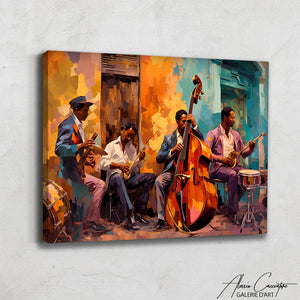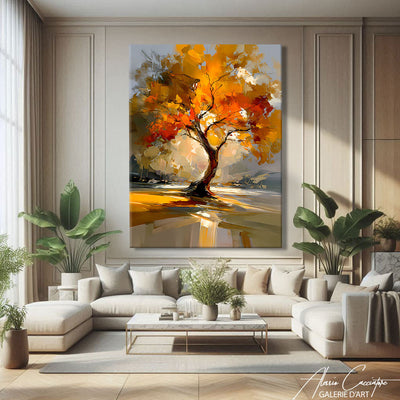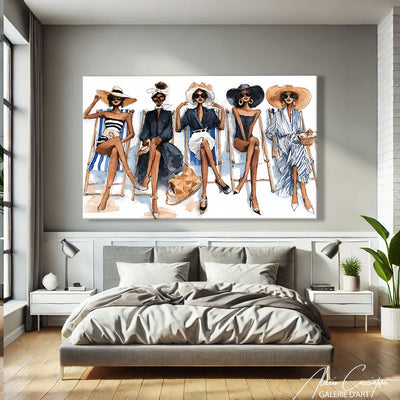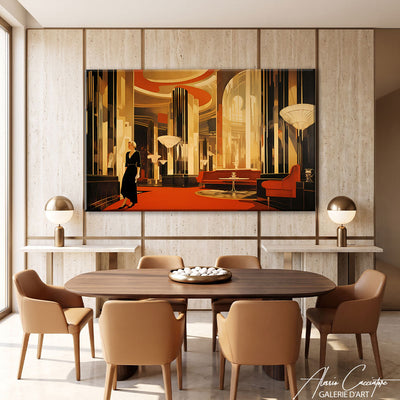

Choosing an African painting isn't just about buying a pretty picture. It's about bringing an earthy palette, a certain fluidity, and a way of representing the body and the gaze into your home that is unlike anything else. And quite practically, it means asking yourself three questions: which subject, which format, and on which wall? These are the questions we are asked most often at the gallery. Here are clear, jargon-free answers.
African painting: what exactly are we talking about?
Behind this somewhat broad term actually lie three distinct families of works, and confusing them is the first trap.
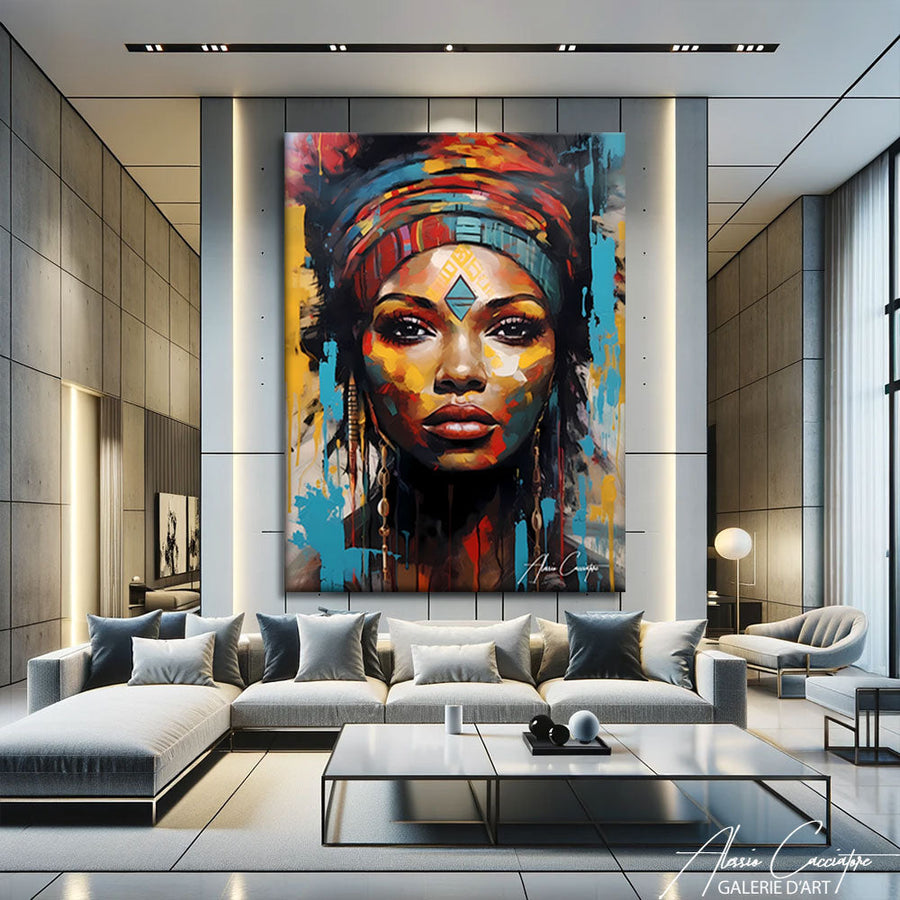
- The female portrait: a face, a profile, a sculpted hairstyle, often treated in colorful flat tints. This is the most emotional register, the one that catches the eye the moment you enter a room.
- The scene of life or dance: several silhouettes in motion, drapes, a composition that tells a story. More narrative, more generous, ideal for a large wall.
- Abstraction inspired by motifs: geometries, stylized textiles, ochres and indigos. The most discreet register, one that blends with almost any interior.
A piece of advice I often repeat: do not choose the family based on trends, but based on what you want to feel when you return home. A portrait looks at you. A dance scene draws you in. An abstraction leaves you be. These are three very different relationships.
How to choose an African painting that reflects you?
Start with the palette, not the subject
It's counterintuitive, but it's the method that fails the least. Look at your room and identify the dominant color of your textiles: curtains, rugs, sofa. An African painting works when it engages in a dialogue with this dominant color, either by extending it (ochre on beige, terracotta on linen) or by frankly contradicting it (deep indigo on white walls). The only case that truly fails is the "almost-the-same": an orange that clashes by two shades with the cushion next to it.
On our African canvases, two ranges appear constantly: warm earths (ochre, brick, sand, gold) and bold contrasts (deep black, white, touches of blue or red). The former warms up a cold or very minimalist interior. The latter provides structure to a room that is already busy.
Then consider the gaze of the work
In a portrait, the direction of the gaze changes everything. A face looking toward the inside of the room is inviting; a face looking toward the wall or a door creates a strange tension that you can't explain but definitely feel. Before hanging it, hold the canvas at arm's length and check this detail. It is worth all the composition advice in the world.

What size to choose and at what height to hang it?
The rule we use for hanging is simple: a single work should occupy between 60 and 75% of the width of the furniture it hangs above. Above a 220 cm sofa, this results in a canvas 130 to 165 cm wide. Anything smaller, and the work floats, giving the impression that it was just placed there while waiting for something better.
For the height, forget the theoretical eye-level of 165 cm used in museums: at home, you are sitting half the time. In a living room, aim for the center of the work to be 150 cm from the floor, or 20 to 25 cm above the back of the sofa. In a bedroom, go a little lower: the work should be comfortable for someone lying down.
A word on the medium, since we are asked about it systematically. All our pieces are printed on canvas stretched over a wooden frame, with an optional plexiglass finish that adds depth and a slight sheen to the blacks. The canvas has a huge advantage for this type of subject: it doesn't create any glare, and the colorful flat tints of African art keep their full density, even when backlit.
In which room should you hang an African painting?
The living room: the natural terrain
This is where these works show their full potential, because there is depth. An African painting is best viewed from three meters away: it is the distance at which the overall composition and the details of the brushwork coexist. Place it on the wall you see when entering, never behind the television — you would have two points of focus fighting each other.
The bedroom: provided you lower the volume
A dance scene with saturated colors above a bed is too much. On the other hand, an African subject treated in broken tones, powdery ochres, or earthy camaieu works beautifully in a bedroom: it adds warmth without agitating the room. Choose horizontal compositions that follow the line of the bed.

The entryway and the office: the unloved but highly effective spots
An entryway is almost always a hallway: little depth, lots of foot traffic. Paradoxically, it is the ideal place for a vertical portrait that you pass by rather than contemplate. In an office, an African painting placed in your peripheral field of vision — never behind the screen — provides a warm focal point during long days.

Our entire selection is gathered in the African painting collection, where you can filter by format before deciding.
What should you pair it with without falling into clichés?
The most common reflex is to pile up all the signs: the painting, the woven basket, the patterned throw, the ethnic vase. The result is a room that looks like a store aisle. Our approach is the opposite: a single strong work, and a calm environment around it. White or sand-beige walls, a natural textile, and that's it. The work should be the event of the room, not one element among twelve.
If you want to create a wall of multiple canvases, pair an African subject with a contemporary portrait from another register instead: the dialogue is much more interesting than repetition. Our women's portraits pair particularly well with African portraits, provided you keep a common palette.
Frequently Asked Questions
Is an African painting suitable for a very modern interior?
Yes, and that is often where it works best. A contemporary interior — polished concrete, straight lines, neutral tones — almost always lacks warmth. A canvas with warm earth tones solves this problem in a single piece, without having to change anything else.
Should you choose a portrait or a group scene?
It's a question of viewing distance and intent. Portrait for a narrow wall, an entryway, or immediate impact. Group scene for a large living room or dining room wall, when you want something to look at for a long time. If you are hesitant, our guide modern African painting: how to choose the right one details the scenarios.
How do you maintain it?
A dry microfiber cloth, two or three times a year, wiping in the direction of the grain. Never use household products or a damp sponge on a canvas. And avoid direct afternoon sun exposure, which fades reds faster than the rest of the palette.
To conclude
A successful African painting comes down to three simple decisions: a subject that really speaks to you, a palette that engages with your textiles, and a format generous enough to anchor the wall. The rest — trends, matching accessories, magazine advice — is secondary. If you want to reflect further on the room as a whole, our 5 tips for a modern African decor will complete this reading well.
Take the time to browse the African painting collection: each canvas is presented in context, which remains the best way to visualize it before choosing.