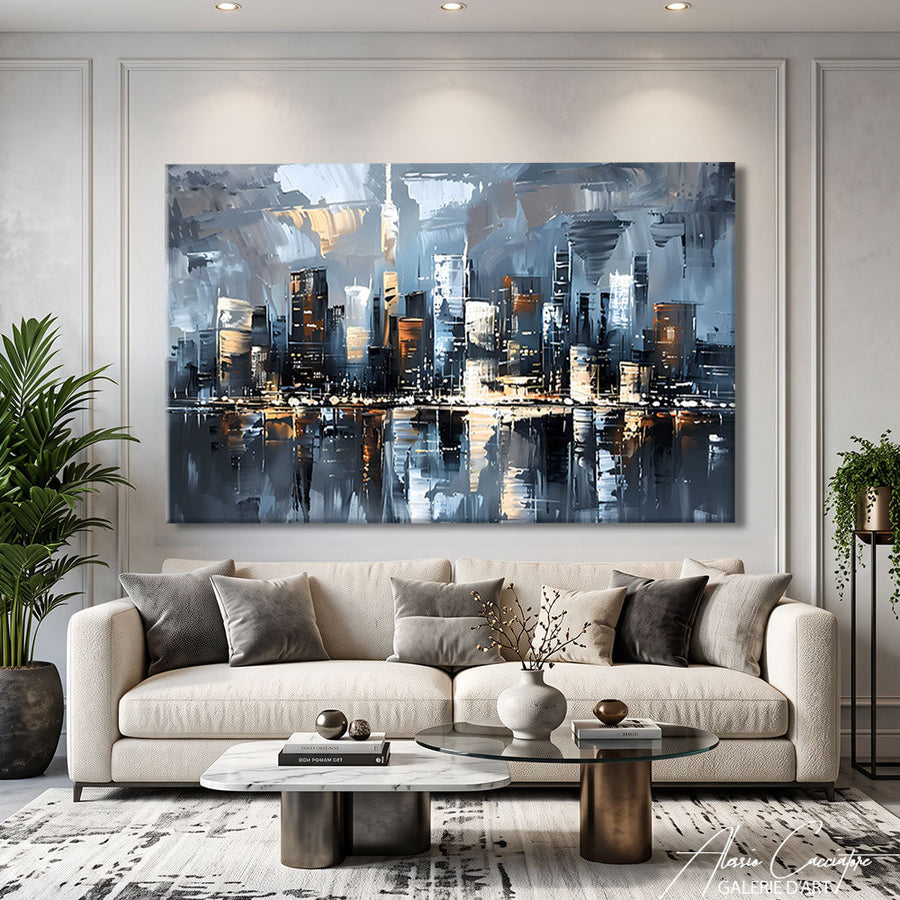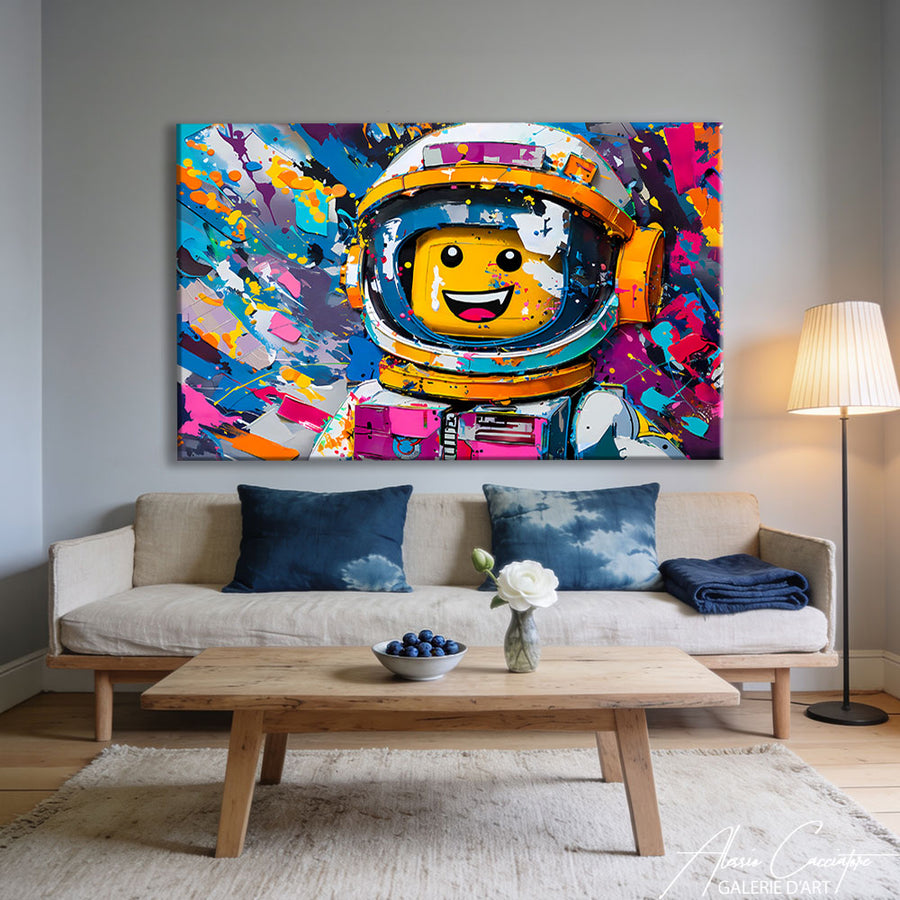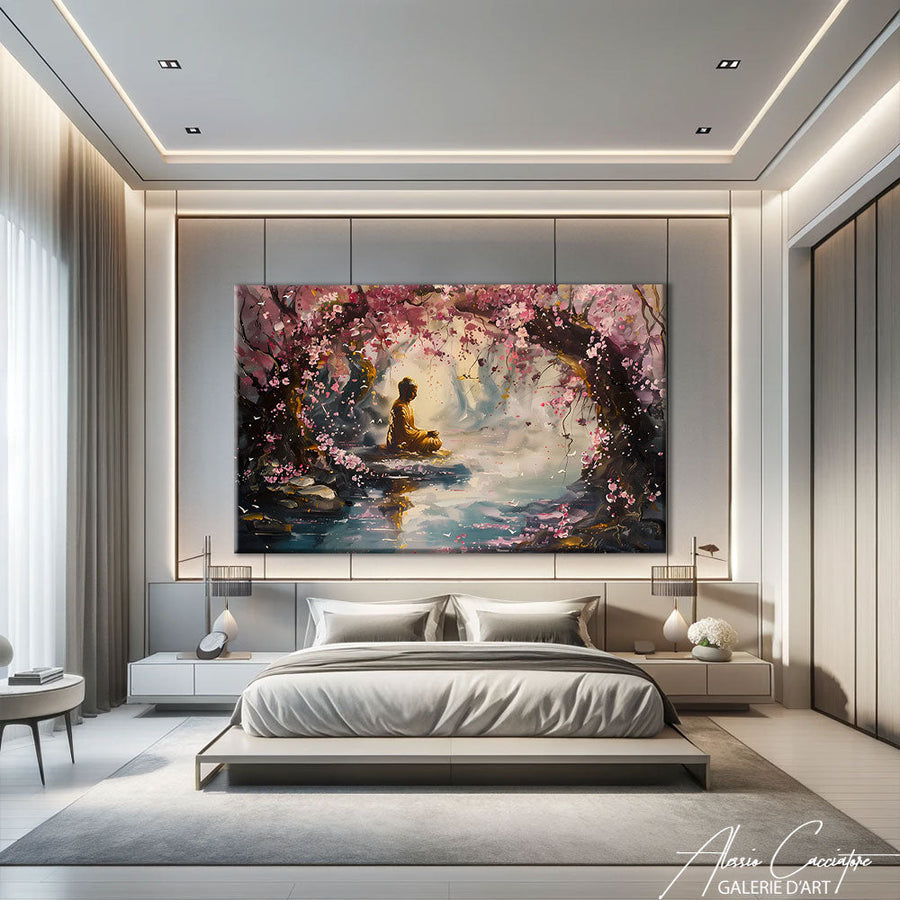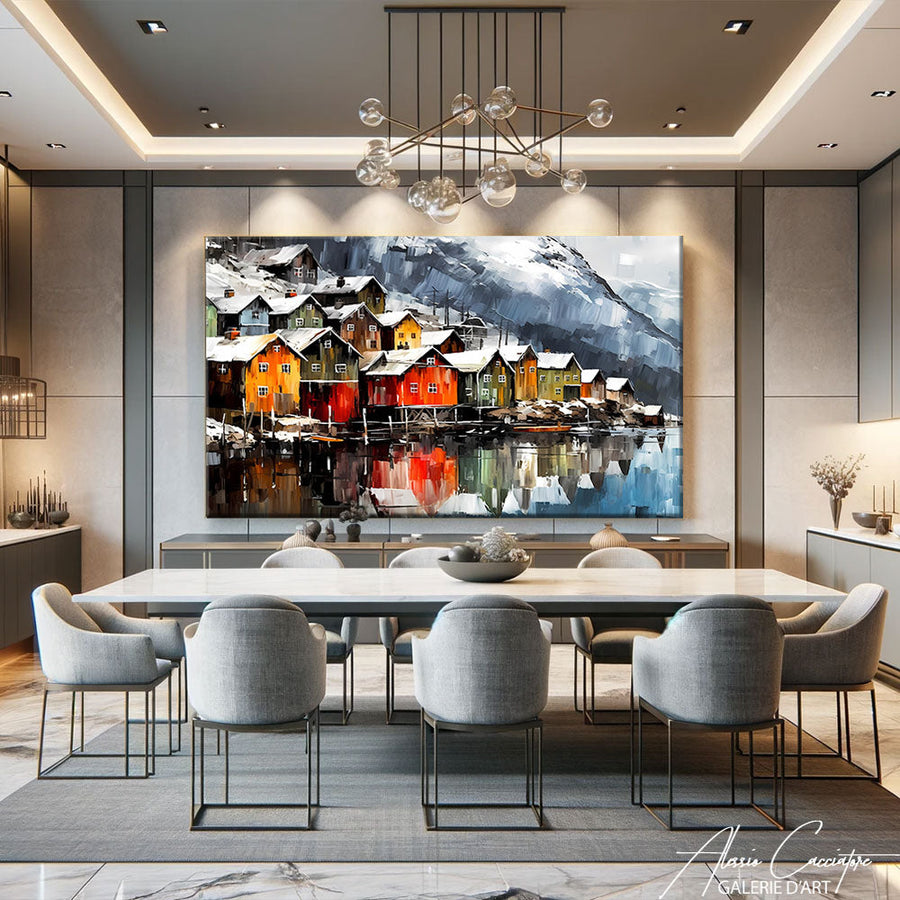

A psychedelic painting is the kind of canvas that turns heads the moment you step into the room. Hypnotic spirals, saturated colors, patterns that seem to move when you stare at them for too long: this style, inherited from the 60s, has lost none of its power. But that is precisely where the real question arises: how do you choose a psychedelic painting without turning your living room into a nightclub? Where should you hang it so it shines instead of overwhelming everything else? After years of advising clients who vacillate between "I love it" and "I'm afraid it's too much," here are my answers, candid and practical.
What is a psychedelic painting, exactly?
The word comes from Greek and literally means "mind-revealing." Psychedelic art was born in California and London in the mid-60s, appearing on concert posters and album covers. Its codes are unmistakable: fluid, undulating shapes, complementary colors that vibrate against each other (orange against blue, pink against green), fractal patterns, faces, or mushrooms distorted as if seen through a kaleidoscope.
What many don't realize is that this movement shares a great deal with the pop art of the same era. It has the same taste for bold, flat areas of color and the same refusal of bourgeois restraint. If you like one, you will likely like the other, and our article on Warhol's legacy in today's interiors will show you how well the two styles converse.
On a canvas print stretched over a wooden frame, this type of motif takes on a special dimension: the texture of the canvas slightly softens the most garish colors, making the whole piece more "habitable" than a glossy poster. It’s a detail that makes all the difference in daily life.
How do you choose a psychedelic painting that isn't hard on the eyes?
That is THE question I am asked. My opinion is firm: a successful psychedelic painting is not the one with the most colors, but the one with an anchor point. A face, a silhouette, or a central object around which the chaos is organized. Without that, the eye doesn't know where to rest and gets tired within a few weeks.
Three criteria that make a difference
- A clear dominant color. Look at the canvas while squinting: if one color stands out (a deep violet, a solar orange), that's a good sign. If everything blends into grey, keep looking.
- A readable subject from three meters away. Mushrooms, a portrait, a rocket, a skull: the motif should be clear from a distance, while the details are discovered up close.
- Controlled contrast. The best psychedelic canvases play with two or three pairs of complementary colors, not the entire rainbow.
Our guide to integrating colorful abstract paintings details this logic of dominance and contrast, and it applies word-for-word here.

In which room should you hang a psychedelic painting?
Here is my rule: psychedelic goes where we live while standing and awake, not where we seek calm. In practice, this results in a fairly clear ranking.
The living room: the ideal playground
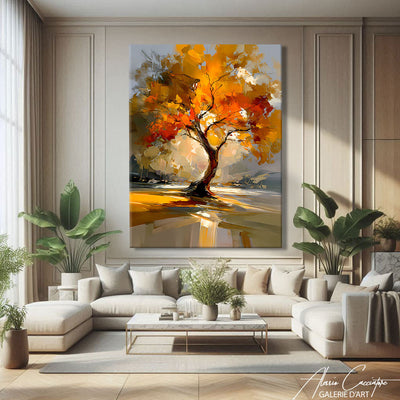
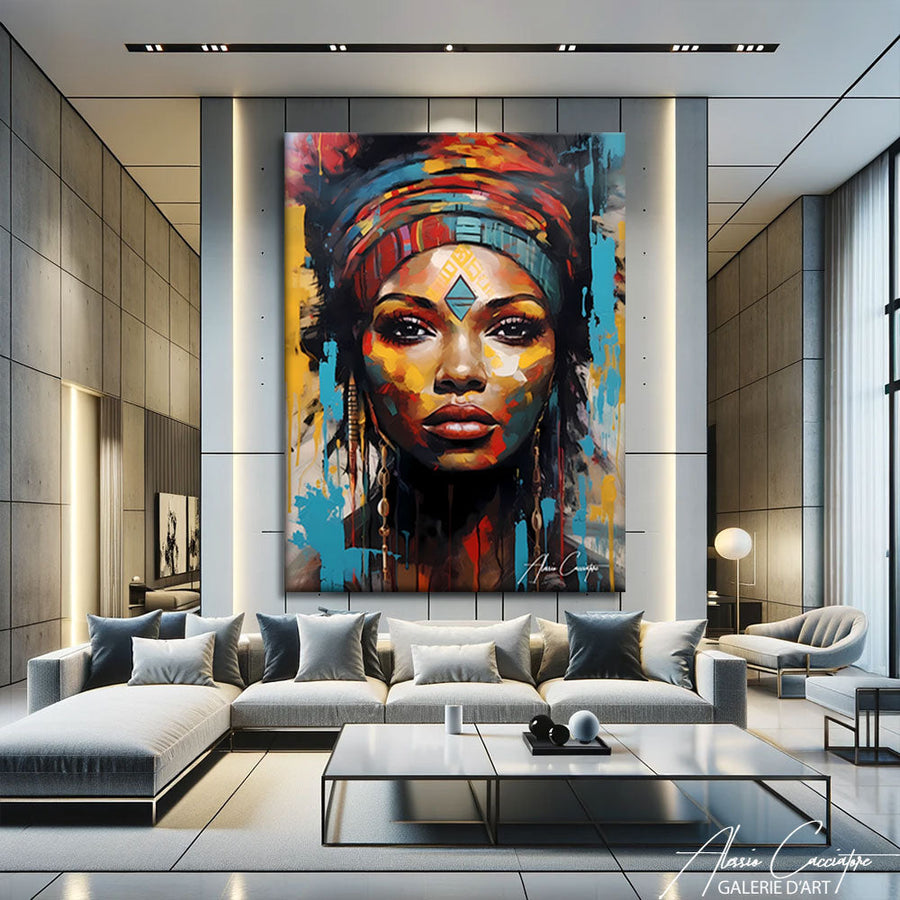
This is the room that best absorbs this type of canvas, provided you give it space. A large white or light grey wall behind the sofa, no other frames around it, and the painting becomes the room's center of gravity. I once saw a client hang a canvas with orange and turquoise spirals above a bottle-green velvet sofa: the result was spectacular precisely because everything else remained understated.
The office or studio: for stimulation
A psychedelic painting in a creative workspace is a choice I defend. The saturated colors wake you up, and the moving patterns maintain a form of energy. Place it on the wall you see when you look up from your screen, not behind you.
The bedroom: yes, but with caution
Counter-intuitive, but possible. Choose a canvas with darker tones (violet, midnight blue, deep green) rather than a neon firework display, and hang it on the wall facing the bed rather than above the headboard. You can look at it as you fall asleep, and it won't dominate your rest. A teenager's bedroom, by the way, is a perfect fit for it.

Which size and format should you choose?
A small psychedelic painting is almost always a disappointment: the motif needs space to breathe and produce its hypnotic effect. On a standard living room wall, aim for at least 60 x 90 cm, and don't be afraid of 80 x 120 cm if the wall is more than three meters wide.
As for format, square and portrait work particularly well with centered compositions (faces, mandalas, mushrooms), while landscape suits wave-like patterns that unfold horizontally. For an even more vibrant look, the plexiglass option applied over the canvas accentuates the depth of the colors, much like a glossy varnish on an oil painting.
What should you pair a psychedelic painting with?
The secret is a contrast in temperament. An exuberant canvas demands an environment that knows how to be quiet. A few combinations that always work:
- Neutral walls: off-white, pearl grey, linen beige. Avoid colored walls unless you are picking up a secondary shade from the painting exactly.
- Simple furniture: straight lines, light wood, or matte black. Scandinavian or industrial styles handle a psychedelic canvas very well.
- One or two accent pieces: a cushion, a vase, or a throw in the painting's dominant color—no more than that.
This balancing act between a bold piece and a sober decor is the same one you encounter when you want to bring the energy of street art into your home: the canvas provides the show, and the rest holds the stage. And if you are looking for other unconventional paths, take a look at our original wall decoration ideas.

FAQ: your questions about psychedelic paintings
Is a psychedelic painting outdated?
No, quite the opposite. After a decade of beige minimalist decor, the return of bold colors and maximalism is bringing this style back to the forefront. What has changed is how we use it: one single, bold canvas rather than an accumulation.
Can you combine a psychedelic painting with an abstract painting?
Yes, provided they share a palette. An abstract piece in soft tones next to a psychedelic canvas acts as a breather. To fully understand this logic of dialogue between artworks, our abstract painting guide is a great foundation.
How should you light it?
Preferably with indirect natural light. If you add a spotlight, choose a warm temperature (2700 to 3000 K) that flatters the oranges and pinks without turning the blues green. Avoid cool LEDs: they make the colors look garish.
In summary: dare, but dare just enough
A well-chosen psychedelic painting is a canvas with a readable subject, a clear dominant color, and a generous size, hung alone on a neutral wall in a living area. Respect these few principles, and you will achieve what this style does best: an interior that has a soul, in the literal sense of the word. To find yours, browse our collection of psychedelic paintings, all printed on canvas stretched over wooden frames. And if you are still hesitating between hypnotic spirals and bold flat colors, our pop art collection will offer an ideal basis for comparison. You can also read our advice on choosing a colorful pop art painting before making your decision.