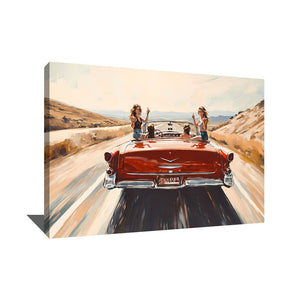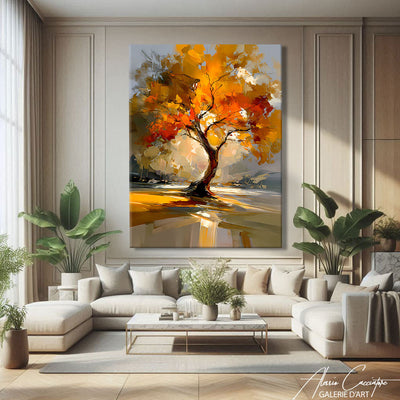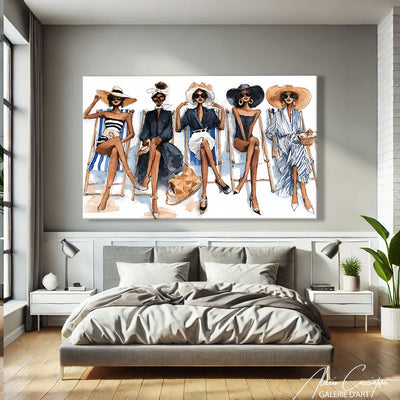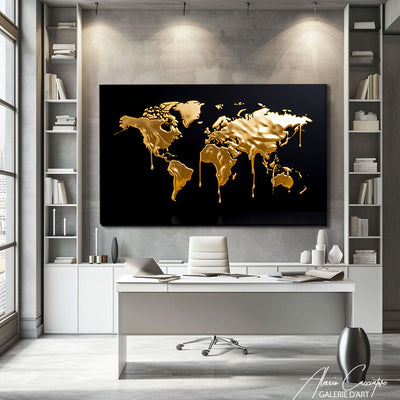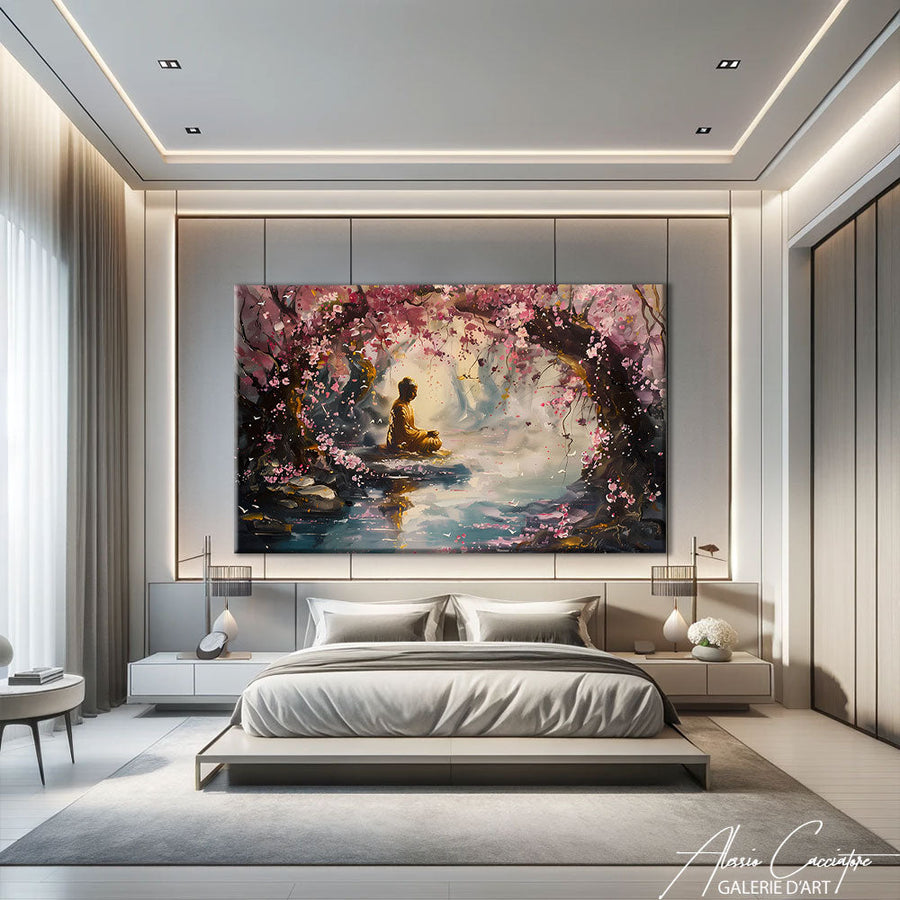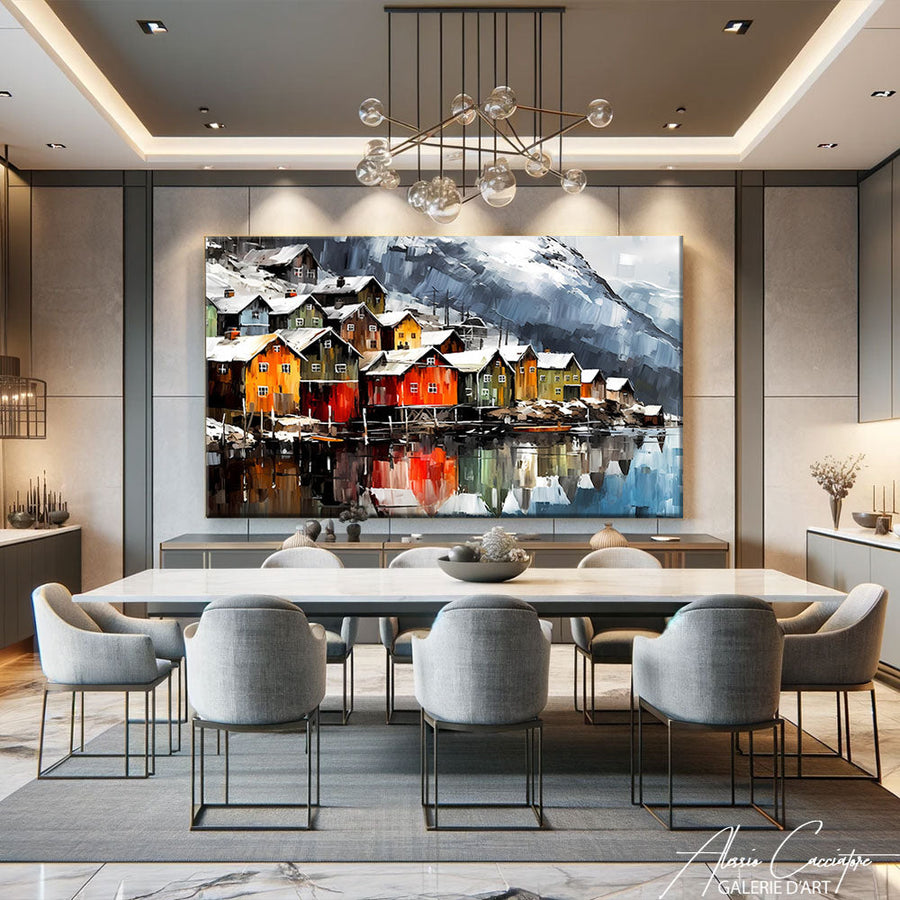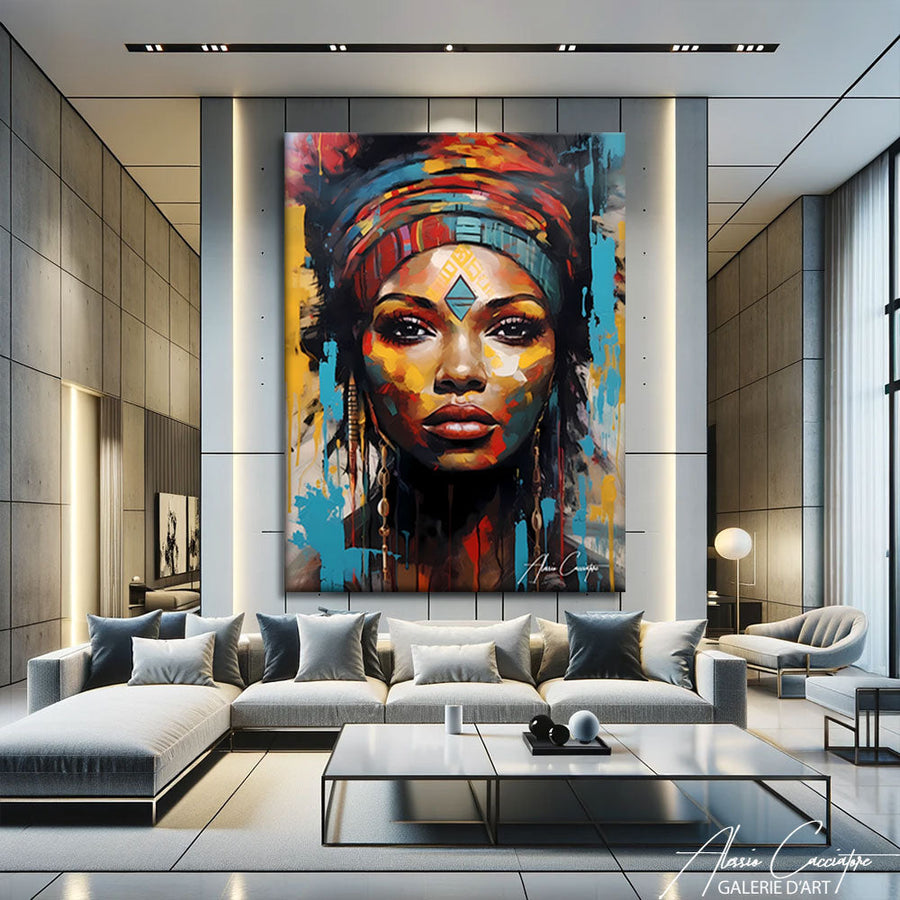

Last week, a client wrote to me: "Alessio, I love your work but I'm afraid it's too much." Too much what? Too colorful. Too vibrant. Too… present. We've become so accustomed to beige-gray-white interiors that the mere idea of hanging a colorful abstract painting triggers a mini existential crisis. Yet, Kandinsky never apologized for his electric blues, nor Mondrian for his stark primaries. So why should you?
Why colorful abstraction scares people (and why it's silly)
There's a common misconception that a modern abstract painting needs to be "discreet" to be elegant. False.
The problem is that we often confuse discretion with lack of personality. A neutral interior is restful. A dead interior is just sad. The difference? A single strong focal point—and a colorful abstract painting plays exactly that role.
In my studio, I've seen dozens of people looking for "something that goes with everything." Spoiler: it doesn't exist. What does exist is a work that asserts its own universe, and around which everything else is built. Mondrian never tried to match an Ikea sofa.
Color in abstraction isn't visual noise. It's pure energy.
“Color is the keyboard, the eyes are the hammers, the soul is the piano with many strings.” — Kandinsky
And frankly, if Kandinsky had been afraid of red, we never would have had Yellow-Red-Blue.
The three families of colorful abstract paintings (and how to choose yours)

Not all modern abstract paintings are alike. Here are the three main families I encounter—and produce.
Geometric abstraction: Mondrian 2.0
Clean shapes, primary colors, rigorous compositions. This is a safe choice for a contemporary interior. A handmade abstract painting in this style brings structure without being aggressive.
Works well in: an office, a minimalist living room, a hallway.
Works less well in: a bedroom (too "cerebral"), a kitchen (too cold).
Lyrical abstraction: Pollock meets Matisse
Free gestures, overlapping colors, explosions of texture. This is my comfort zone. A lyrical colorful painting is frozen motion. It breathes, it lives.
Works well in: above a sofa, in an entryway, facing a bed.
Works less well in: a space that is already visually very busy.
Color-field abstraction: Rothko and his descendants
Large swaths of color, soft or abrupt transitions, pure contemplation. Less "demonstrative" than lyrical, but just as powerful.
Works well in: a room with high ceilings, facing an empty wall.
Works less well in: a small studio (it overwhelms).
In my catalog, you'll find mostly lyrical and geometric works—because these styles best support medium formats (50×70 to 100×120 cm) and fit into 90% of interiors.
How to incorporate a colorful abstract painting without turning your living room into a funfair
Here's the golden rule: a colorful abstract painting doesn't "match," it dominates.
If you're trying to match your artwork to your cushions, you've already lost. The artwork comes first. The rest follows.
In practice?
Step 1: Choose ONE dominant color in the painting
No need to use all ten shades. One is enough. If your painting has a lot of blue, a navy blue throw on the sofa creates a subtle resonance.
Step 2: Keep the rest neutral
White or light gray walls. Natural wood or matte black furniture. The painting takes center stage, everything else supports it.
Step 3: Create breathing room
A 100×80 cm painting needs 30-40 cm of free space around it. No frames, no climbing plants, no lamps right next to it. Just emptiness.
I have a client in Berlin who hung one of my most saturated pieces (yellow, orange, magenta) in an entirely white living room. The result? Magnificent. Because she had the courage to let the artwork breathe.
The opposite—a small colorful painting lost in the middle of a 4-meter wall—never works.
Mistakes I see all the time (and how to avoid them)

Mistake #1: Buying too small
You're afraid it's "too much," so you get a 40×50. Result: it looks timid. An abstract modern painting, especially a colorful one, needs presence. For a 2-meter sofa, aim for at least 80×100 cm.
Mistake #2: Trying to match everything
"I have sage green in my curtains, terracotta in my rug, will this painting with yellow and blue work?"
No. Because you're not looking for a piece of art, you're looking for a decorative accessory. A real colorful abstract painting imposes its palette. You adjust your decor afterward, not the other way around.
Mistake #3: Cheap plexiglass/glass cover
A handmade abstract painting under shiny supermarket glass is a waste. Either frame it properly (float frame, thin molding), or leave it unframed if the edges are painted.
Mistake #4: Multiplication
One colorful abstract painting per room. Maximum. If you want a gallery wall, reserve it for black and white or monochrome. Two colorful abstracts side by side is war.
In my opinion, the most serious mistake remains choosing a work that one doesn't truly feel—just because it "goes well with the gray sofa."
Kandinsky, Mondrian, and why art history will help you choose
When Kandinsky painted Composition VIII in 1923, he wasn't wondering if it would fit in a Parisian loft. He sought to translate music into shapes and colors.
Yet, today, his canvases sell for a fortune—because they carry a visible intention.
That's the difference between a modern abstract painting that ages well and a trendy decor that becomes outdated in three years: intention.
Mondrian, similarly. His red-yellow-blue grids became iconic because they didn't try to please. They asserted a vision of the world.
Lyrical abstraction of the 50s-60s (Hartung, Soulages in his colorful periods, Joan Mitchell) also understood this: color must be a gesture, not a fill.
When choosing a colorful abstract painting for your interior, ask yourself:
- Do I feel something when I look at it?
- Did the artist take a risk (composition, palette, gesture)?
- Will I still find it beautiful in 10 years?
If you answer yes to all three, buy it. If you hesitate because "the pink might not go with my parquet," move on.
In my work, I draw a lot from this tradition: bold forms, assertive colors, no compromise. Because frankly, no one wants to hang a compromise above their sofa.
Colorful abstract paintings: what size for which room?

Living room: 100×120 cm or more
This is the main living area. The artwork needs presence. If your ceiling is over 2.80m, don't hesitate to go up to 120×150 cm.
Bedroom: 70×100 cm
More intimate, less "energizing." A colorful abstract painting in a bedroom, yes, but avoid overly nervous compositions. Favor soft blocks of color.
Office: 50×70 to 80×100 cm
A medium format that stimulates without distracting. Geometric abstraction works very well here.
Hallway: 40×120 cm (vertical or horizontal)
A long format that guides the eye. Hallways are often underutilized—a good modern abstract painting can change everything.
Kitchen/dining room: 60×80 cm
A high-traffic area, modest size but strong impact. Watch out for splashes if you cook like me (badly).
Rule of thumb: painting width = 60-75% of the width of the furniture below it (sofa, console, bed). Less, it floats. More, it overflows.
And if you're in doubt, always go up a size. No one has ever regretted buying too big.
My colorful abstract paintings in the catalog (and how to choose them)
I produce between 40 and 60 unique works each year, all handmade in my Berlin studio.
My signature? Layering of acrylic glazes, spontaneous gestures, saturated but balanced colors.
If you are looking for a handmade abstract painting, here's how I advise you to navigate the catalog:
-
Start with the dominant color you want
Are you drawn to blue? Filter by blue. Same for red, yellow, green. I have series in each chromatic family. -
Look at the composition
Do you prefer sharp shapes or free gestures? Some pieces are more structured (geometric), others more organic (lyrical). -
Check the format
Dimensions are always indicated. If you hesitate between two sizes, take the larger one—seriously. -
Read the technical sheet
I always indicate the exact colors, the type of finish (matte or satin), and if the edges are painted (for unframed hanging).
Each artwork is photographed in natural light. What you see on screen is 95% accurate (the remaining 5% is your screen lying, not me).
And if you don't find exactly what you're looking for, you can also contact me for a custom order. Lead time: 4-6 weeks.
Care and durability: a colorful painting that lasts
A colorful abstract painting is an investment. Not in a financial sense (although some of my pieces appreciate in value), but in an emotional sense: you will live with it for years.
So it might as well last.
All my works are varnished (satin UV varnish)
This protects against dust, UV rays, and moderate humidity. You can dust with a dry microfiber cloth. No products, ever.
Hanging
Always with a two-point system (not a single nail in the middle). I provide suitable fixings with each order.
Light
Avoid direct sunlight 8 hours a day. Acrylic pigments are quite resistant, but why take the risk?
Framing
If you frame it, no glass (it reflects and stifles). A simple light wood or matte black float frame is sufficient.
Last point: a modern abstract painting doesn't really "restore." If a corner gets damaged, contact me, I can sometimes touch it up. But honestly, with minimal care, you'll keep it intact for 20 or 30 years.
And in 30 years, you'll still be glad you chose color over beige.
Frequently Asked Questions
Does a colorful abstract painting work in a Scandinavian interior?
Absolutely. Scandinavian interiors are based on neutral foundations (white, light wood, gray), making them the ideal backdrop for a colorful abstract painting. It provides precisely the focal point often missing in these interiors. Choose a work with primary colors or natural shades (ochre, forest green, midnight blue) to maintain coherence.
How can I tell if a painting is handmade or printed?
Three clues: texture (a handmade painting has relief, you can see brushstrokes or palette knife marks), edges (if painted, it's a good sign), and the product description (a serious artist always indicates "acrylic on canvas" or "original painting"). In a physical gallery, get close: a print is perfectly smooth, a painting has substance.
What's the difference between abstract and contemporary?
Contemporary art refers to a period (from 1945 to today). Abstract art is a style (which represents nothing recognizable). A painting can be both abstract AND contemporary, but also abstract and vintage (Kandinsky, 1920s). When you're looking for a modern abstract painting, you're actually looking for contemporary abstract art.
How much does a real handmade colorful abstract painting cost?
Between €300 (40×50 cm format, emerging artist) and €3000 (120×150 cm format, established artist). Below €150, it's probably a print. Above €5000, you're paying for the artist's reputation. In my catalog, prices range from €380 to €2200, depending on format and complexity.
Can an abstract painting be hung unframed?
Yes, provided the edges (sides) of the canvas are painted and clean. This is even my preferred setup: it gives a raw, direct, contemporary feel. If the edges are raw or stapled, then a frame (float frame) becomes necessary. All my works have painted edges.
How to transport a colorful abstract painting without damaging it?
Wrap it in bubble wrap (painted side protected, never in direct contact with plastic). Slip it into a rigid cardboard box. If you're moving, transport it flat or upright, never tilted. And most importantly, don't put anything on top of it. I deliver all my works with reinforced packaging—keep it, it might come in handy again.
All artworks mentioned in this article are available on the gallery. Worldwide shipping offered, 30-day money-back guarantee.