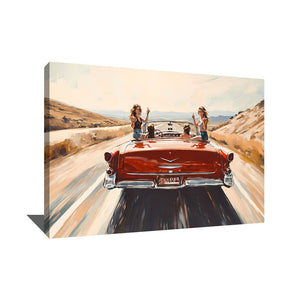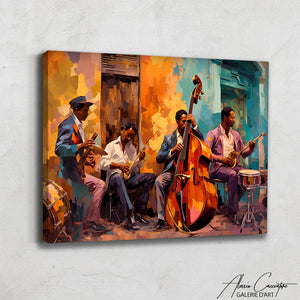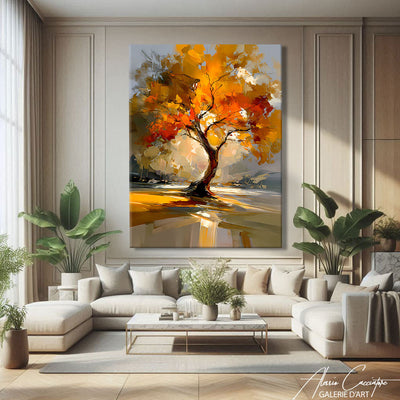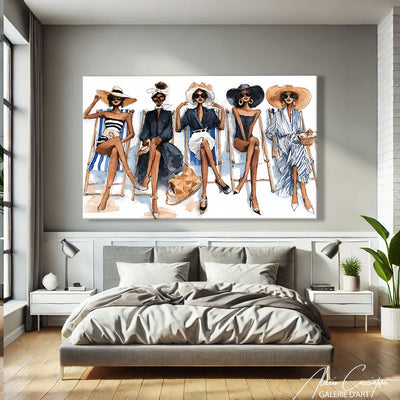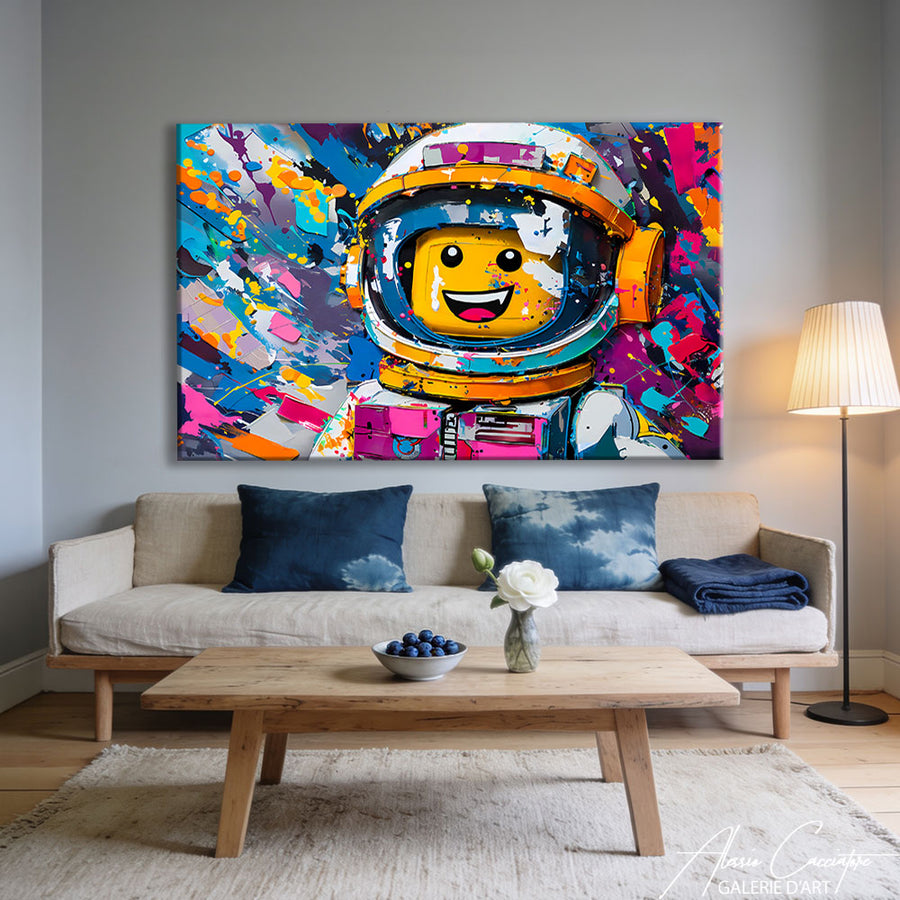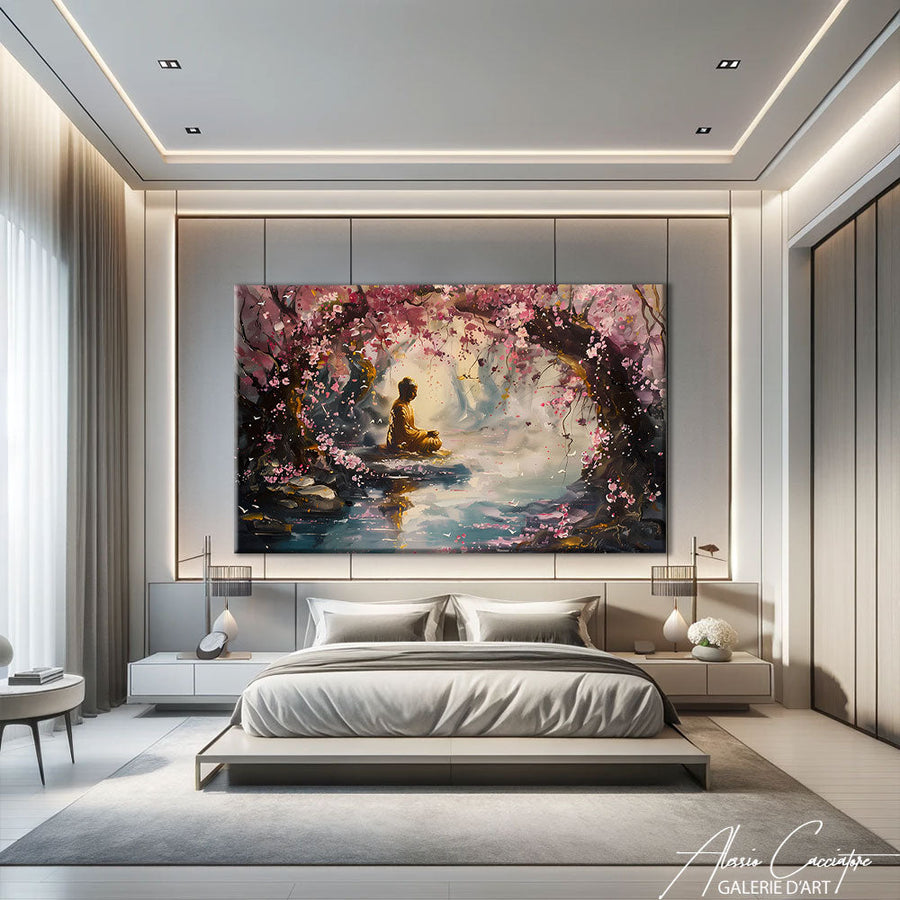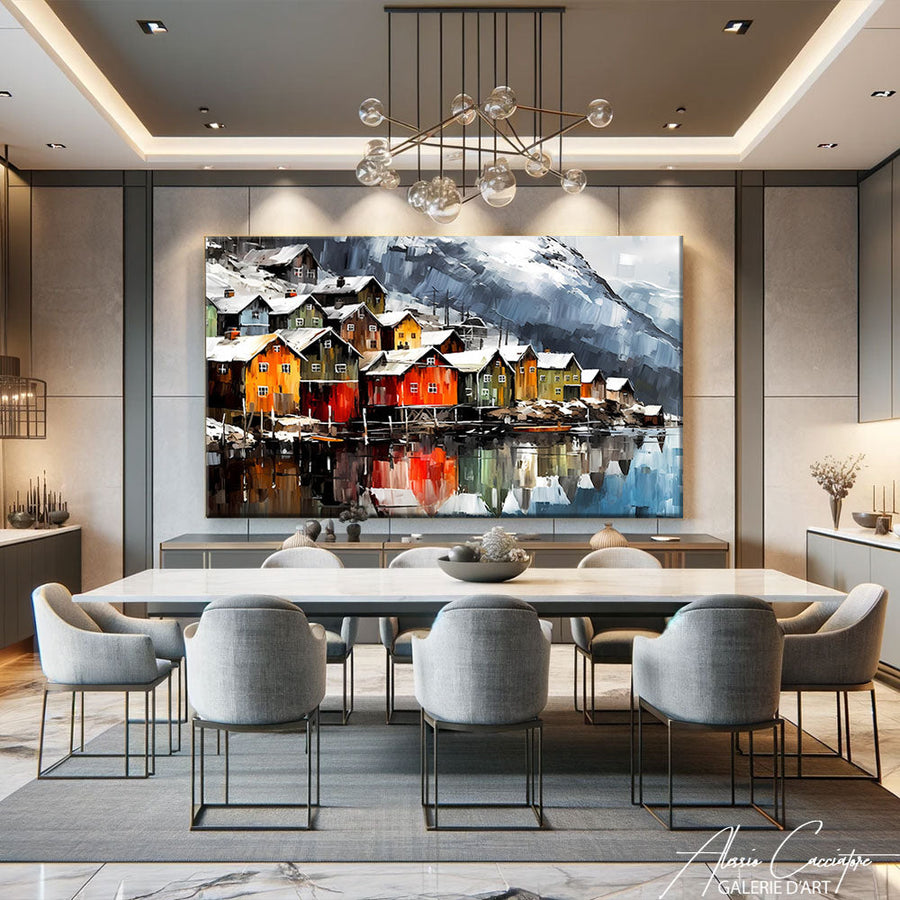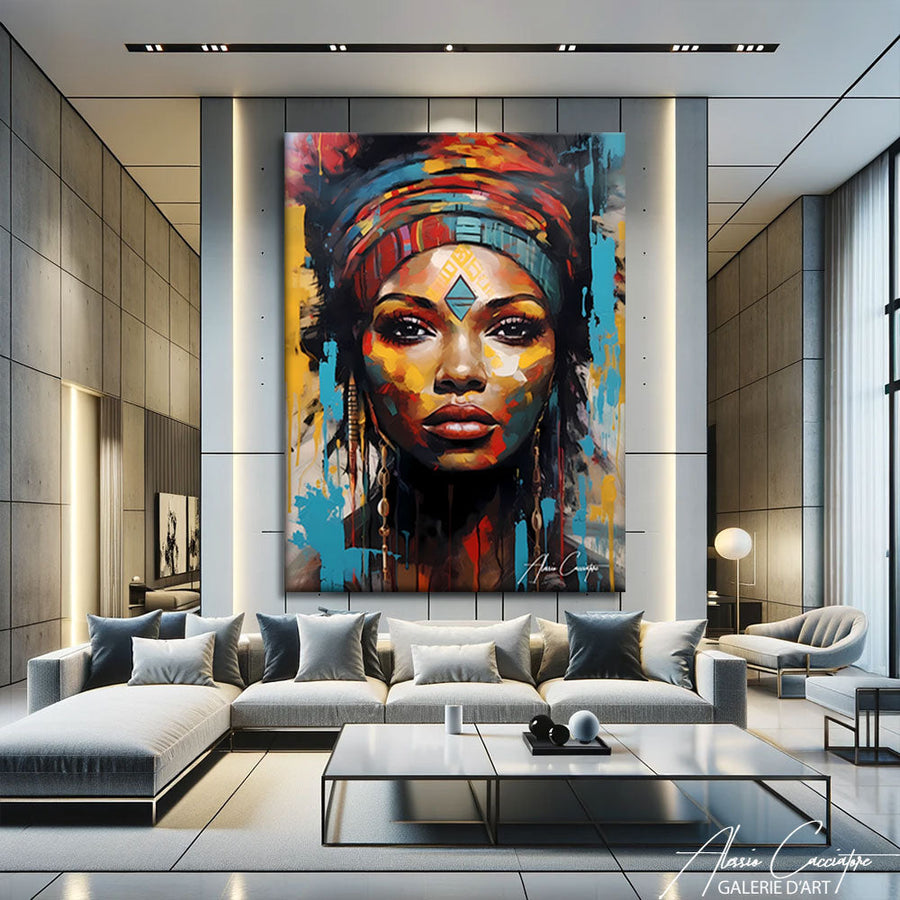

Last week, a visitor told me they were looking for "a modern painting, but not too weird." I smiled. Because "modern" in art doesn't mean what 95% of people think it does. A modern painting isn't just a recent canvas with bright colors. It's a specific period, identifiable movements, a break with 19th-century academicism. And above all, it's very different from contemporary art. In this article, I give you 8 concrete criteria to recognize, choose, and hang a truly modern painting in your home—without being fooled by fake modern art or industrial decor pretending to be art.
Modern vs. Contemporary: The Difference No One Knows (and Why It Changes Everything)
Let's start by dismantling a persistent confusion.
In art, "modern" does NOT mean "recent". Modern art refers to a historical period: roughly from 1860 (the Impressionists) until 1945-1950. Everything that comes after 1945 is contemporary art.
So yes, when you type "modern painting" into Google, you'll find current works. But technically, you're looking for contemporary art.
Why is this important?
Because the aesthetic codes are not the same. A truly modern painting—a Cubist Picasso, an Abstract Kandinsky, a Fauvist Matisse—has specific formal characteristics. It breaks with academic realism, but it remains rooted in pure painting: canvas, color, composition.
Contemporary art, on the other hand, can be a printed photo, an installation, digital art, mixed media. Frankly, anything goes.
So when you want "a chic modern painting" for your living room, first ask yourself: do I want a modern style (Cubism, Fauvism, Abstract Expressionism) or a recent work inspired by contemporary codes (minimalism, street art, current geometric abstraction)?
This distinction completely changes your search.
Criterion 1 — The Artistic Movement: If You Can't Name It, It's Probably Not Modern

Here's a simple test.
Look at the painting you like. Can you say: "It's Cubist," "It's Fauvist," "It's Abstract Expressionist"?
If so, congratulations. You're probably looking at a work that falls within modern art or adopts its codes.
If you just say "it's colorful" or "it's abstract," you might be looking at decor.
Major Modern Movements to Know
- Impressionism (1860-1886): visible brushstrokes, play of light, outdoor scenes. Monet, Renoir.
- Fauvism (1905-1910): pure, non-naturalistic colors, violent flat areas. Matisse, Derain.
- Cubism (1907-1920): geometric fragmentation, multiple viewpoints. Picasso, Braque.
- Expressionism (1905-1930): emotional distortion, raw colors. Munch, Kirchner.
- Lyrical and Geometric Abstraction (1910-1950): Kandinsky, Mondrian, Malevich.
- Surrealism (1920-1950): dreams, unconscious, illogical juxtapositions. Dalí, Magritte.
- Abstract Expressionism (1940-1960): gesture, material, large format. Pollock, Rothko.
If your painting falls within one of these movements—or clearly dialogues with them—you have a modern-style work.
If it's just "pretty and recent," you might have a printed decoration.
Criterion 2 — Breaking with Realism: A Modern Painting Distorts, Simplifies, Abstracts
Modern art is, above all, a rebellion against academicism.
Before 1860, a good painting had to be hyper-realistic, well-finished, with a noble subject (mythology, history, religion). The Impressionists said: "we don't care, we paint light, not details." The Cubists said: "we're going to show a face from three angles at once." The Fauves said: "a tree can be purple if it feels purple."
So a truly modern painting never seeks to reproduce reality as it is.
It transforms it:
- Through color (Fauvism, Expressionism)
- Through form (Cubism, Geometric Abstraction)
- Through gesture (Abstract Expressionism, Tachisme)
- Through symbolism (Surrealism)
If you see a hyper-realistic landscape painted in 2024, it's technically contemporary, but it's NOT modern style. It's the opposite.
In the studio, when I work on an abstract series, I often start with a real form—a body, a movement—but I simplify it until only the emotion remains. That's the modern spirit.
Criterion 3 — Technique: Pure Painting, Asserted Material, Visible Gesture

A modern painting is pure painting.
No digital collage. No giclée print sold as an "original work." Canvas, paint (oil, acrylic, tempera), and a human gesture.
The gesture, precisely, is often visible. Brushstrokes are not smoothed, the material is thick (impasto), traces of creation are embraced. Look at a Pollock: you see the movement. Look at a Soulages: you see the tool that scraped the surface.
This criterion allows you to eliminate 80% of "modern paintings" sold on Amazon or some decor websites.
How to Check?
- Always ask if it's a unique piece or a reproduction
- Check the mentioned technique: oil on canvas? Acrylic on wood? Mixed media?
- Look at close-up photos: you should see the texture, the reliefs, the imperfections
- Beware of perfect edges and ultra-smooth surfaces without any human trace
On alessiocacciatore.com, each work is unique, signed, and I always photograph material details. Because that's art—not a Photoshop file mass-printed.
Criterion 4 — Signature and Dating: A True Modern Painting Has a Story
An authentic modern painting always bears a signature.
Not a stamp. Not a sticker. A handwritten signature, often on the back or bottom right.
It should also have:
- A creation date (at least the year)
- A certificate of authenticity if it's a work by an established artist
- An inventory number if the artist catalogs their works
- Information about the medium, exact dimensions, technique
What deeply annoys me is that you find hundreds of "modern paintings" online without any information about the artist. No bio. No website. No career path. Just "Abstract painting 80x120 cm, delivered in 48h."
That's not art. That's industrial decoration.
A true painting, even by an emerging artist, comes with a story: who created it, why, in what context, what series. You should be able to find the artist, see their work, understand their approach.
Otherwise, you're hanging an anonymous product.
Criterion 5 — Modern Flower Paintings and Decorative Motifs: Beware of Traps

"Modern flower paintings" are a hit on Google (390 searches/month). Understandably so: flowers always work in decor.
But here, you need to be very careful.
True modern paintings with flowers—think Van Gogh's sunflowers, Monet's water lilies, Matisse's floral compositions—are never just pretty. They experiment. They distort. They reinvent color, composition, light.
Most "modern flower paintings" you find online are generic decorative motifs: stylized tulips, pastel peonies, "in the style of" bouquets. Often printed.
How to tell the difference?
- See if the flower is reinterpreted (non-naturalistic colors, abstract form, expressive gesture) or just neatly represented
- Check the technique: is it an original painting or a print?
- Look for artistic intent: why this flower, why this color, why this format?
I myself created a floral series in 2022. But I never paint a rose "like a rose." I paint the tension of the stem, the violent contrast of red on matte black, the decomposition of the petal. That's a modern painting—even with flowers.
Criterion 6 — Chic Modern Painting: The Balance Between Boldness and Elegance
"Chic modern painting" is searched 720 times a month. And I understand why.
People want a work that asserts taste without being flashy or blandly decorative.
Chic, in modern art, is a subtle balance:
- Formal boldness (abstraction, unconventional color, asymmetrical composition)
- But restraint in execution (no overload, no ease, no kitsch)
A Rothko is chic. Two immense rectangles of color, nothing else. But the emotional intensity is insane.
A Mondrian is chic. Three black lines, three primary colors, a precise balance.
A Soulages is chic. Black on black, but infinite depth.
What is NOT Chic in Modern Art
- Overly illustrative works ("a painting with an elegant woman drinking champagne")
- Repetitive motifs without intent (dots, stripes, logos)
- Overly saturated colors without nuance
- Standardized formats sold in sets of 3 on Amazon
Chic is character + sobriety. Easy to say, hard to find.
But when you come across it, you feel it immediately.
Criterion 7 — Format and Hanging: A Modern Painting Assumes Its Presence
Modern paintings, especially after 1945, often use large formats.
Pollock painted canvases several meters long on the floor. Rothko wanted his works to encompass the viewer. American Abstract Expressionists said: "fuck the small bourgeois salon formats, we want monumentality."
So if you want a true modern painting for your interior, don't be afraid of the size.
A 120x100 cm is a minimum for a main wall. A 150x200 cm is even better if you have the space.
Of course, not everyone has a New York loft. But even in a classic apartment, a well-chosen large format transforms the space.
Hanging Rules
- Center the painting at eye level (1.50 m - 1.60 m at the center of the work)
- Allow it to breathe: at least 20-30 cm around it, no furniture cutting it off
- If you have several paintings, avoid the "Instagram frame wall" accumulation style—that's the opposite of the modern spirit
- One large painting > five small ones
I've seen too many beautiful works drowned in cluttered hangings. A modern painting stands on its own.
Criterion 8 — Price: How Much Does a Modern Painting Really Cost (Without Being Ripped Off)?
Let's talk cash.
A true modern painting—unique piece, living or recently deceased artist, reputable gallery—rarely starts below 500-800 €.
For an emerging artist, expect 800-3000 € depending on the format.
For an established artist (exhibitions, press, collections), expect 3000-15,000 €.
For a living legend or a great name of the 20th century, it's 50,000 € and up.
Why These Prices?
Because a painting is:
- Dozens of hours of work
- Quality materials (canvas, stretcher, pigments)
- Technical know-how
- An artistic approach built over years
- A unique piece that will never be reproduced
So yes, you'll find "modern paintings" for 89 € on some websites. But these are mass prints, or works produced in factories in Asia.
That's not art. That's furniture.
If you have a limited budget, prefer a small original format by an emerging artist rather than a large anonymous canvas. You'll have a real work, with a story, and perhaps an artist who will break through in 10 years.
That's how collections are built.
How to Choose YOUR Modern Painting: My 3 Questions to Ask Before Buying
Okay. You've read all this. You now know the difference between modern and contemporary, how to recognize a movement, and how to avoid traps.
But ultimately, how do you choose the work that IS right for you?
Here are my three questions.
1. Does this work touch me emotionally, or does it just "go well with my sofa"?
If it's just to fill a wall, get a mirror. A painting should evoke something: a gut punch, curiosity, a desire to look again.
2. Can I tell someone about this work?
You should be able to say: "This is a Berlin artist who works with lyrical abstraction, he uses a lot of black and red, I love the tension he creates." If you can't say anything more than "it's beautiful," you haven't found your work yet.
3. Will I still be proud to have it in my home in 5 years?
Modern art transcends eras. Decor trends come and go. A good painting, you love it even more over time. A decor product, you put it in the basement after 18 months.
If you answer yes to these three questions, go for it.
Otherwise, keep looking.
Frequently Asked Questions
What is the difference between modern and contemporary art?
Modern art covers the period from approximately 1860 to 1945 (Impressionism, Cubism, Surrealism, Abstract Expressionism). Contemporary art refers to everything created after 1945. So when you're looking for a "modern painting" for your living room, you're often actually looking for a contemporary work inspired by modern codes.
How do I tell a real modern painting from a simple reproduction?
Check three things: the handwritten signature (not a stamp), the mentioned technique (oil on canvas, acrylic, not "digital print"), and the visible texture in close-up. A real painting has relief, brushstrokes, material. A reproduction is perfectly smooth and can be mass-produced.
What budget should I plan for an original modern painting?
For an emerging artist, expect between 800 and 3000 € depending on the format. For an established artist with a solid career, between 3000 and 15,000 €. Beware of "modern paintings" under 200 €: these are generally industrial prints or mass-produced works.
Which modern art movements are most sought after for decoration?
Geometric abstraction (Mondrian, Malevich) and abstract expressionism (Pollock, Rothko) work very well in contemporary interiors. Cubism and Fauvism bring color and dynamism. It all depends on your interior and your sensibility, but avoid choosing solely to "look pretty."
Can modern art and contemporary decor be mixed?
Absolutely, it's even recommended. A minimalist contemporary interior is enhanced by a bold large modern painting. The important thing is to let the work breathe: a single large format on a clean wall will have much more impact than five small paintings piled together.
Are modern paintings with flowers really modern art?
It depends on the treatment. A decorative and realistic floral motif is not modern. However, an expressionist, abstract, or Fauvist reinterpretation of flowers (as with Matisse or Van Gogh) fits well within modern art. Ask yourself: does the artist reinvent the motif or merely reproduce it prettily?
All works mentioned in this article are available on the gallery. Worldwide shipping offered, 30-day money-back guarantee.