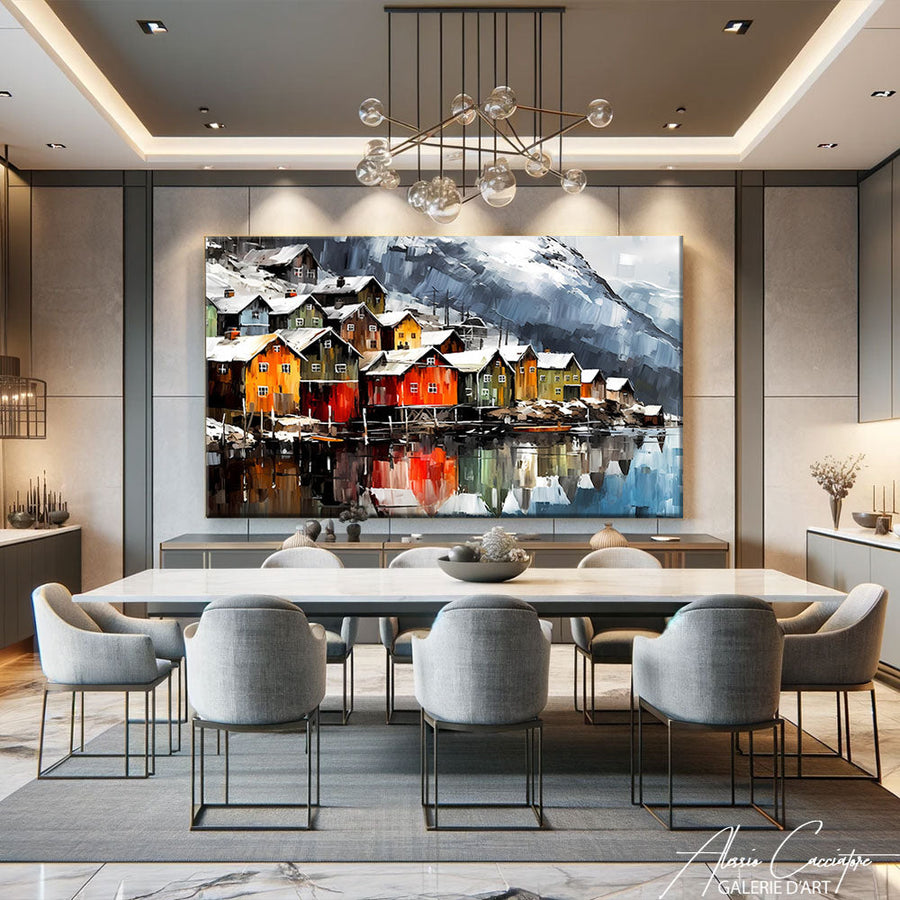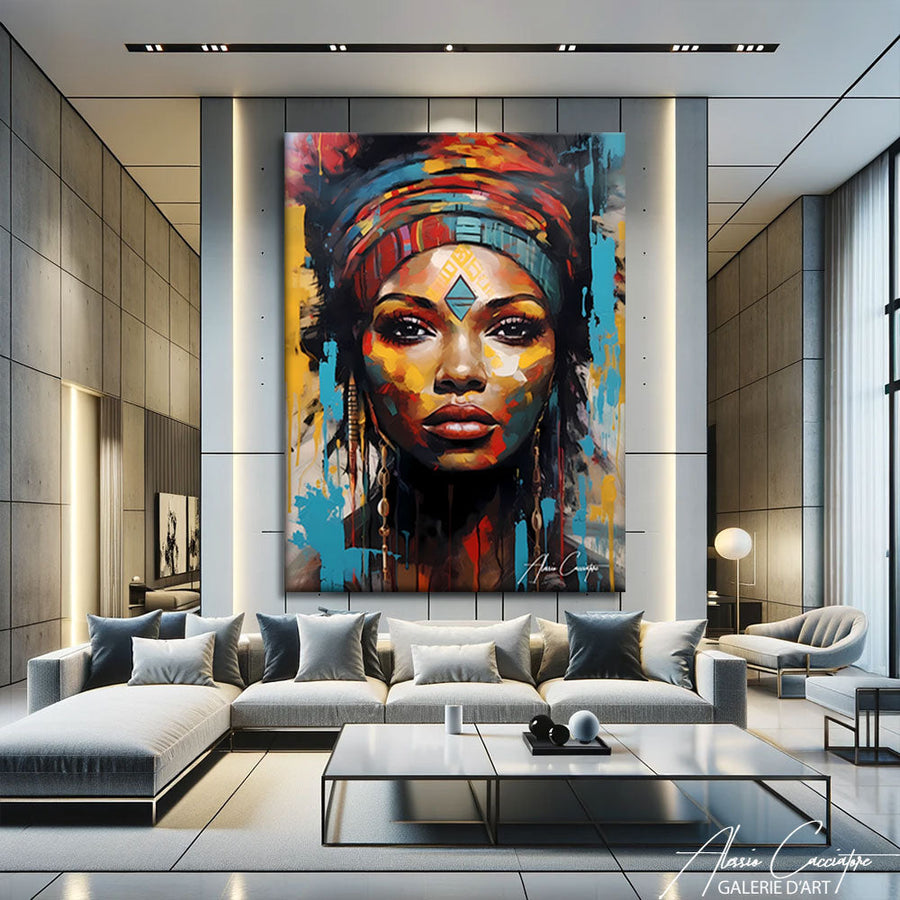

Three years ago, I hung a lithograph in my Parisian bathroom. An abstract nude, warm tones, Hahnemühle paper. Six months later, it was intact. Since then, I’ve systematically installed works of art in my bathrooms—and frankly, it has become one of the rooms where I derive the most visual pleasure. Yet, when I visit apartments or when clients contact me to dress up their interiors, the bathroom remains the great forgotten space. As if humidity forbids any aesthetic ambition. Spoiler: that's false.
Why the bathroom deserves as much attention as the living room
We spend an average of 30 minutes a day in the bathroom. Sometimes more if you like long baths or skincare rituals. It’s downtime, contemplative, where the gaze inevitably lands somewhere.
In my Berlin studio, the bathroom faces a bare wall that I would see every morning while brushing my teeth. It annoyed me. I installed a monochrome screen print—a fragmented face, 50×70 format—and everything changed. Waking up became less brutal. The morning ritual, softer.
The bathroom is one of the few rooms where you are alone, in direct contact with yourself. That moment might as well be visually stimulating. Unlike the living room where works "perform" socially (we show them off, we talk about them), here they create intimacy. A silent dialogue.
And let's admit it: a bathroom with bare walls is sad. Even if the tiling is impeccable and the fixtures are designer, that touch which transforms a functional space into a livable place is missing.
Bathroom art: which materials really survive humidity

The first question everyone asks me: "But won't it get moldy?" No, if you choose the right substrates.
Materials that last
Acrylic under glass or plexiglass: my top choice. The work is protected; moisture only touches the frame. I’ve had a pop-art painting framed under plexiglass in my bathroom since 2021, zero damage.
Prints on Dibond or aluminum: printed directly onto metal, these materials are completely waterproof. Perfect for bathrooms with walk-in showers where steam spreads everywhere. The finish is modern, almost industrial.
Varnished canvases: if you insist on traditional canvas, you need a satin or gloss protective varnish. This creates a barrier against humidity. However, avoid untreated canvases or works on paper without frames—that's a guaranteed disaster.
What to strictly avoid
Unframed watercolors. Antique engravings without glass. Untreated raw wood frames (they swell and warp). Works made of papier-mâché or unprotected organic materials.
A client told me he hung a lithograph without glass in his bathroom—in six months, the paper had warped and the colors had faded. A shame, it was a signed piece.
Bathroom art: what size, what location
Size is always tricky. Too small, the work gets lost in the tiling. Too large, it overwhelms the space.
For a standard bathroom (5-8 m²), I recommend a format between 40×60 cm and 70×100 cm. It remains visible without being invasive. If you have a large bathroom with a freestanding tub (the luxury), you can go up to 100×150 cm.
The ideal location? Opposite the bathtub or sink. That’s where your gaze naturally rests. Avoid walls right above the shower (direct water splashes) or too close to the floor (risk of splashes).
In my old Parisian apartment, I had a long hallway leading to the bathroom. I installed three small formats in a series (30×40 cm each) on the back wall, visible from the door. It created a real mise-en-scène.
Pro tip: if your ventilation is noisy or if you hate the absolute silence in the shower, a strong graphic work distracts the attention. The brain focuses on shapes, colors, and less on the sound environment. Strange, but it works.
Themes that work (and those to avoid)

I have my preferences, obviously. But some themes consistently recur in successful bathrooms.
What works every time
Seascapes, beaches, waves. Classic, but effective. Water calls to water. A client bought a black and white photo of the Norwegian coastline from me—he tells me that every shower becomes an almost meditative experience.
Artistic nudes (not vulgar, of course). The bathroom is the territory of the body. A graphic, stylized nude makes sense. In my current bathroom, I have a minimalist female nude, three ink strokes. Refined.
Geometric or organic abstractions. Fluid shapes, soft colors (or conversely, very bright ones to energize the morning). It doesn't tell a narrative; it just creates an atmosphere. Seascapes and fluid abstractions are, in fact, among my safest bets for this room.
What I frankly advise against
Motivational quotes in script font ("Breathe", "Relax", that sort of thing). It was trendy in 2015; now it's dated. Still lifes with fruit (too kitschy in this context). Portraits that are too realistic and stare at you (unsettling when you're naked).
And above all, avoid works that are too emotionally charged. A dramatic scene, a war photo, an expressionist scream... The bathroom should remain a refuge, not a place of intense visual confrontation.
Bathroom wall decorative panels: the alternative to classic paintings
If a framed painting feels too formal, there are other options.
Brushed aluminum panels with photographic printing: ultra-resistant, mounted directly to the wall without a frame. I used one for a series of contemporary minimalist portraits in my Berlin bathroom. The look is raw, almost street art.
Printed tempered glass plates: these are becoming increasingly common, especially for reproductions of contemporary works. They clean just like a mirror, zero maintenance.
Artistic wall mosaics: if you are renovating your bathroom, why not integrate the work directly into the tiling? I’ve seen projects where an entire wall becomes an abstract ceramic composition. It’s work, but the result is permanent and spectacular.
My personal take: rigid panels are less "precious" than a framed painting, but they bring a raw modernity. If your interior is more industrial or minimalist, it's a great path to take.
How to keep your bathroom art from ending up damaged
A few common-sense rules so your work lasts for years.
1. Proper ventilation. A well-functioning ventilation system reduces ambient humidity. If your bathroom tends to turn into a steam room after every shower, even the best varnish won't last forever.
2. Distance from water sources. Even if the material is waterproof, avoid hanging it directly above the tub or in the direct path of the shower head. Give it a little space, and everything will be fine.
3. Treated or metal frames. Untreated wood frames swell. I’ve seen old frames crack in three months. Favor aluminum, steel, or varnished wood.
4. Visual check once a quarter. Check if signs of moisture are appearing under the glass, or if the frame is moving. Five minutes, no more. If you see the beginning of a problem, act immediately.
One of my Parisian collectors installed a small, discreet electric dehumidifier in his bathroom (inexpensive, €40 on Amazon). Since then, zero issues. It might be excessive, but if you have a particularly humid room, it could be worth it.
My recommendations based on your bathroom style
Because not all bathrooms look the same.
Modern/Minimalist bathroom
Graphic black and white painting. Geometric abstraction. Clean lines, no frills. A medium format (60×80), slim black or white aluminum frame. It reinforces the minimalist aesthetic.
Vintage/Retro bathroom
Botanical engraving under glass, vintage poster (Art Deco typography), or sepia photograph. Varnished light wood frame. Avoid total kitsch, stick to elegant vintage.
Zen/Spa bathroom
Calming natural landscape (forest, water, stone). Neutral tones (beige, gray, soft green). Panoramic format if you have a long wall. The idea: extend the feeling of relaxation.
Colorful/Eclectic bathroom
Pop art painting, vibrant portrait, multicolored abstraction. Here, you can be bold. A large format (80×120) that pops. White or transparent frame so as not to weigh it down.
In my current bathroom (white tile, black fixtures), I put a female portrait in neon pink and electric blue acrylic. It literally wakes you up. Every morning, this painting puts me in a good mood.
Bathroom wall decoration: what if you created a mini-gallery
Rather than one imposing work, you can compose a gallery wall.
I did this in my Berlin bathroom: six small formats (20×30 and 30×40) arranged in an asymmetrical grid. Black and white only, varied themes (portrait, urban, abstract). Identical frames, black aluminum.
The advantage: you can change a work from time to time without redoing everything. It becomes an evolving collection. And visually, it creates rhythm.
Technical tip: if you do a gallery wall, keep chromatic or stylistic consistency. Otherwise, it turns into chaos. Unify either by colors, by frames, or by theme.
Also be careful not to overload it. In a small bathroom, three works max. Beyond that, it suffocates the room.
Where to find the perfect painting for your bathroom (without breaking the bank)
You have several options, depending on your budget and your desires.
Online galleries (like mine, alessiocacciatore.com): you find original works or limited editions, often at more accessible prices than in physical galleries. The advantage is that you can filter by size, color, and style.
Limited edition art prints: cheaper than a unique piece, but with real artistic value. Look for emerging artists, numbered screen prints, signed photos.
Local art markets and artist studios: if you like to hunt for bargains, you can come across gems. A friend of mine found a watercolor framed under glass for €80 from an artist in Belleville. Three years later, it’s perfect.
DIY prints on waterproof materials: some photo labs offer prints on Dibond or aluminum from your own files. If you have an eye for composition, you can print a personal photo and create something unique.
Avoid low-end posters without frames. Even if the visual is beautiful, without protection, it won't last. Invest at least in a decent frame with glass.
Frequently asked questions
Can you put a painting in a bathroom with a shower?
Yes, provided you choose a resistant material (acrylic under glass, Dibond, aluminum) and install it away from direct water spray. Good ventilation helps too. I have had paintings in my bathrooms with showers for years, zero problems.
What size painting for a small bathroom?
For a bathroom under 5 m², stay between 40×60 cm and 60×80 cm maximum. Beyond that, it overwhelms the space. If you want several works, opt for small formats (30×40) in a wall composition.
Do canvas paintings hold up in a humid bathroom?
Yes, if the canvas is properly varnished with a satin or gloss protective varnish. Without protection, the canvas risks warping or molding. Still, favor more waterproof materials if your humidity level is very high.
Where to hang a painting in the bathroom?
Ideally opposite the bathtub, above the sink (not too close to avoid splashes), or on the wall facing the door. Just avoid right above the shower or too close to the floor.
Is a painting in the bathroom really useful?
Aesthetically, absolutely. The bathroom is an intimate room where we spend time alone—it might as well be visually pleasant. It transforms a functional space into a livable place. After that, if you prefer bare walls, that's up to you.
All the works mentioned in this article are available at the gallery. Worldwide shipping included, satisfaction guaranteed or your money back within 30 days.