
The other day, a collector showed me a painting he had bought for €2,000 at a fair. Two years later, he wanted to resell it. Nobody wanted it. Not because it was ugly—it was technically correct—but because it said absolutely nothing. In contemporary art, the difference between a work that stands the test of time and a decoration that ages poorly often lies in a few details that one learns to spot. I'm going to show you which ones.
A contemporary painting isn't just "recent"
The first confusion to clear up: a contemporary painting isn't just something painted after 2000.
It's a work that dialogues with its era. One that asks a question, that captures an unease, a joy, a current tension. It can be figurative, abstract, minimalist, maximalist—style doesn't matter. What matters is that there is a discernible intention.
In my studio, I see dozens of artist applications every month. Many produce technically impeccable paintings, with beautiful color harmonies and balanced compositions. But when I ask them, "Why does this work exist?", they answer, "Because I love to paint." That's legitimate, but insufficient.
A solid contemporary painting carries an urgency. Even a small one. Even a silent one.
"Contemporary art is art that looks at you as much as you look at it."
So yes, a painting created in 1985 can be contemporary in its approach. And a painting created yesterday can be completely dated.
Coherence: the first sign of a serious artist

When you look at an artist's portfolio, you should recognize a signature style. Not necessarily a fixed style—I hate that idea—but an internal logic.
Take an artist who does pop art one day, lyrical abstraction the next, then hyperrealist landscapes the week after. Either they are a protean genius (extremely rare), or they are someone looking for what sells.
Since my beginnings, I have revolved around the same obsessions: the human figure, the relationship to gaze, the tension between presence and absence. My series evolve, my techniques too, but there is a common thread. It is this thread that gives value to a body of work.
How to check an artist's coherence?
- Look at 5-10 of their works: is there a recognizable universe?
- Read their artistic statement (if it exists): is it credible or vague?
- Check their past exhibitions: have they been invited multiple times to the same venues?
A solid contemporary artist builds a narrative, not a product catalog.
The contemporary face painting: a case study
Portraiture is my playground. And frankly, it's one of the most saturated genres on the market.
On Instagram, you find 10,000 artists who paint faces. Some are extraordinary. Others awkwardly copy what works on Pinterest.
So how do you know if a contemporary face painting has character?
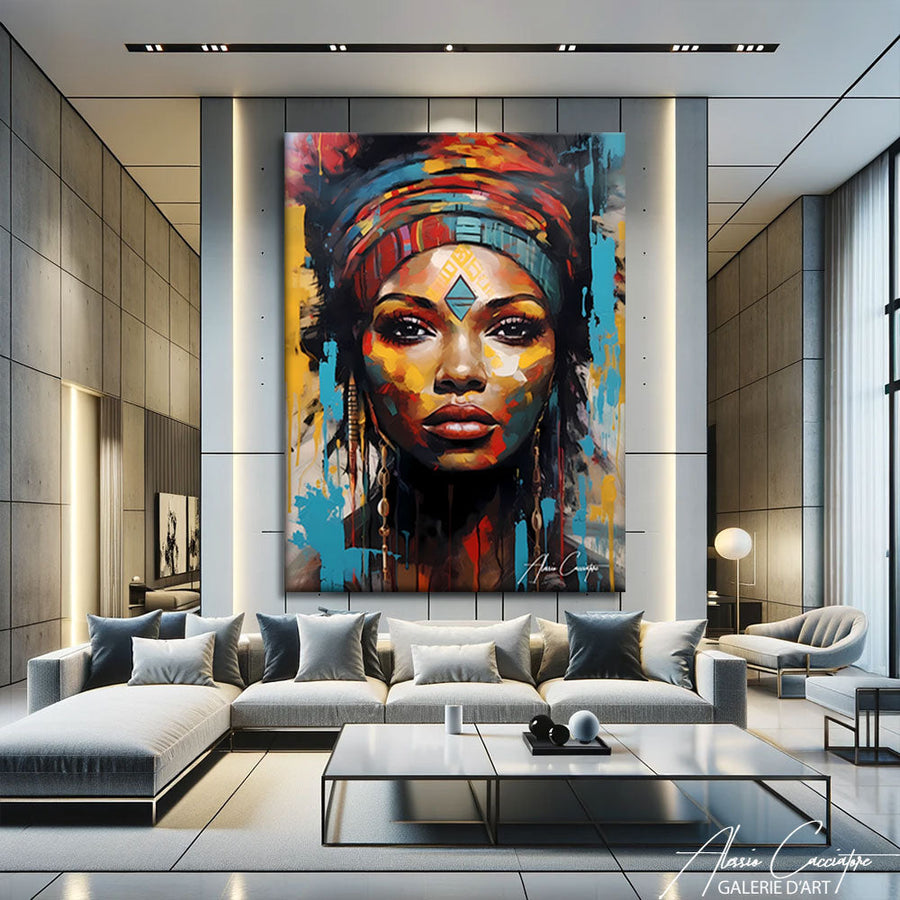
First: the gaze. A successful contemporary portrait doesn't just reproduce a face. It captures an interiority, a psychological state. Look at the eyes: are they lively? Absent? Inquisitive? A good portrait makes you uncomfortable, or moves you, or intrigues you. It never leaves you indifferent.
Then: the plastic treatment. Did the artist dare something? Saturated color blocks, blurred areas, brutal contrasts, thick impasto? Or is it just a "pretty" face without a strong stance?
I sold a portrait last year to a collector who told me: "What struck me was that it looks at me even when my back is turned." Bingo. That's exactly what I'm looking for.
A successful contemporary face painting inhabits the space. Not just the wall.
Painting size: large format changes everything

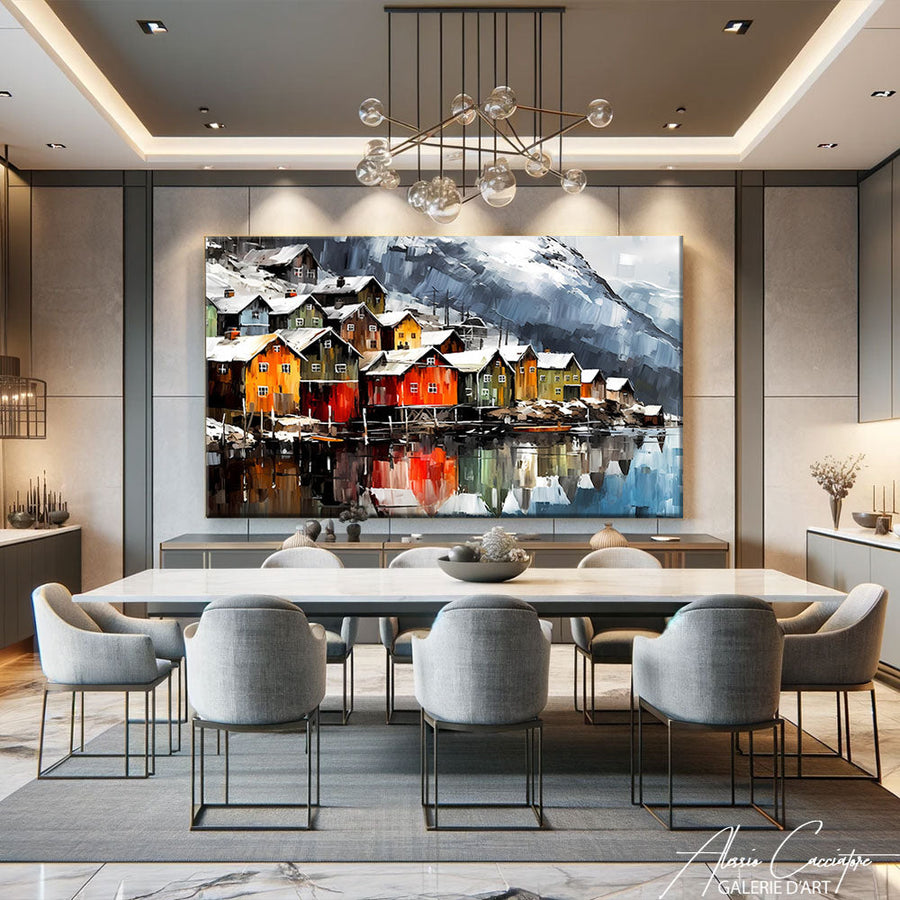
A large format contemporary painting isn't just a small canvas made bigger.
It's a physical experience. You no longer view it from afar, comfortably seated on your sofa. It envelops you. It occupies your field of vision. It imposes its presence.
In galleries, I notice that collectors often hesitate in front of large formats. "It's too big for my living room," "I don't know where to put it." That's normal. A large format contemporary painting requires courage.
But that's also what makes it powerful.
Advantages of a large format
- Immediate visual impact: it structures the space, becoming the focal point of the room
- Details invisible in small format: the texture, nuances, happy accidents take on full meaning
- Higher perceived value: for equal quality, a large format always commands a better price
However, be careful: a poorly executed large format quickly becomes cumbersome. Before buying, ask yourself if the work deserves this scale. Do the subject, composition, and energy justify 150×200 cm? Or is it just to "go big"?
A good contemporary artist knows when to go for large format. And when to stay at 50×70.
Materials and technique: beyond the canvas
Today, limiting contemporary art to "paint on canvas" would be ridiculous.
I mainly work on canvas, it's true. But I also incorporate mixed media, collages, sometimes resin. What interests me is the final result, not the academic purity of the medium.
When evaluating a contemporary art painting, look at how the artist utilizes their materials:
- Acrylic: dries quickly, allows for layering and crisp flat colors. Ideal for pop art, geometric abstraction.
- Oil: slower, more sensual, allows for subtle blending. Perfect for portraits, atmospheres.
- Mixed media: spray, ink, pastel, gold leaf... as long as it serves the purpose and isn't just for show.
What annoys me is when an artist accumulates techniques just to "be contemporary." Three types of paint + glitter + magazine collage + glitter varnish = often an illegible mess.
Technique must serve intention, never the other way around.
Provenance and traceability: the importance of the journey

A contemporary painting that is worth something has a story.
Where has it been exhibited? Who bought it first? Does the artist have a consistent resume?
I'm not saying you should only buy ultra-rated artists. On the contrary, emerging young artists often offer the best value for money. But even a serious beginner leaves traces:
- Group exhibitions in recognized galleries
- Artist residencies
- Publications, interviews, press articles
- Sales in galleries (not just on Etsy or Saatchi Art)
If an artist has no presence outside of Instagram, ask yourself: are they truly "contemporary" in the artistic sense, or just "present on social media"?
Personally, I have always favored physical exhibitions. Nothing replaces direct contact with the public, feedback from collectors, the gaze of an exhibition curator.
A good contemporary art painting has been confronted with gazes other than that of its creator.
Price: how to assess if it's justified
A thorny question. How much is a contemporary painting worth?
It all depends.
But there are some objective benchmarks:
- Size: on average, count €30 to €80/dm² for an emerging artist, €100 to €300/dm² for an established artist (excluding market stars)
- Reputation: solo exhibitions, art prizes, public collections drive up the value
- Rarity: a limited series is worth more than unlimited production
- Medium: canvas > paper > digital print (in perceived value)
But beware, price isn't everything. I've seen paintings for €10,000 that weren't worth €500, and vice versa.
What really matters:
- Does the work speak to you? If you have to look at it every day, that's the only question that matters.
- Is the artist building a serious career? If so, your purchase may gain value. Otherwise, consider it a pleasure, not an investment.
And frankly, in my opinion, too many people buy art "to invest." Art is not a savings account. It's an emotional gamble above all.
Where to confidently buy a contemporary painting
The internet has democratized access to art. That's great. But it has also opened the door to a lot of nonsense.
My recommendations:
Specialized online galleries
Prioritize platforms that select their artists. Not marketplaces where anyone can sign up in 5 minutes. A serious gallery curates, supports artists, and guarantees authenticity.
Direct artist sales
Buying directly from the artist (via their website, studio) can be an excellent option. You pay less than at a gallery (no commission), and you create a direct connection. But still check their background.
Physical galleries
Nothing replaces direct contact with the artwork. The texture, the light, the real scale. If you're hesitant about a large contemporary painting, go see it in person.
Art fairs and shows
Art Paris, Affordable Art Fair, Drawing Now... These events bring together hundreds of galleries. It's intense, but you can compare, negotiate, and meet the artists.
Absolutely avoid:
- "Artist reproductions" sold as originals
- Sites that sell "on demand" (this is disguised digital printing)
- Artists without a coherent portfolio, no bio, no artistic statement
There's no denying that buying art requires a minimum of research. But that's also what makes the experience exciting.
Frequently asked questions
What is the difference between a contemporary painting and a modern painting?
Modern painting refers to works created between approximately 1870 and 1950 (Impressionism, Cubism, Surrealism...). Contemporary painting begins after 1945-1950 and encompasses all current production. But be careful, "contemporary" also refers to an artistic approach that questions its era, not just a creation date.
How do I know if a contemporary painting will increase in value?
It's impossible to guarantee. But a few clues: the artist exhibits regularly, has a coherent discourse, their production is limited and documented, and they are represented by a serious gallery. That said, buy first because the work moves you, not to speculate.
What budget should I plan for an original contemporary painting?
For an emerging artist, count €300 to €1500 for a small format (50×70 cm), €1500 to €5000 for a large format. An established artist can ask €5000 to €20,000 or more. But there are excellent works at all prices—the important thing is to check the coherence of the price with the artist's career.
Can I buy a contemporary painting online without having seen it in person?
Yes, if you buy from a reputable gallery that offers high-definition photos, a certificate of authenticity, and a return policy. Carefully check the actual dimensions, the texture of the canvas (matte, glossy, thick), and read reviews from other buyers. I have many clients who buy online and are never disappointed—the key is the seller's transparency.
Does a contemporary face painting go out of style faster than an abstract painting?
No, provided the treatment is personal and not just a simple copy of what's popular on Instagram. A strong contemporary portrait transcends trends. Abstract art can also age very poorly if it follows a fleeting decor trend. What matters is the artist's intention, not the subject.
All works mentioned in this article are available on the gallery. Worldwide shipping offered, 30-day satisfaction guarantee.