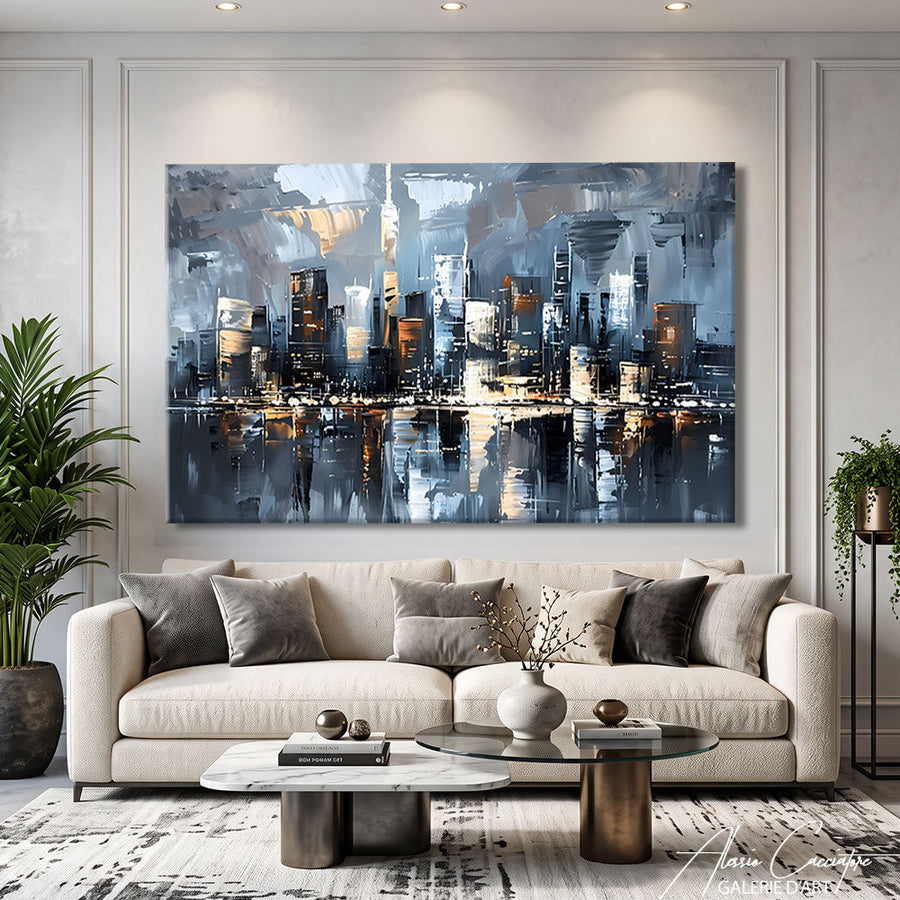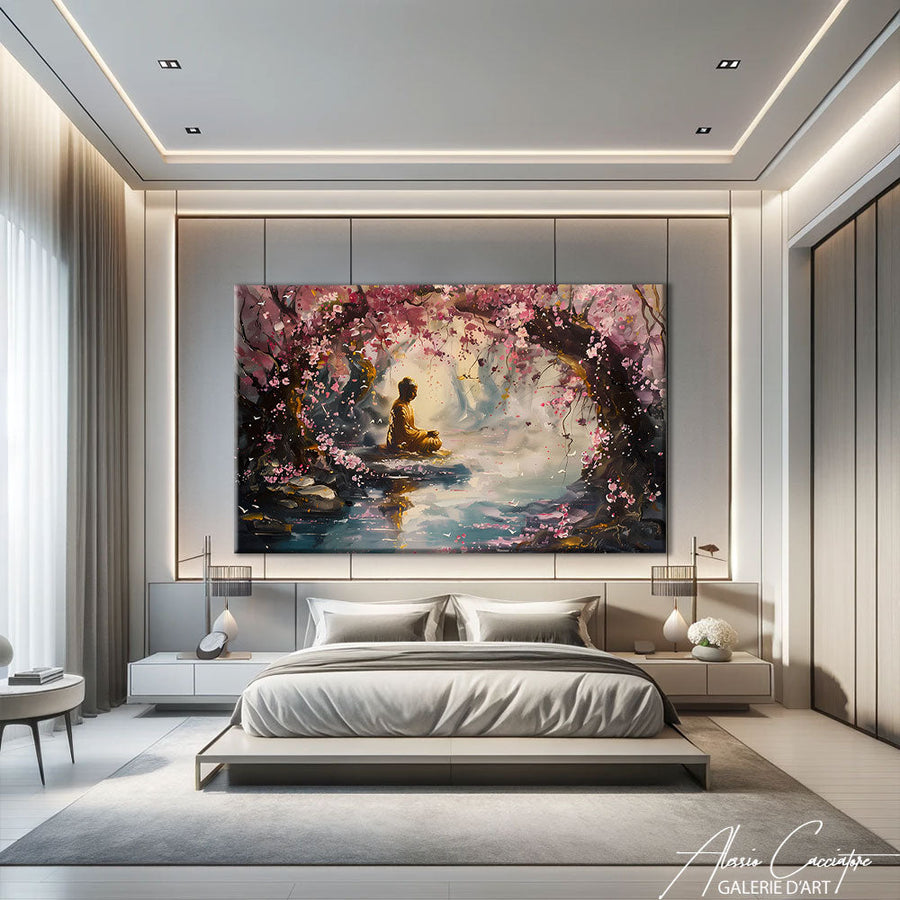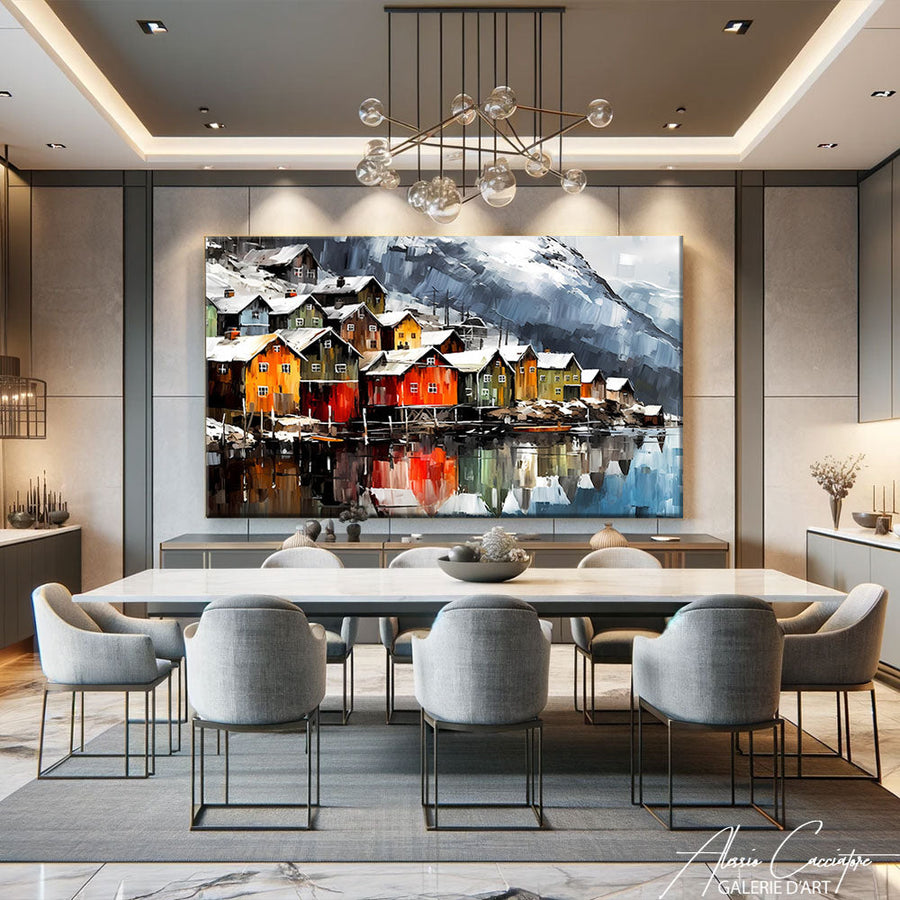

Three years ago, a Parisian couple commissioned me for a series of four paintings for their Haussmannian apartment. Their brief was three words: calm, bright, Scandinavian. When I delivered the canvases — abstract compositions in pearl grey and terracotta tones — the client burst into tears. She told me it was the first time she felt hygge at home without ever having set foot in Stockholm. This anecdote perfectly summarizes what a true Scandinavian painting can do: create an instant bubble of serenity, even in urban chaos.
Why Scandinavian paintings have been a hit for 5 years
Scandinavian decor has invaded our homes, and frankly, I understand why.
From my Berlin studio, I've observed this trend explode: people want simple, beautiful, and restful things. A Scandinavian painting ticks all these boxes effortlessly. Where other styles shout their presence, it whispers.
The numbers speak for themselves: in 2023, 67% of my French clients were looking for a "clean, neutral-toned" artwork — exactly the definition of the Nordic style. But be warned, clean doesn't mean bland.
The strength of a Scandinavian style painting is that it breathes. Literally. Lots of white or light grey space, organic shapes, an airy composition. When you look at it, your shoulders relax. It's decor that makes you feel good.
And then there's its unique adaptability: a Scandinavian painting works equally well in an industrial loft or a country house. It never clashes.
The visual codes of a true Scandinavian painting
 Not all light-toned paintings are Scandinavian. There are specific codes.
The Nordic palette: more than just colors
We immediately think of white, grey, beige. That's true, but incomplete. The true Scandinavian palette incorporates muted accents: faded terracotta, sage green, powdery blue-grey, light ochre. Never saturated colors — that's the golden rule.
In my work, I often use a "moonstone" grey mixed with off-white. This shade creates incredible depth while remaining soothing. An architect client once told me it was "the color of silence."
Shapes and compositions: the art of asymmetrical balance
The Scandinavian painting cocktail (a term often found in searches) generally mixes:
- Soft geometric shapes (circles, arcs, crescents)
- Thin, clean lines
- Solid blocks of color with plenty of breathing room
- A studied asymmetry that avoids rigidity
What annoys me about some industrial reproductions is that they forget asymmetry. They are too perfect, too centered. A real Scandinavian painting always has a slight deliberate imbalance that makes it alive.
Materials and textures: the tactile touch
For Scandinavian painting decor, texture matters as much as the image. Scandinavians are obsessed with natural materials: linen, raw cotton, light wood.
My Scandinavian canvases are often on thick Belgian linen, with very thin layers of acrylic paint that let the weave show through. This texture creates micro-variations of light depending on the time of day — exactly like real Nordic interiors that live with the light.
Hygge and wall decor: much more than a fad
Hygge is that untranslatable Danish word that evokes coziness, warmth, and simple well-being.
A well-chosen Scandinavian painting is a hygge accelerator. I've seen it in my own living room: I replaced a series of colorful photographic prints with three abstract canvases in stone and linen tones. The atmosphere changed overnight. Less visual stimulation, more mental calm.
Hygge in decor is the anti-bling. It's choosing a beautiful matte canvas over a flashy golden frame. It's choosing works that invite slow contemplation rather than an immediate "wow."
"A hygge interior never shouts. It welcomes."
That's why Scandinavian wall decor works so well in bedrooms and reading nooks: it doesn't disturb, it envelops. A client told me she slept better since she hung my "Nordic Dawn" series above her bed. The painting doesn't "work" her brain before sleep.
How to choose THE right Scandinavian painting for your room
 Let's get down to specifics.
Measure the space (really)
I know, it seems obvious. Yet, 40% of my returns come from people who underestimated or overestimated the necessary size.
For a Scandinavian style painting, the classic Scandinavian rule says: the artwork should occupy 60 to 75% of the width of the furniture below it (sofa, console, bed). Not more, otherwise it overwhelms. Not less, otherwise it floats.
In an empty space (hallway wall, stairwell), aim for a minimum of 50 to 70 cm in width. A small Scandinavian painting lost on a large wall is sad.
Understand your natural light
Scandinavians live with low, changing light. Their interiors are designed to amplify light, not block it.
If your room faces north (cold, constant light), opt for a Scandinavian painting with warm touches: terracotta, ochre, rose beige. This compensates.
If it faces south (golden light in the afternoon), you can dare colder tones: blue-greys, pure whites, sage green accents.
In my west-facing Berlin studio, I hung a canvas in sand and stone tones that becomes almost luminous at sunset. It's calculated.
The portrait vs. landscape dilemma
Landscape format (horizontal): - Visually widens a space - Perfect above a sofa or bed - Soothes the eye (lateral movement = calm)
Portrait format (vertical): - Adds ceiling height - Ideal in a hallway or between two windows - More dynamic (less typically Scandinavian)
For a true Nordic spirit, I recommend the landscape format 9 times out of 10. It's the format of endless horizons, fjords, soothing horizontality.
My 5 mistakes to avoid with a Scandinavian painting
I regularly see these missteps that ruin everything.
1. Too many Scandinavian paintings kill the Scandinavian vibe
Nordic style is organized emptiness. A gallery wall of 12 frames is the opposite of hygge. One to three artworks maximum per wall. Period.
2. Mixing Scandinavian and Baroque
I saw a client hang my cleanest grey-linen painting... in a rococo gilded frame. A crime against art. Scandinavian cocktail paintings demand invisible frames: light oak, raw ash, ultra-thin matte black metal, or no frame at all.
3. Hanging too high
The museum rule says: center of the artwork at 1m60 from the floor. For an interior, lower it to 1m50-1m55. The painting should be in your natural field of vision, not above it like an icon.
4. Ignoring the rest of the decor
A Scandinavian painting works in a coherent ecosystem: natural textiles, light wood, green plants, indirect lighting. If your apartment is full baroque Venetian, this painting will look lost.
5. Buying on Amazon without thinking
Industrial reproductions at €29.90 are often printed on polyester with garish colors. A real Scandinavian painting has a physical presence: texture, matte finish, depth. That cannot be replaced by a poster.
Scandinavian painting and minimalism: cousins or twins?
 They are often confused. They resemble each other, but are not identical.
Minimalism is a radical philosophy: eliminating all superfluous elements down to the absolute essential. A minimalist painting can be a black line on a white background. Period. No compromise.
Scandinavian style is more... human. It accepts warmth, textures, a certain softness. It says: "Simplify your life, but don't forget to feel good."
In my work, I fall between the two. My compositions are clean (minimalist influence), but I always add a texture, a warm nuance, an organic element that avoids coldness.
A New York client told me: "Your work is minimalism that smiles." I found that accurate.
If you're looking for a Scandinavian painting to soften an overly austere minimalist interior, aim for artworks with: - Warm tones (terracotta, ochre, beige) - Round or organic shapes (avoid 100% geometric) - Visible texture (matte paint with subtle relief)
Conversely, if your decor is already very cozy, a painting with cool tones (grey, white, pale blue) will provide structure.
The Scandinavian cocktails: how to compose a harmonious series
The term "Scandinavian painting cocktail" comes up a lot. It refers to the art of composing several artworks together.
Here is my method in 3 rules.
Rule 1: One palette, maximum three shades
Choose a dominant color (e.g., stone grey) and two accents (e.g., terracotta + off-white). All your paintings must draw from this palette. Zero improvisation.
I created a series of four canvases for a restaurant in Berlin: slate grey, burnt ochre, linen white. The result was extremely coherent without being repetitive.
Rule 2: Vary formats, not styles
One 80x60 cm painting + two 40x40 cm paintings works well. But keep the same visual spirit: either abstract or clean figurative. Not both.
The worst cocktail I saw: a fjord landscape + graphic typography + a forest photo. No unity whatsoever.
Rule 3: Breathe between frames
Minimum spacing: 5 cm between each painting. Ideal: 8-10 cm. Empty space is part of the composition in Scandinavian aesthetics.
If your paintings touch, the hygge effect disappears instantly.
Where to hang a Scandinavian painting in each room
Each space has its logic.
Living room: above the sofa or opposite
Classic but effective. Landscape format, 120-150 cm wide. Centered on the sofa or slightly off-center if you have a corner lamp. In a large living room, dare a composition of two paintings side by side.
Bedroom: always above the headboard
It's the first thing you see in the morning. A Scandinavian painting in soft tones (pearl grey, rose beige, off-white) programs your brain for serenity. Absolutely avoid reds, bright oranges, or overly complex compositions.
Kitchen: the forgotten wall
Few people put art in their kitchen. A mistake. A small painting (40x40 or 50x70) near the table or on a free wall transforms the atmosphere. Prefer artworks with white (less visually messy) and framed under glass for protection.
Office: concentration boost
A Scandinavian painting facing you, not behind (otherwise it's useless). Square or slightly vertical format. Cool tones (grey, pale blue) to promote concentration. I have a lawyer client who swears my grey canvas helps her structure her arguments.
Hallway: the space not to neglect
A vertical series of 3 paintings (portrait format, 30x40 each) creates a rhythm. Or a large landscape format to visually widen the space. Hallways are often dark: choose light tones.
Why I create Scandinavian paintings (and what it teaches me)
A little personal interlude.
I grew up in Italy, a country of color, baroque, and exuberance. When I arrived in Berlin eight years ago, the aesthetic shock was violent. Everything was grey, white, minimal.
At first, it depressed me. Then I understood.
This Nordic restraint is not an absence of life — it's an intensification of perception. When you remove the superfluous, what remains becomes immensely powerful. A shade of grey becomes fascinating. A line becomes an event.
My Scandinavian style paintings were born from this tension between my Mediterranean roots (warmth, texture, sensuality) and my Nordic environment (purity, silence, light).
The result: clean compositions that are never cold, structured but never rigid. Mediterranean Scandinavian, if such a thing exists.
What I like is that these artworks have a function: to create calm in chaos. It might sound pretentious, but I've received enough testimonials to know it's true. A Parisian client told me my canvas helped her "decompress in 30 seconds" after coming home from the metro.
Ultimately, perhaps that's the essence of Scandinavian painting: to be beautiful without trying too hard, and to help us live better.
Frequently Asked Questions
What is the difference between a Scandinavian painting and a modern painting?
A modern painting can be colorful, complex, avant-garde. A Scandinavian painting always prioritizes simplicity, neutral tones, and an airy composition. It seeks calm rather than provocation. In concrete terms: if the artwork screams "look at me," it's not Scandinavian.
Can Scandinavian painting be mixed with industrial decor?
Absolutely. Both styles share purity and raw materials. Pair a grey-white toned painting with black metal and raw wood furniture: the effect is very successful. I have several clients who do this mix in lofts. Scandinavian painting softens the harshness of industrial style.
What budget should I plan for a true Scandinavian painting?
Expect €150-€400 for an original small format (40x50 cm) by an emerging artist. €500-€1500 for a medium format (80x100 cm). Quality reproductions start at €80-€120. Absolutely avoid €30 prints: they are visually flat and kill the desired effect.
How to clean a Scandinavian painting without damaging it?
If it's a painted canvas (unvarnished): dust gently with a soft, wide brush, never a damp cloth. If it's under glass: use glass spray and a microfiber cloth, avoiding the edges of the frame. Never use alcohol-based products on unprotected matte paint.
Does a Scandinavian painting work in a small apartment?
It's even ideal. Scandinavian style was invented for Nordic interiors, often small and not very bright. A painting with light tones and an airy composition visually enlarges the space. Opt for a medium format (60x80 cm) rather than several small ones that fragment the view.
Can a Scandinavian painting be hung in a bathroom?
Yes, but with precautions. Choose a work framed under glass (protection against humidity) and install it away from the shower or bathtub. An unprotected painting will quickly warp with steam. If your bathroom is well-ventilated, it works perfectly to create a spa atmosphere.
All works mentioned in this article are available in the gallery. Free worldwide shipping, 30-day satisfaction guarantee.