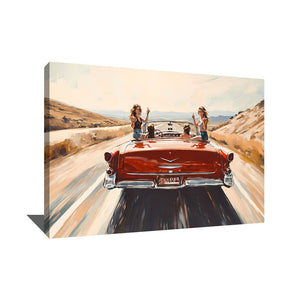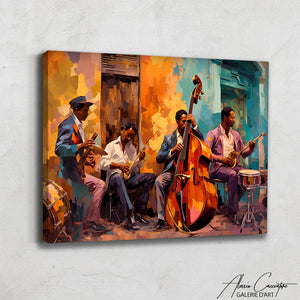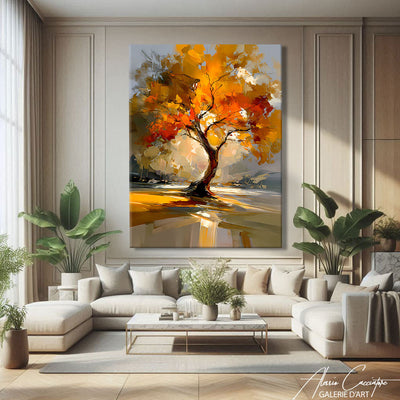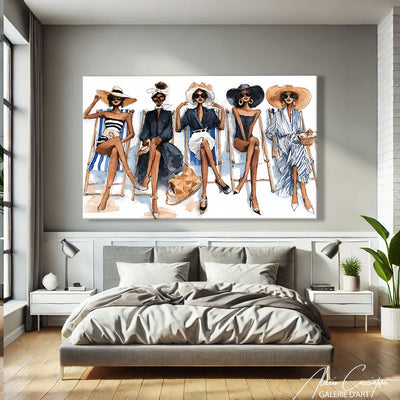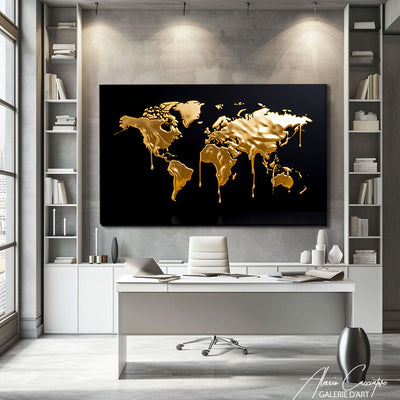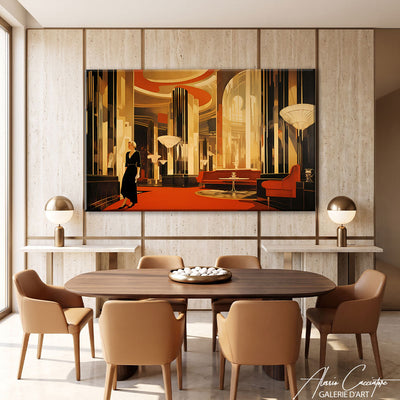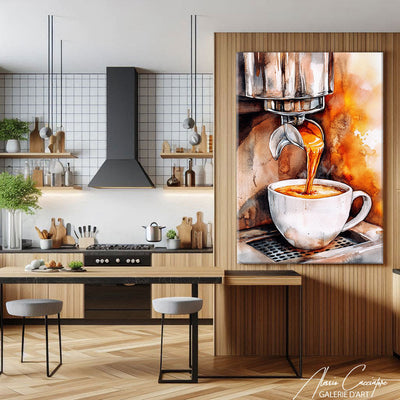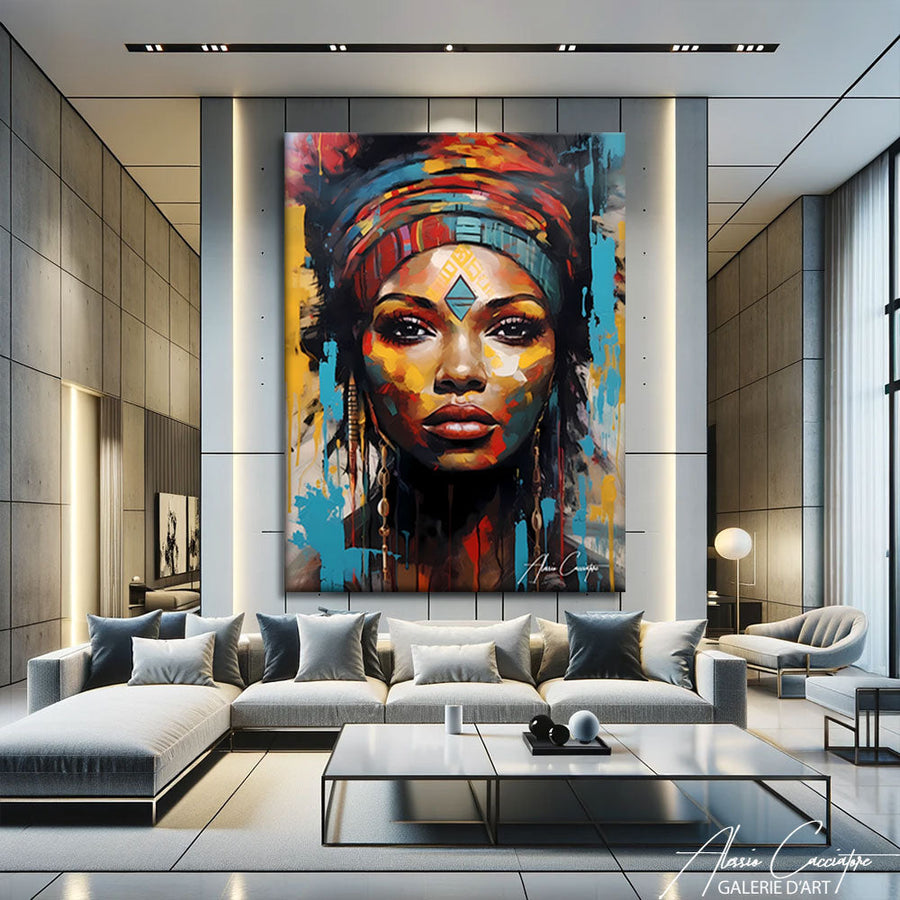

Three years ago, a client called me to return a piece of art. Not because it was ugly—on the contrary, it was magnificent. But he was no longer working. He was spending his time staring at it instead of finishing his files. That day, I understood that office art is a delicate balance: it must inspire without hypnotizing. Recent studies show that art at work boosts creativity by 15% and reduces stress, but you still need to choose the right piece for the right space.
Why office art is more than just decoration
Frankly, for a long time, I thought putting a painting in an office was just for aesthetics. A way to fill a blank wall.
Then I started getting feedback from clients—entrepreneurs, lawyers, architects. They all told me the same thing: their workspace had changed. Not just visually. Mentally.
The neurological impact of art on concentration
A 2014 study by the University of Exeter showed that employees working in offices with art were 15% more productive than those in empty spaces. The brain reacts to visual stimulation: too little, it shuts down; too much, it gets overwhelmed.
Professional office art plays on this boundary. It activates the brain's reward centers without monopolizing attention. That's why in my studio, I always have an abstract piece facing me—it accompanies me without speaking to me.
What art changes in your relationship with work
- Spatial anchoring: your brain associates this space with creativity
- Visual micro-breaks: looking at a piece for 10 seconds resets attention
- Identity signal: the painting reflects who you are, not the company
There's no denying it, an empty wall is anxiety-inducing. Especially when working remotely, where the line between professional and personal life becomes blurred.
Colors that stimulate (or not) productivity

The first mistake I see all the time: choosing an office painting just because it's beautiful. But beautiful for where? For what purpose?
Colors have a direct impact on your nervous system. It's not folklore, it's cognitive psychology.
Blue: a safe bet for intellectual professions
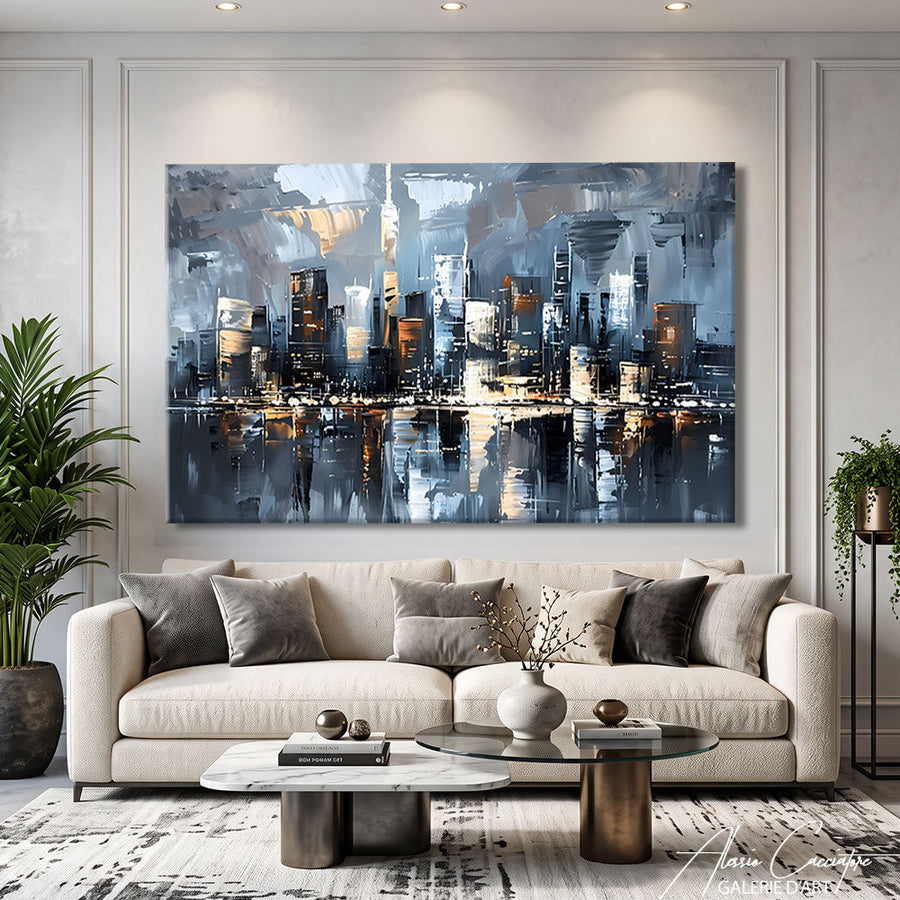
Blue reduces heart rate and promotes concentration. If you're a consultant, developer, writer—in short, if you spend 8 hours thinking—opt for works with dominant blues. Not necessarily a smooth marine sky, but compositions with deep blue, navy blue, steel blue.
In my collection, I've noticed that my blue-grey abstracts always sell first to architects.
Yellow and orange: for creatives who need a boost
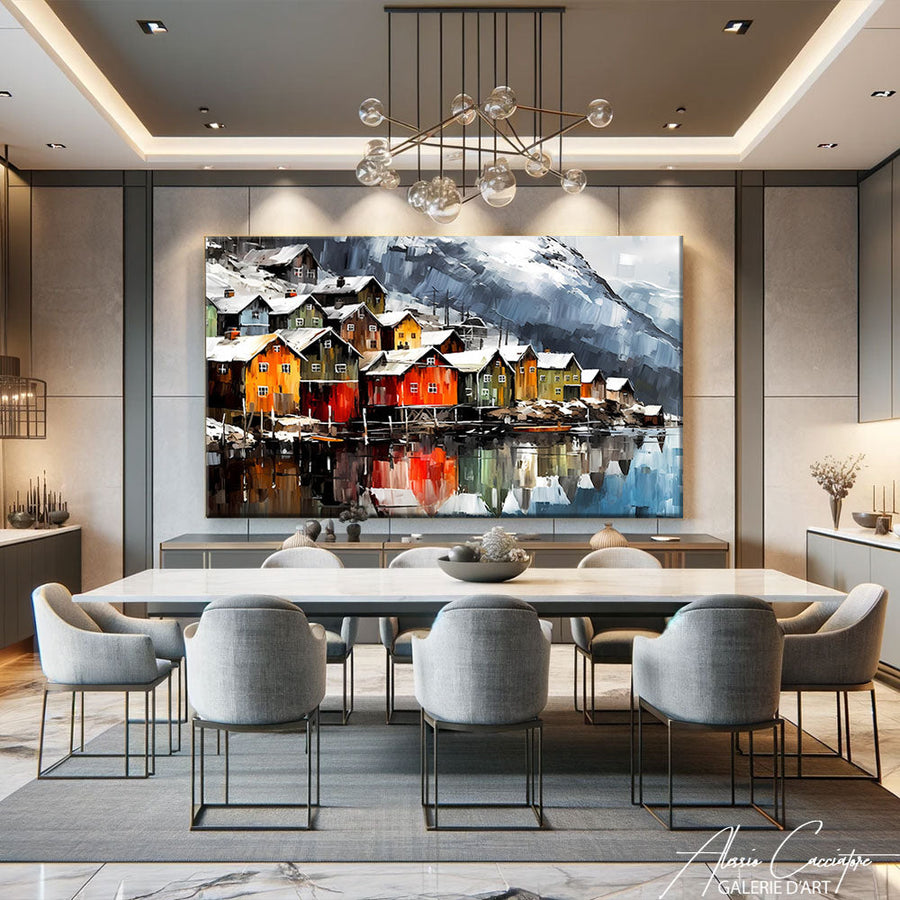
These shades stimulate dopamine. Perfect if you're a graphic designer, advertiser, or if your job requires constant innovation. But be careful: too much bright yellow can create anxiety.
A designer client bought a mustard yellow canvas with black accents from me. She put it in her home office. Six months later, she wrote to me: "I've tripled my freelance projects." Well, I'm not saying it's all thanks to the painting, but it didn't hurt.
Red: handle with caution
Red activates, but it can also be aggressive. I only recommend it if your profession requires physical energy or quick decision-making (salespeople, sports coaches). For in-depth work, avoid it.
Black and white: timeless elegance
My favorite. Black and white office art is timeless. It structures the space, it doesn't shout, it doesn't go out of style. And most importantly, it leaves your brain alone. It's my personal choice in my Parisian studio: a large black and white piece above my workbench.
What size painting to choose based on your workspace
A painting that's too small looks cheap. A painting that's too big overwhelms. The two-thirds rule is your friend.
Individual office (10-15 m²)
Ideal size: 60×80 cm to 80×100 cm. You want the artwork to occupy approximately two-thirds of the width of the wall facing your desk. No more. If you have a screen, the painting should not be in your direct line of sight, but slightly to the side or behind the screen.
I have a notary client who put an 80×120 cm piece just above his visitor's chair. Result: people are more relaxed during appointments. The artwork creates an atmosphere, without them even realizing it.
Open plan office or shared desk
Here, it's more delicate. You don't want to impose your tastes on colleagues. Opt for consensual works: soft abstracts, stylized landscapes, geometry. Avoid overly narrative figurative art or political messages.
Recommended size: 50×70 cm maximum, unless it's on a common wall far from workstations.
Home office
You're at home, you do what you want. But if you're often on video calls, think about what your interlocutor will see. A large format (100×120 cm) behind you gives an impression of seriousness and success. It's visual personal branding.
Be careful with a cork board if you're also aiming for an organizational space: in this case, clearly separate the artistic area (decorative painting) from the functional area (cork, planning). Otherwise, it looks messy.
Abstract or figurative: which promotes concentration?

This is THE question everyone asks me. And the answer might surprise you: it depends on your profession.
Why abstract often wins
An abstract work doesn't tell a story. Your brain doesn't try to decipher a meaning, a scene, a character. It simply receives shapes, colors, movements. It's relaxing.
If you're in an analytical profession (finance, law, IT), abstract art is your best ally. It offers visual breathing room without demanding interpretation.
In my Berlin studio, I have a series of abstract canvases I call Static Noise. They consist of black lines on a white background. They sell like hotcakes to consulting firms.
When figurative works
If your work is creative (design, architecture, fashion), a figurative piece can nourish your imagination. A stylized portrait, an urban scene, a dreamlike landscape—all of this can become a source of inspiration.
But there's a rule: no complex narrative. A face, yes. A knight's battle with 12 characters, no. Too many details = distraction.
Last year, I sold a minimalist female silhouette painting to an interior designer. She told me: "I look at it when I'm looking for an idea. It gives me direction without imposing a style on me."
The trap of the classic landscape
Landscapes soothe. But they can also make you sleepy. If you tend to procrastinate, a Tuscan sunset above your desk is the worst idea in the world. You'll daydream instead of working.
Prefer urban, graphic landscapes with contrast. New York in black and white works. A lavender field, much less so.
Office wall decor: beyond the single painting
A single painting is good. But sometimes, an office wall needs more rhythm.
The triptych: structure and elegance
If you have a large wall (3-4 meters), a triptych creates dynamism without being overwhelming. Three canvases of the same height, spaced 5-10 cm apart, guide the eye horizontally. It's modern, it's professional.
I've designed several triptychs specifically for offices: black-white-grey abstracts that respond to each other without repeating. The goal: to give an impression of movement, but fluid.
The gallery wall: for strong personalities
Are you an entrepreneur, a freelancer, do you receive clients at home? A gallery wall (5-8 mixed small formats) tells your story. Be careful: it requires consistency. Same color palette, or same theme, or same frame style.
Frankly, it's a composition exercise. If you're hesitant, stick to one or two large formats. A failed gallery is worse than an empty wall.
The modular option: interchangeable works
Some of my clients like to change artwork according to the seasons or their mood. In this case, opt for standard formats (50×70, 60×80) with interchangeable frames. You can even rent artworks if you're in France—several platforms exist.
As for me, I change the artwork in my office every 6 months. It's like redecorating without moving.
Where to place the painting: mistakes to absolutely avoid

Position > artwork. I've seen it a hundred times: a magnificent painting poorly placed becomes invisible or bothersome.
Mistake #1: behind the computer screen
If the painting is directly behind your screen, you'll never see it. It's a waste. Put it on the side wall or facing you (if you don't have a wall-mounted screen).
Mistake #2: too high
The universal rule: the center of the painting should be at eye level, about 1.60 m from the floor. Not on the ceiling. I've seen offices where the artwork was hung at 2 meters. Why? A mystery.
Mistake #3: facing a bright window
If you hang a painting facing a very bright window, you'll have constant reflections. Opt for a wall perpendicular to the natural light source.
The right position according to your setup
- Desk against a wall: painting above the desk or on the left side wall (if you're right-handed, your gaze will naturally go to the left during breaks)
- Desk in the center of the room: painting on the wall facing you, but not in your direct line of sight when working on a screen
- Desk under a window: painting on the opposite wall, which you'll see when you turn around
In my Parisian studio, I have my desk (yes, I have a desk integrated into a piece of furniture with a large vertical panel) facing the window. The artwork is on the wall to my right. Result: I look up, I see the artwork, I breathe, I dive back in.
Realistic budget: how much to invest in office art?
Let's talk cash. Because yes, art has a cost, but that doesn't mean breaking the bank.
Reproduction or original: the real debate
An artist's reproduction (giclée, screen print) costs between €80 and €300. An original starts at €400 and can go up to several thousand.
My strong opinion: if you're starting your business, if you receive clients, invest in an original. Even a small one. It shows, it feels. A reproduction is fine to start, but it doesn't have the same energy.
Price range by profile
- Student / young professional: €100-300 for a medium format (50×70 cm), reproduction or young artist
- Freelancer / small business: €400-800 for an original 60×80 cm format
- Firm / company: €1000-3000 for a large format or several coordinated works
I have a lawyer client who spent €2,500 on a triptych in his office. He tells me it pays for itself in credibility: clients see that he cares about his environment.
Art rental: the flexible option
If you're not sure of your choice, or if you like change, art rental (€20-50/month) is a good option. Several platforms offer this in France. You try it out, and if you really like it, you buy it.
Personally, I find it clever for a co-working space or a temporary office.
My recommendations based on your profession
Because no, a developer and a life coach don't need the same painting.
Analytical professions (finance, law, engineering)
Recommended style: geometric abstract, black and white, navy blue
Size: 60×80 cm to 80×100 cm
Example: clean lines, minimalist shapes, symmetrical composition
These professions demand rigor. The artwork should reflect that: structure, clarity, sobriety.
Creative professions (design, advertising, architecture)
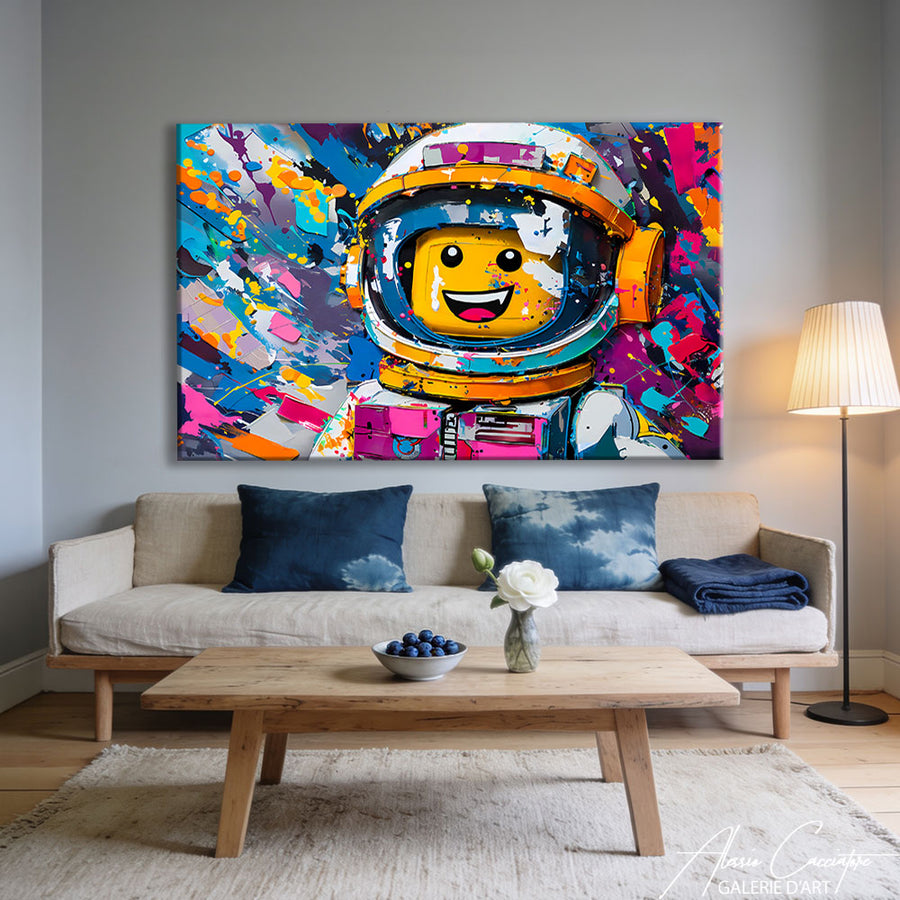
Recommended style: colorful abstract, pop art, stylized street art
Size: 80×100 cm to 120×150 cm (dare to go big)
Example: vibrant colors, organic shapes, dynamic compositions
Here, the artwork can be a manifesto. It shows that you're not afraid to take risks.
Consulting and coaching professions
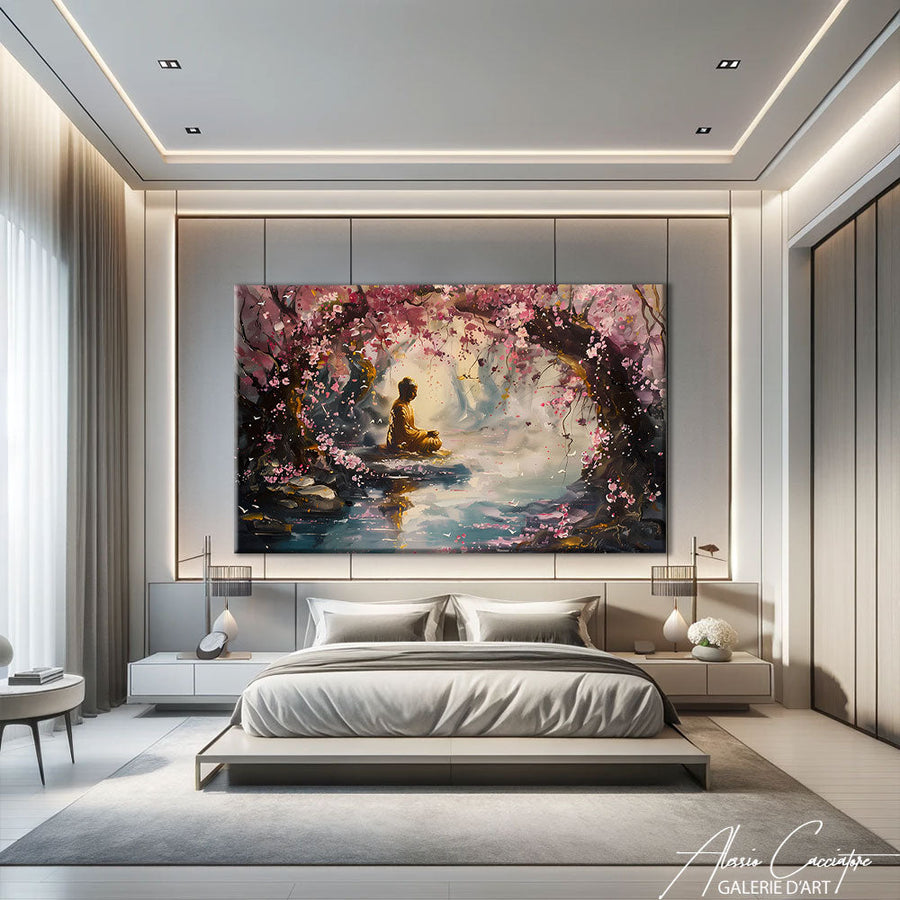
Recommended style: soft figurative, soothing abstract, stylized landscape
Size: 70×90 cm
Example: expressive faces, contemplative scenes, warm colors
You receive people seeking solutions. The artwork should reassure, inspire confidence, open perspectives.
Medical and paramedical professions
Recommended style: soft abstract, soothing landscape, dominant blue/green
Size: 50×70 cm (discreet)
Example: fluid shapes, zen compositions
No red, no visual aggression. The goal: to relax the patient.
Entrepreneurs and executives
Recommended style: whatever you want, but owned
Size: large (100×120 cm minimum)
Example: the artwork should say something about you
This is your office, this is your company. Art here is an extension of your vision. Don't seek consensus, be yourself.
Frequently asked questions
What size painting for a 12 m² office?
For a 12 m² office, opt for a size between 60×80 cm and 80×100 cm. The artwork should occupy approximately two-thirds of the width of the main wall, without overwhelming the space. If you have several walls available, you can also opt for two medium formats (50×70 cm) rather than one large one.
Is an abstract or figurative painting better for concentration?
Abstract art generally promotes better concentration, as it doesn't require the brain to decode a story or a scene. If your profession is analytical (finance, law, IT), go for abstract. If you're in a creative field, a minimalist figurative piece can nourish your inspiration without distracting.
Where to hang a painting in an office with a computer screen?
Never place the painting directly behind your screen: you won't see it. Opt for a side wall (to the left if you're right-handed) or the wall facing you, slightly offset from your direct field of vision. The painting should be visible during your micro-breaks, not while you're staring at the screen.
What's a realistic budget for quality office art?
Expect to pay between €100 and €300 for a quality reproduction, and from €400 for an original by an emerging artist. If you receive clients in your office, investing €800 to €1500 in an original piece is relevant: it projects an image of seriousness and success.
Do the colors of a painting really influence productivity?
Yes, it's proven by several studies in cognitive psychology. Blue promotes concentration and reduces stress, yellow stimulates creativity, red activates but can cause anxiety. For an office, prefer dominant blues, greys or blacks if you're looking for concentration, and mustard yellow or orange if you need a creative boost.
Can you mix several paintings in the same office?
Yes, but with consistency. A triptych (three canvases of the same height) structures a large wall well. A gallery wall (5-8 small formats) can work if you maintain unity: same color palette, same theme, or same frame style. Otherwise, a single well-chosen large format is better than a messy accumulation.
All works mentioned in this article are available in the gallery. Free worldwide shipping, 30-day money-back guarantee.