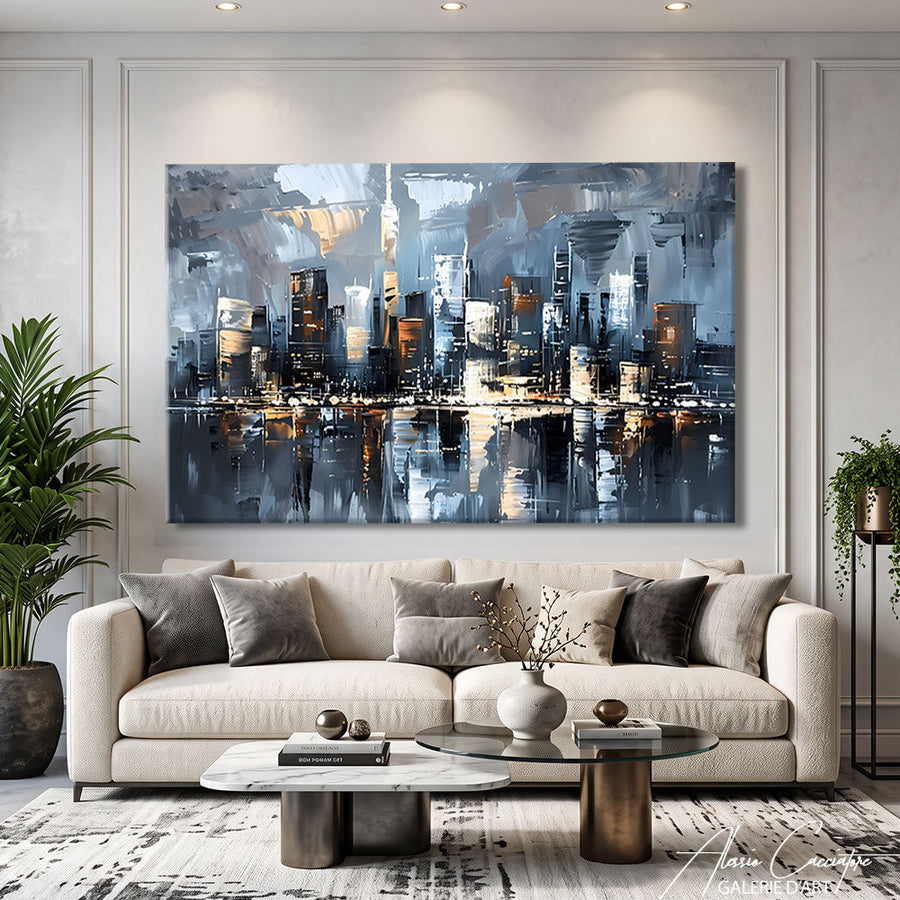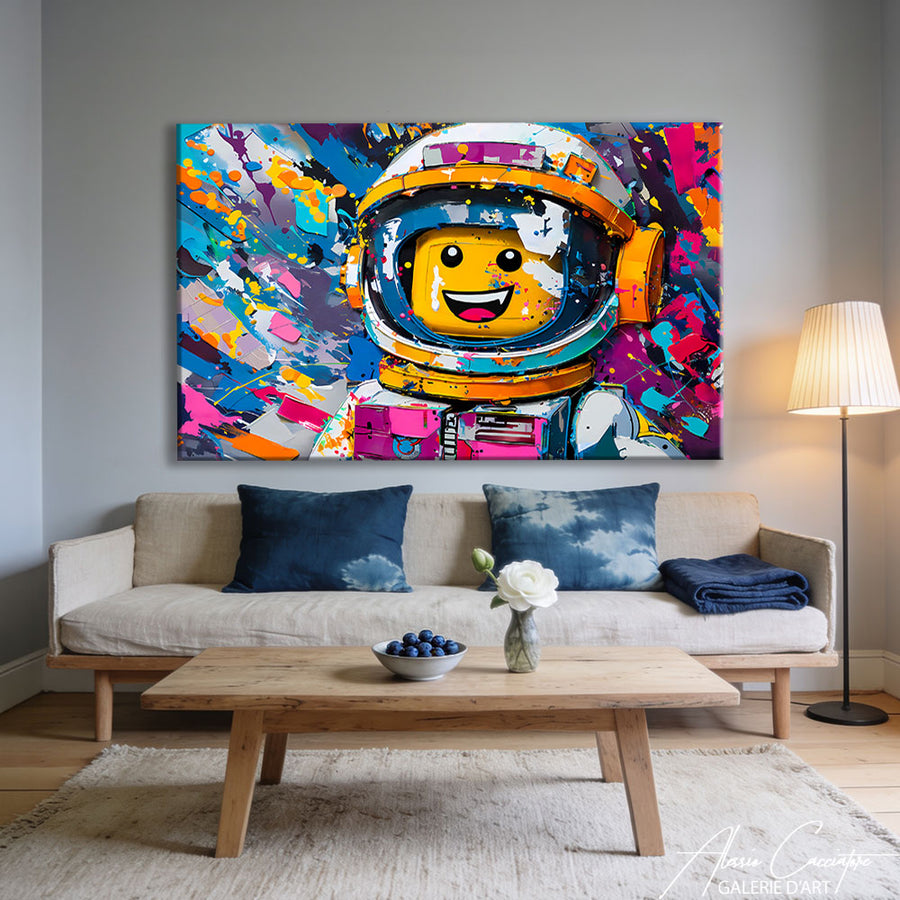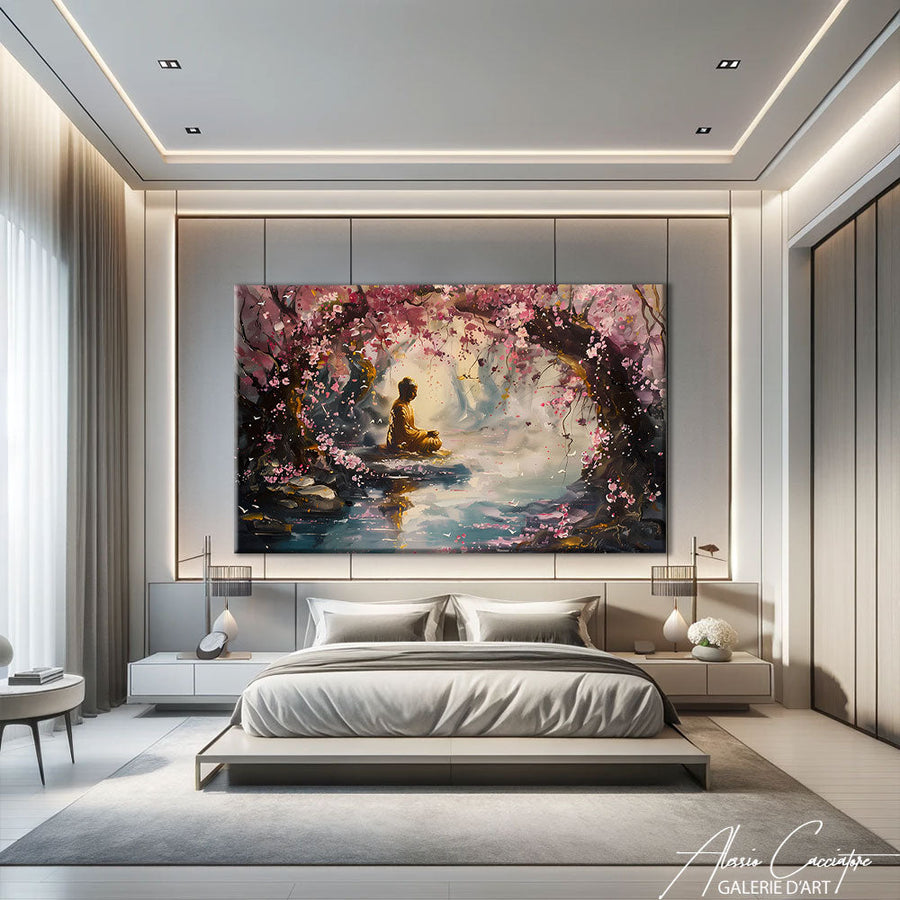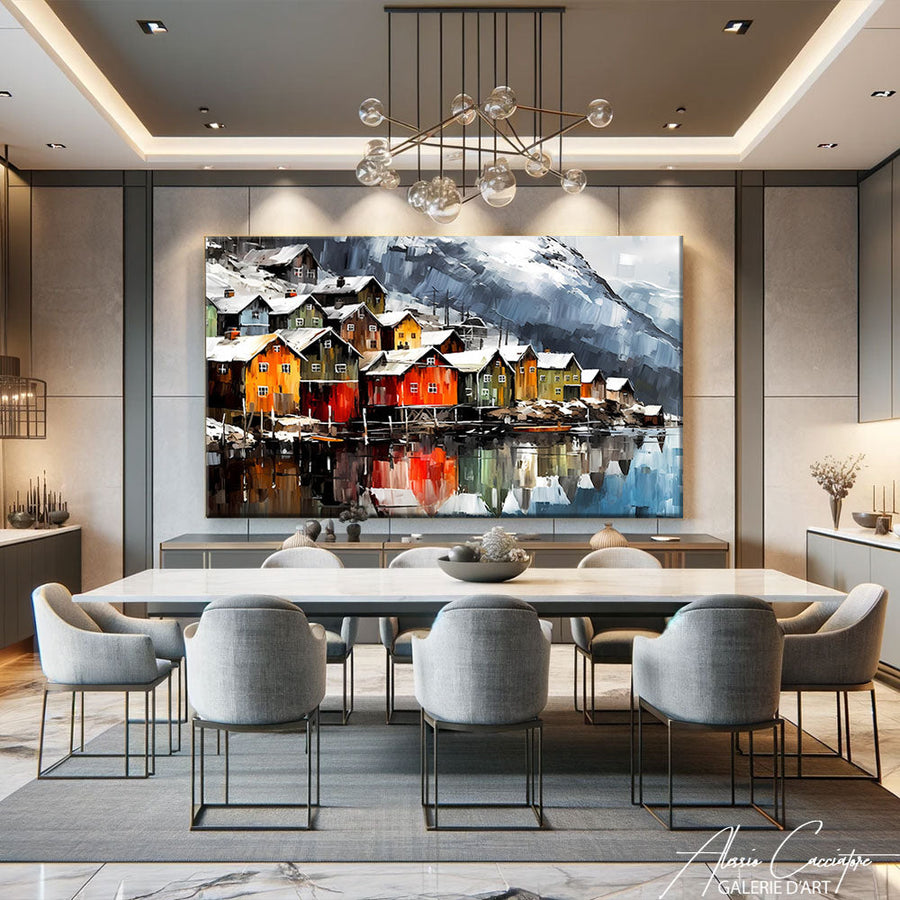

Last year, a client brought me a photo of her grandfather in front of his carpentry workshop, taken in the 1950s. Huge grain, faded colors, torn edges. She wanted to hang it in her living room, 120x80 cm. Frankly, I hesitated. But once printed on canvas with the right settings, this photo became one of the most moving pieces I've seen in a home. Because a photo print on canvas, when done well, isn't just an enlarged print — it's an intention, a deliberate artistic choice.
Why canvas changes everything (and not classic photo paper)
Photo paper, even museum quality, is still paper. It shines under light, catches reflections, and ages quickly if you hang it facing a window.
Canvas, on the other hand, absorbs light differently. No parasitic reflections. A physical texture that gives body to the image — exactly like my own paintings in the studio. When you walk past it, you feel the material.
And then there's this strange thing: a photo on canvas mentally becomes an "artwork," not just "an enlarged photo." Guests stop in front of it. They ask where you found it. It occupies a different status in the space.
The three real technical differences
- Durability: a canvas stretched on a wooden frame breathes, doesn't warp with humidity. Paper, even framed, remains fragile.
- Visual depth: the canvas texture gives a third dimension to the image, especially for portraits or landscapes with relief.
- Architectural integration: a frameless canvas (with printed edges) fits into a modern interior without weighing down the wall. Framed paper remains... framed.
In my opinion, if you have a photo that really matters — not a vacation selfie, but the one where your child is looking at the ocean at age three — canvas is the only medium that does it justice.
Choosing the right format: not what you think

Classic mistake: using the original photo's format. Your iPhone shoots in 3:4, so you order 60x80. Except that in your living room, between the sofa and the bookcase, you need 100x70 for it to breathe.
I recrop 80% of client photos before printing. Not to damage them — but to reveal them.
The formats that truly work in homes
Square format (50x50, 80x80, 100x100): ideal for centered compositions, tight portraits, abstractions. It works well in a series of three above a sideboard. But beware, square is demanding — if your composition is unbalanced, it will show.
Classic landscape format (80x60, 120x80, 150x100): the standard for a reason. It naturally fits the human eye, integrates above a sofa, a bed, a desk. It's my favorite format for city scenes, coastal landscapes, group photos.
Panoramic format (150x50, 180x60): spectacular, but difficult. You need a long enough wall, a truly horizontal photo (not a forced crop), and a composition that guides the eye from left to right. When it works, it's magnificent. When it fails, it looks like a stretched piece of photo.
Portrait format (60x90, 80x120): underestimated. Perfect for hallways, entrances, narrow walls between two doors. And frankly, an 80x120 cm vertical portrait in a living room imposes a different rhythm — it breaks the monotony of horizontals.
My advice: first measure the available wall space, then choose the format. Not the other way around.
The quality of your photo: let's be honest for a minute
Here's what annoys me: printing sites that let you order anything, even an Instagram photo from 2015 in 120x80. They take your money, you receive a pixelated mess, and then you think that "canvas printing isn't great."
No. It's your photo that wasn't good.
For a quality canvas print, you need a minimum of 300 DPI at the final size. What does that mean in practice?
- For 60x80 cm: file of 7087x5315 pixels minimum
- For 80x120 cm: file of 9449x14173 pixels minimum
- For 100x100 cm: file of 11811x11811 pixels minimum
Your recent iPhone photos (since iPhone 12) are about 4000x3000 pixels. So for 60x40 cm, that's fine. For 120x80, forget it.
Exceptions that still work
Sometimes, a "technically" insufficient photo yields a magnificent result. The photo of the grandfather I mentioned at the beginning? 1800 pixels wide. But the film grain, the harsh contrasts, the slight blur — all of it served the image when printed large.
If your photo is graphic (strong contrasts, simple composition, saturated colors), it tolerates low resolution better. If it is detailed (landscape with trees, crowd, complex architecture), it will be unforgiving.
My trick: I slightly blur my eyes, I zoom to 100% in Photoshop. If I see pixels, it's dead for large format. If I still see sharp details, we can go for it.
Decorative wall canvas: the three effect-killing mistakes

You can have the best print in the world, but if you place it poorly, it disappears. Or worse, it weighs down the space.
Mistake 1: Hanging too high
The golden rule: the center of the image at eye level (about 1.50 m from the floor). Not the top of the image — the center. People systematically hang things too high, as if aiming for the ceiling. Result: you have to strain your neck to see the image, it's uncomfortable, no one really looks at it.
Mistake 2: Choosing an image that clashes with the ambiance
I saw a couple hang a saturated tropical beach photo in a minimalist Scandinavian living room of gray and light wood. It screamed. The print was perfect, but the image had no business being there.
Your decorative wall canvas must dialogue with the room. Not necessarily match perfectly — but dialogue. A timeless black and white works everywhere. An explosion of colors requires a decor that can absorb it.
Mistake 3: Forgetting natural light
A canvas facing a window, even a good quality one, will fade in 3-5 years. It's physical, there's nothing you can do about it. If you absolutely insist on that location, choose a contrasting image where the loss of saturation won't be dramatic. Or use sheer curtains.
What always works
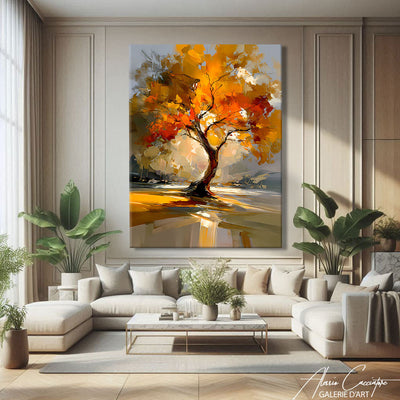
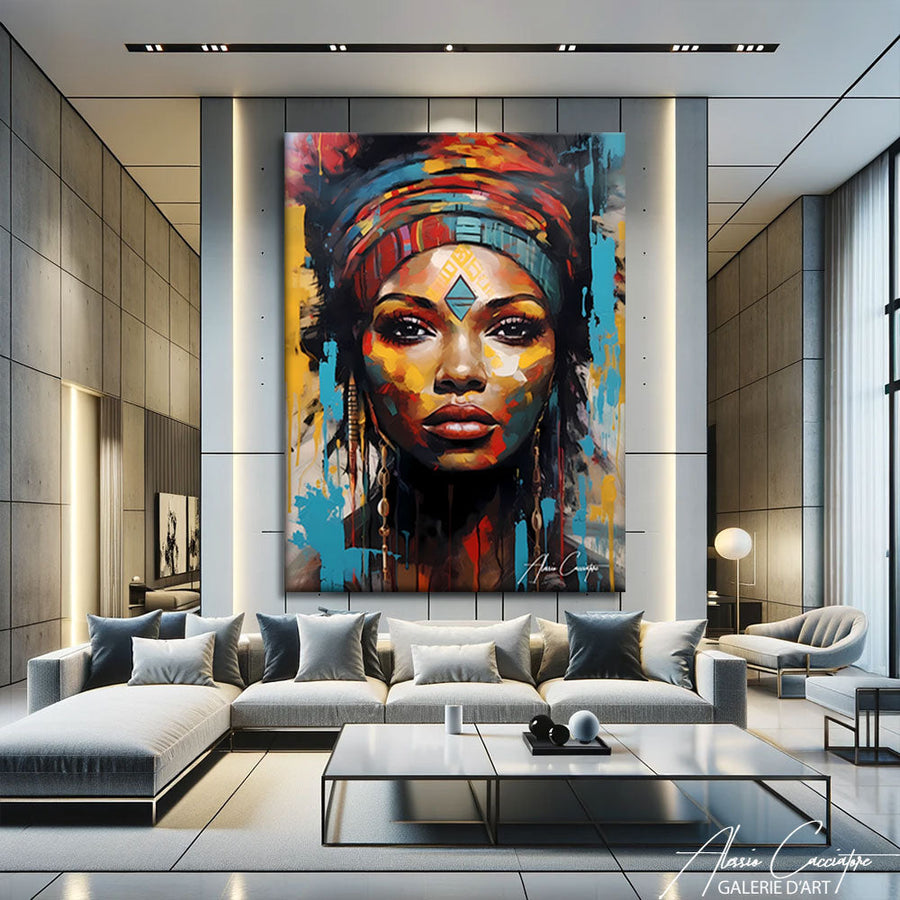
A decorative wall canvas above the sofa, 20 cm above the backrest, width between 50% and 75% of the sofa's width. This is the most visually balanced configuration, and one of my go-to choices for contemporary art in a living room. There's no denying it, it works.
Canvas print as art: when your photo becomes an artist's piece
There's a difference between "printing a photo on canvas" and "creating a canvas print as art." The latter implies artistic intent. A choice of treatment. A visual signature.
When I prepare a print for a client who truly wants a strong piece, I go through three steps:
1. Chromatic treatment (not just an Instagram filter)
I push the contrasts, desaturate certain colors, and saturate others. The idea: for the eye to feel that there was an artistic gesture. A raw photo, even a beautiful one, remains a photo. A worked photo becomes a piece.
Concrete example: a street photo in New York. I desaturate the yellows/greens (taxis, signs), I push the blues and reds. The image becomes more graphic, less documentary. It resembles my urban series.
2. Deliberate cropping
I don't necessarily keep the entire image. Sometimes, the best artwork is 60% of the original photo. I zoom in on a detail, I recenter, I cut what doesn't serve the composition.
A client had a photo of herself and her two sisters, as children, in a garden. A nice family photo. I cropped tightly on their three laughing faces, I converted to black and white with a film grain. It was no longer a family photo — it was a timeless childhood portrait.
3. Thick stretcher bar (4 cm minimum)
If you want an "artwork" effect, choose a stretcher bar that is at least 4 cm thick. This gives volume, a physical presence. A canvas on a thin stretcher bar (2 cm) remains a print. A canvas on a thick stretcher bar is an architectural piece.
Frankly, that €15 difference changes everything.
Series of canvas prints: composing a wall

A single canvas is good. Three canvases that interact with each other are an installation.
I love composed walls — but they are difficult to get right. Here's how I proceed when a client wants several canvas prints in the same space.
Option 1: Classic triptych
Three canvases of the same format (e.g., 60x80 each), spaced 5-10 cm apart. The image can be a single photo cut into three, or three distinct but coherent photos (same palette, same light, same treatment).
What does NOT work: three random photos taken at different times. The eye looks for a link, doesn't find it, and it's uncomfortable.
Option 2: Organized multiple formats
One large central canvas (100x80) + two smaller lateral ones (50x40). Or a horizontal one (120x60) above, two squares (60x60) below. The important thing: maintain a common vertical or horizontal axis. If everything floats in all directions, it's chaos.
I always draw the plan with a pencil before hanging. I stick masking tape on the wall to visualize the placements. It takes 10 minutes, it avoids three hours of hassle and ten holes in the wrong place.
Option 3: Gallery wall (for the brave)
5 to 9 canvases, varied formats, spaced 8-12 cm apart, occupying an entire wall section. It's spectacular when done well. It's catastrophic when done wrong.
My rule: all canvases must share at least two common points (same color palette + same treatment / or same theme + same frames / etc.). Without that, it's just visual noise.
And honestly? If you're hesitating between 2 and 5 canvases, start with 2. You can always add more.
Maintenance and lifespan: what they don't tell you
A quality canvas photo print, well hung, in good conditions, lasts 20 to 30 years without flinching. But there are conditions.
Regular dusting
Once a month, a quick wipe with a duster or a dry microfiber cloth. No products, especially no Pledge or other spray that will clog the pores of the canvas. Just remove dust before it settles in.
Avoid direct humidity
No canvas in the bathroom (unless ventilation is excellent). Repeated steam will deform the wooden frame, causing the canvas to warp. I've seen canvases literally peel off the frame after two years above a bathtub.
Protect from UV rays
If your canvas is facing a south-facing window, either you use sheer curtains, or you accept that it will lose 20-30% saturation in 5 years. Modern inks are much more stable than before, but they remain sensitive to UV rays.
Repaint edges if needed
On a frameless canvas (printed edges), the edges may slightly wear over time if you handle it often. It's not serious — a touch-up with matching acrylic paint, no one will notice.
What annoys me: people who invest €200 in a beautiful print, and then let it rot in a damp corner because they didn't know. Take care of it, it will outlive you.
My process when creating a canvas for a client
Because you're on my site, you have the right to know how I work concretely.
15-minute exchange (by email or phone). I ask: which room, which specific wall, what dominant colors in the decor, what desired ambiance. Not "a beautiful canvas." But "a piece that gives character to my overly modest living room" or "something calming for my bedroom."
Selection of the source image. Either the client already has their photo, or I draw from my archives (I have 12 years of photos from Berlin, Paris, New York, Italian coast). I check the resolution, I mentally test the format.
Lightroom + Photoshop treatment. I adjust contrasts, saturation, sharpness. I recrop if necessary. I sometimes add a slight film grain to portraits to soften the digital look. Duration: 30 to 90 minutes depending on complexity.
Client validation (with visual mockup in the room if possible). I send them a high-resolution JPEG, they can have it printed wherever they want — but 90% order from me because I also handle hanging.
Professional printing (Epson UltraChrome pigment inks, 350g/m² canvas, 4 cm FSC-certified wooden frame). Delivery time: 7 to 10 days.
Delivery or installation. If the client is in the Paris region and it's a piece larger than 120 cm, I travel. I hang it, we adjust together, I leave when it's perfect.
Does it cost more than an automated site? Yes. Is the result incomparable? Frankly, yes it is.
Frequently Asked Questions
What is the minimum resolution for a 100x100 cm photo print on canvas?
For optimal rendering, you need a file of at least 11811x11811 pixels (approximately 140 megapixels). Below 7000x7000 pixels, you risk seeing pixels or an unsightly blur. If your photo is slightly below but the composition is graphic (strong contrasts, few fine details), it might still work — but it's borderline.
How long does a printed canvas hung in direct sunlight last?
With quality pigment inks, count about 5 to 8 years before visible discoloration if the canvas is exposed south-facing without protection. With sheer curtains or by avoiding direct exposure, you can easily get 20-30 years. UV rays are the main enemy of canvas prints, much more so than humidity or heat.
Can an Instagram photo be printed on canvas in large format?
Technically yes, practically it's rarely a good idea. Instagram photos are often compressed and rarely exceed 1080x1080 pixels. For small formats (30x30, 40x40 cm), it might pass. Beyond that, you will see compression artifacts and pixelation. If you absolutely want this image, limit yourself to a maximum of 50x50 cm.
Is it better to choose a 2 cm or 4 cm thick stretcher bar?
The 4 cm gives much more presence and an "artist's painting" effect. The 2 cm remains more discreet, visually lighter. For a decorative wall canvas larger than 80 cm, I always recommend the 4 cm — it really changes the perception of the piece. For small formats (40x50 cm), the 2 cm is amply sufficient.
Should a canvas print be varnished after reception?
No, modern professional prints do not need varnish. Varnish was necessary 15 years ago when inks were unstable, but today it is unnecessary — and it can even alter colors or create unwanted reflections. Simply dust regularly with a dry cloth.
Can several photos be transformed into a single large panoramic print?
Yes, provided the photos were taken with sufficient overlap and identical lighting conditions. I do this regularly for urban panoramas or coastal landscapes. But be careful: if the photos are taken at different times (changing light), the seams will be visible. In this case, it's better to have a composition of several distinct canvases rather than a forced assembly.
All works mentioned in this article are available in the gallery. Worldwide shipping offered, satisfied or refunded within 30 days.