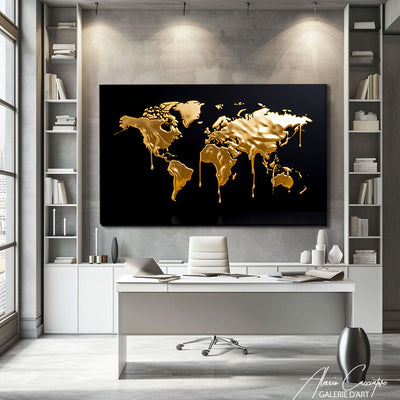

I sold my first world map three years ago to a couple who had visited 47 countries together. They wanted something that didn't look like the school maps you find everywhere. Since then, I've created dozens – some minimalist, others saturated with color – and I've realized one thing: a world map on the wall is never just decoration. It's a statement. A way of saying "the world is vast, and I intend to see as much of it as possible." In this workshop between Paris and Berlin, I've seen travelers from all walks of life come through, and their expectations are always the same: they want a piece that inspires them every morning, that reminds them where they come from and, above all, where they're going.
Why a world map radically changes an interior
A wall world map is like an open window to elsewhere. I've always found it fascinating to see how my clients react when they hang theirs: their living room immediately becomes less ordinary.
Where an abstract painting brings color or a diffuse emotion, a world map brings meaning. It structures the space, creates a massive focal point, and above all, it tells something about you. In my workshop, I have a vintage map with all the cities where I've exhibited marked with a golden felt-tip pen. Every visitor asks me questions about it. That's the magic: it becomes a conversation piece, not just something on the wall.
And then there's the practical aspect we often forget: a world map visually occupies a lot of space without cluttering. A large format fills an empty wall without the need for multiple frames. A single element, maximum impact.
Honestly, if you've traveled – or dream of doing so – and your main wall is still blank, you're missing out on something.
Different styles of world maps (and how to choose yours)

The vintage map, for nostalgics
Sepia tones, retro typography, borders from another century. This style always works very well in classic interiors, libraries, notary offices. But be careful: it can quickly turn kitsch if the framing is cheap. I've seen magnificent vintage maps massacred by an overly shiny gold frame bought at a big box store.
My advice: if you opt for vintage, go all the way. Thick paper, assertive brown tones, raw wooden frame or matte black metal. No half measures.
The modern minimalist map
This is my favorite style, and the one I use most in my own creations. Clean lines, black and white or monochrome palette, sober typography. It fits into any contemporary interior: industrial loft, Scandinavian apartment, designer office.
What often annoys me with the minimalist maps found online is that they lack character. Too smooth, too neutral. A good minimalist map must have a graphic tension: a bold cartographic projection choice, a textural grain, a variation of gray that creates depth.
The colorful and pop map
Bright red, electric blue, sunny yellow. These maps are perfect for eclectic interiors, children's bedrooms (or adults who embrace their playful side), co-working spaces. They bring immediate energy.
The trap: falling into "too much." I've seen maps with fifteen different colors that gave me a headache. Here again, even in pop, there must be coherence. Three or four colors maximum, and tones that interact with each other.
The topographical relief map
Less common, but spectacular when well done. You see mountains, ocean trenches, the real relief of the planet. It's technical, it's beautiful, and it's immensely popular with geography or nature lovers.
If you choose this style, opt for large formats. In small sizes, the relief is not visible enough and the effect is lost.
What size for which room?
The question everyone asks me: "What size should I get?" And my answer is always the same: bigger than you imagine.
A 60x90 cm format might seem imposing on your computer screen, but once on the wall in a 25 m² living room, it looks tiny. I've seen so many disappointed clients because they underestimated the scale.
For a living room or dining room, aim for at least 100x150 cm, ideally 120x180 cm or more. The goal is for the map to occupy at least 60-70% of the main wall's width. Below that, it floats in space and the effect is lost.
For an office, you can go down to 80x120 cm if the space is small, but again, don't be shy. A world map in an office is a statement. It must assert something.
In a bedroom, especially behind the headboard, a wide horizontal format (e.g., 150x100 cm) works very well. It visually structures the sleeping area without overwhelming the room.
And for a hallway? Vertical or panoramic horizontal format, depending on the configuration. Hallways are often underutilized in decor, yet they offer entire walls to dress up.
Mistakes I see all the time (and how to avoid them)
 Mistake #1: Buying too small. I've already mentioned it, but it's so common that I'm bringing it up again. Measure your wall. Visualize with masking tape. Don't rely on e-commerce site photos.
Mistake #2: Choosing a style that doesn't match the rest. An ultra-busy vintage map in a minimalist Scandinavian interior doesn't work. Or you have to embrace the total clash and make it a real statement piece. But often, it's just off-kilter.
Mistake #3: Neglecting the framing or the support. A beautiful map printed on cheap paper or poorly stretched on a frame is a waste. Invest in quality support: canvas mounted on a wooden frame, print on aluminum dibond, or frame with anti-reflective glass if you like classic framing.
Mistake #4: Placing the map incorrectly. Too high, too low, off-center. Basic rule: the center of the artwork should be at eye level, approximately 150-160 cm from the floor. If you hang it above a sofa, leave 15-20 cm between the backrest and the bottom of the map.
Mistake #5: Forgetting about lighting. An unlit world map is like a painting you can't see. Two adjustable spotlights or a discreet LED strip change everything. It sculpts the reliefs, reveals details, and above all, it creates an ambiance in the evening.
Personalizing your map: pins, markers, and other ideas
A wall world map truly becomes yours when you personalize it. In my workshop, I always encourage clients to interact with their map. It's not a static object.
Colored pins are the classic choice. Red for countries visited, blue for those on your list, green for cities where you have family. It works, it's tactile, and it evolves with you. The only downside: you need a map on a thick enough support (cork or rigid foam) for the pins to hold.
Repositionable stickers are a less invasive alternative. You can mark, move, erase. Perfect if you're a renter or if you like to change things often.
Chalk markers or dry-erase markers on a laminated or glass-covered map: great for noting dates, anecdotes, projects. I have a client who writes his children's names on each country they visit together. In fifteen years, that map will be full of memories.
And then there's the commissioned option: asking an artist (or me, if you're interested) to create a map that directly incorporates your journeys, your stops, your symbols. More expensive, but absolutely unique. There's no denying, it makes all the difference.
World map: aluminum, canvas, paper… what support?

The support is what makes the difference between a print that will last ten years and one that will buckle after six months.
Canvas on wooden frame: my favorite for medium and large formats (from 80 cm). It gives a matte finish, natural texture, very museum-like. Canvas slightly absorbs light, which avoids unpleasant reflections. However, it is sensitive to humidity: avoid the bathroom.
Aluminum dibond: ultra-modern, lightweight, rigid, never deforms. Colors are vibrant, almost backlit. Perfect for contemporary interiors and pop maps. Disadvantage: if you like soft textures, it can seem a bit cold.
Framed art paper: classic and elegant, especially for vintage maps. Opt for paper of at least 200 gsm, matte or slightly textured. The framing then becomes essential: anti-reflective glass, cream or black passe-partout depending on the style.
Plexiglass or acrylic: showcase effect, maximum brilliance. Spectacular for very graphic maps in black and white. Beware of fingerprints and maintenance.
In my opinion, canvas remains the best compromise between aesthetics, durability, and price. But it really depends on your interior and your taste.
Where to buy a world map wall decoration with character
Honestly, the market is saturated with generic maps. IKEA, Maisons du Monde, Amazon… you'll find maps for €30-€40, mass-produced in thousands of copies. They do the job if you're just looking to fill a wall, but they sorely lack soul.
If you want something that stands out, look at online galleries of contemporary artists. Many of us offer limited editions or unique pieces, with genuine graphic research. On alessiocacciatore.com, for example, I create maps that blend geometric abstraction and geography, in color palettes you won't see anywhere else.
Print-on-demand platforms (Etsy, Redbubble, etc.) also offer a lot of choice, with independent creators. Be careful, however, about print quality: always ask for samples or read reviews in detail.
And if you have the budget, consider physical galleries specializing in geographical art. Yes, they exist. In Paris, London, New York, several galleries exhibit maps by artists. It's more expensive, but you leave with a collector's item.
Last option: custom order. Do you have a precise idea, a specific cartographic projection, a color palette that matches your sofa? Contact an artist directly. It's longer, more expensive, but you'll get exactly what you want.
How to care for a world map?
We never think about it, but a wall world map, especially in a large format, accumulates dust like any other surface.
On canvas: a gentle wipe with a slightly damp cloth every two months is enough. Never use aggressive chemicals; they can alter the pigments. If you have a stain, dab gently with clean water.
On aluminum or plexiglass: a window spray and a microfiber cloth will do the trick. Avoid circular motions that leave streaks; prefer vertical movements.
Framed under glass: dust the glass regularly, and check once a year that moisture has not seeped under the frame. If you see fog or stains, immediately open the frame and let it dry.
And above all: protect your map from direct sunlight. UV rays fade prints, even the highest quality ones. If your wall is very exposed, install a blind or filtering curtains.
Frequently Asked Questions
What size world map for a 3-meter wide wall?
For a 3-meter wall, aim for a map at least 180-200 cm wide. The ideal is to cover 60 to 70% of the total width to avoid the "postage stamp" effect. If you're hesitant between two sizes, always choose the larger one: clients who dared to go big never regret it.
Is a world map suitable for a minimalist interior?
Absolutely, provided you choose the right style. Opt for a monochrome map (black and white or gray tones), with clean lines, and not too many typographic details. Prioritize a modern support like aluminum dibond or stretched canvas. In a minimalist interior, the map becomes the centerpiece — and that's exactly what you need.
Can you hang a world map in a child's bedroom?
Yes, and it's even an excellent idea. Choose a colorful and playful version, with illustrations of animals or monuments if the child is young. For a teenager, a more sober or vintage map can become a real identity element. Choose a light support and solid fastening (no glass, to avoid the risk of breakage).
How to hang a large world map without drilling?
Several solutions: ultra-strong double-sided adhesive strips (Command type) support up to 5-6 kg if you use several. You can also opt for a suspended rail system (Scandinavian hanging poster type) with magnetic rods at the top and bottom. Finally, if the map is on canvas, some frames have reusable adhesive hooks.
Are scratch-off world maps worth it?
Honestly, they're a gimmick. The "scratch" effect is fun the first few times, but after a few countries, the map becomes visually unbalanced: some areas are gold, others colored, it lacks coherence. If you want to interact with your map, prefer pins or dry-erase markers; you'll get a much more harmonious result.
Does a vintage world map go with modern furniture?
It can create an interesting clash, provided you fully embrace it. In a very contemporary interior, a vintage map can become a statement piece, a bridge between past and present. But you need to take care of the framing (raw wood or black metal, no baroque gilding) and avoid multiplying retro objects around it, otherwise it will look like a junk shop.
All works mentioned in this article are available in the gallery. Free worldwide shipping, 30-day money-back guarantee.