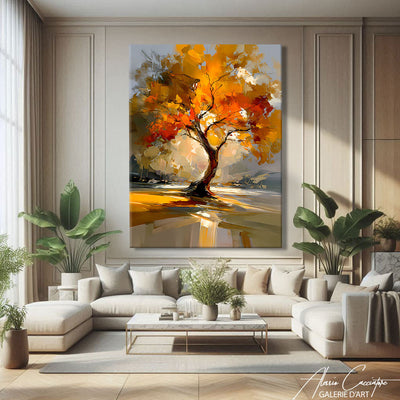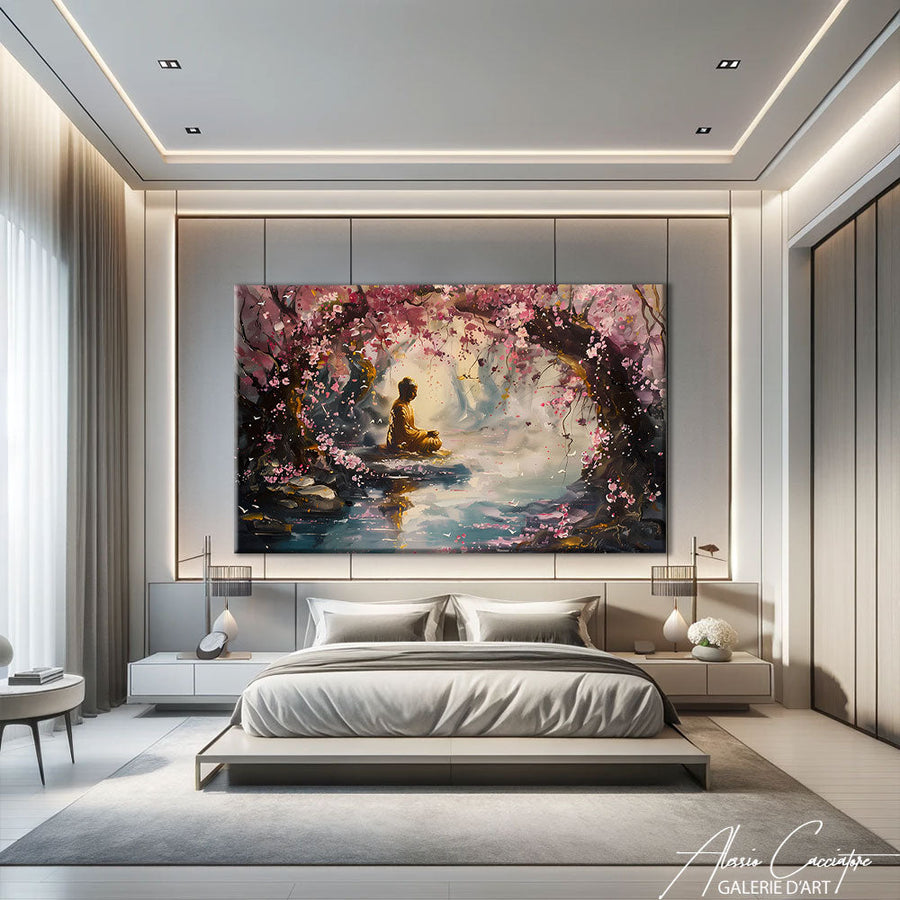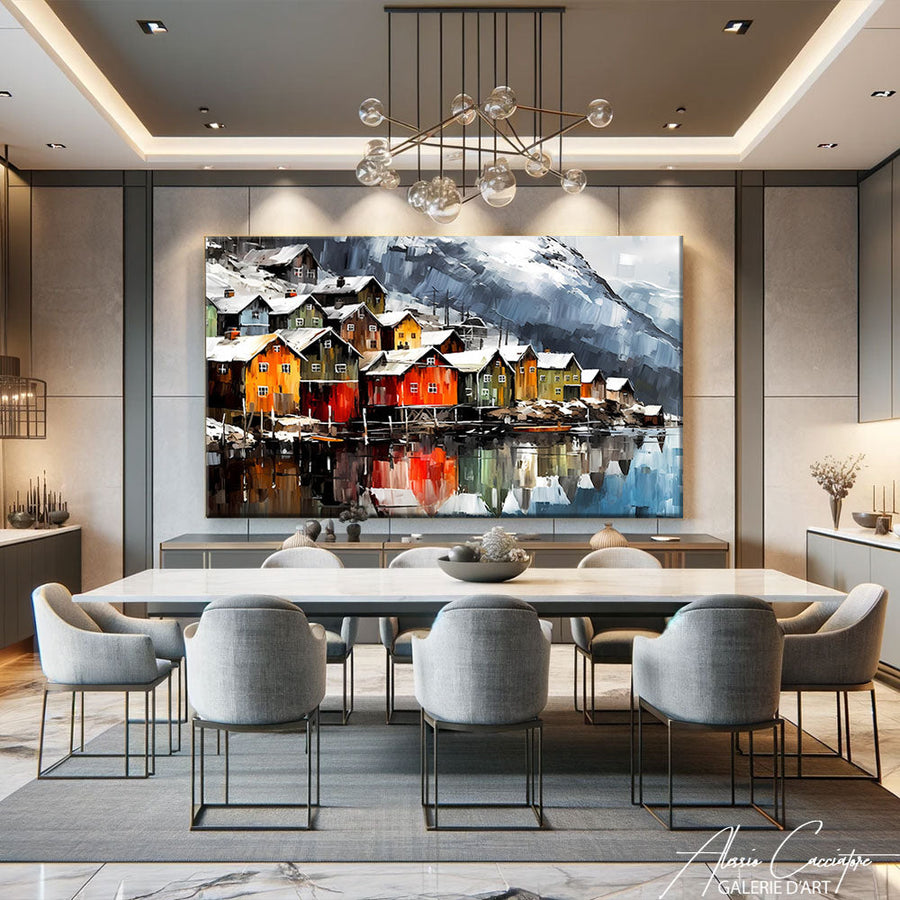

There's one thing that strikes me every time I visit an interior: the tree of life is everywhere. Minimalist Scandinavian living rooms, therapist's offices, bohemian bedrooms, contemporary entrances—this motif transcends all styles. And for good reason: it carries a universal symbolic weight that few other subjects can rival. In my studio, I've worked on this theme a good dozen times, and each version tells a different story. So why does this symbol work so well in wall decor, and more importantly, how do you choose it so that it truly speaks to your space?
Why the Tree of Life Resonates with Us (and Not Just in Decor)
The tree of life isn't just a cute decorative motif. It's a symbol that has spanned cultures for millennia: Nordic cosmic tree, Kabbalistic tree, Buddhist tree, Celtic symbol... Each civilization has reinterpreted it in its own way.
What fascinates me is that this motif spontaneously speaks to almost everyone. Even without knowing its origin.
The three symbolic pillars of the tree of life:
- Rootedness: the roots delve into the earth, symbolizing our origins, family, and grounding
- Growth: the trunk rises towards the sky, evoking our personal development and evolution
- Connection: the branches connect the earthly and the celestial, the individual and the cosmos
In my own experience, I've noticed that people who purchase a tree of life artwork are often going through a period of transition. Moving. New job. Birth. As if this symbol helps to anchor a new beginning.
This also explains why it works so well in wall decor: the tree of life isn't just aesthetic. It carries an intention. And honestly, that changes everything.
Different Styles of Tree of Life in Wall Decor
 When you type "tree of life wall decor" into Google, you'll find an ocean of options. Carved wood, forged metal, printed canvas, mandala, minimalist version... It's enough to make your head spin.
I'll simplify it for you.
The Traditional Mandala Style
This is the classic: a circular tree, with symmetrical branches and roots forming a perfect circle. Often associated with the spiritual world, yoga, and meditation. Advantage: it immediately creates a calming focal point. Disadvantage: can become "too zen" if the rest of your decor doesn't match.
The Contemporary Geometric Style
Here, the tree becomes abstract, almost architectural. Clean lines, angular shapes, a restricted palette (often black and white or metallic tones). This is the style I favor in my creations for modern spaces. It retains the symbolism but without the "esoteric shop" feel.
The Colorful Tree of Life Painting
My favorite version to create. A tree that explodes in vibrant colors, pop art or expressionist style. The branches become a pretext for gradients, contrasts, textures. Who is it for? People who want visual impact AND symbolic depth. Those who embrace color in their interior.
The Organic Bohemian Style
A "raw nature" version: a tree with irregular branches, detailed leaves, earthy tones (ochres, olive greens, browns). Integrates well into ethnic, rustic, or interiors that focus on natural materials.
Each style corresponds to a different interior energy. The question isn't "which is the most beautiful" but "which resonates with your space."
The Tree of Life in My Work as an Artist: Feedback
I remember the first time I was commissioned for a tree of life. It was in 2019. A client wanted to mark her divorce—not in pain, but in rebirth.
She asked me for a tree with chaotic roots and branches going in all directions. No symmetry. No perfect circle. Just messy, real life.
I worked on that painting for three weeks. Layers of paint, texture, deliberate cracks. The tree was both fractured and powerful. She cried when she received it.
This project taught me something essential: the tree of life doesn't need to be perfect to be strong. On the contrary.
Since then, I've created minimalist versions for offices, XXL multicolored versions for living rooms, triptychs for bedrooms. But I always keep this idea: the tree must be alive, not just decorative. It must have movement, texture, a real presence.
“A good tree of life in wall decor isn't just looked at. It's felt.”
That's also why I always advise against generic, cheap canvas prints. They have the motif, but they lack a soul. And in such a loaded symbol, the absence of a soul is noticeable.
How to Choose THE Right Tree of Life Artwork for Your Home
 OK. You're convinced. You want a tree of life in your home. But which one? Here's my method in 5 questions.
1. What is the role of this artwork in your room?
Main focal point or complementary element? If it's the former, go for XXL and contrast. If it's the latter, favor tones that interact with the rest.
2. What energy do you want to create?
Calm → neutral tones, symmetrical composition, mandala
Dynamism → vibrant colors, fragmented shapes, pop style
Elegance → black and white, clean lines, large format
3. What is your current decor palette?
A colorful tree of life painting works best in an interior with light walls and a few existing splashes of color (cushions, rugs, objects). In a very neutral space, it will be THE color accent—make sure that's what you want.
4. What size for which wall?
Rule of thumb: the artwork should occupy about 2/3 of the width of the furniture below it (sofa, console, bed). For an empty wall, aim for a minimum of 60 to 80 cm wide—anything smaller will look "timid."
5. Reproduction or original artwork?
I'm an artist, so I'm biased. But frankly: if you're hanging a symbol as personal as the tree of life, a unique piece or a signed limited edition will have infinitely more presence than a generic print.
And if you have a tight budget, prefer a small original work over a large, soulless reproduction.
Where to Place a Tree of Life in Your Home (and Especially: Where NOT to Put It)
Placement is half the battle. A misplaced tree of life loses all its power.
Spots that always work:
Living room, main wall: this is the living space, a gathering place. The tree of life makes perfect sense here. Above the sofa or on an empty wall facing the entrance.
Bedroom, headboard: for grounding and serenity. I recommend soft versions, natural or pastel tones. Avoid overly bright colors that will disrupt sleep.
Office/workspace: perfect for symbolizing growth, projects, ambition. Favor a contemporary or geometric style, more professional than spiritual.
Entrance: symbolic welcome message. A tree of life here says "you are entering a grounded, vibrant space." A medium size is sufficient.
Places to avoid:
Kitchen: too much activity, too much steam, risk of devaluing the artwork
Bathroom: humidity, symbolism not aligned
Narrow hallway: you won't be able to step back enough to appreciate the whole piece
A tip I always give: place the artwork so that it is visible from your favorite spot in the room. Sofa, desk, bed. Not just "on a free wall."
Pairing the Tree of Life with Other Decor Elements Without a Faux Pas
 A tree of life is visually powerful. So you have to be careful about what you put around it.
Golden rule: avoid symbolic overload.
If you already have a tree of life in your wall decor, there's no need to add dreamcatchers, mandalas, Buddhas, and inspirational quotes everywhere. That creates a spiritual jumble. The tree is enough. Let it breathe.
What works well with it:
- Green plants: obviously. This reinforces the nature/life connection. A Monstera or a Ficus next to a tree of life is consistent.
- Raw wood furniture: a dialogue between material and symbol. Light wood for a soft version, dark wood for a dramatic version.
- Cushions and textiles in natural tones: terracotta, beige, olive green. This anchors the tree in an organic atmosphere.
- Sleek designer lighting: avoid overly elaborate lamps. The tree is already the statement piece.
What works less well:
- Cold industrial decor (raw metal, concrete, steel gray) UNLESS the tree itself is metallic or very graphic
- Too many floral patterns elsewhere — risk of visual confusion
- Additional frames around it: the tree needs its own space
If you opt for a colorful pop-style tree of life painting, you can allow for more whimsy: graphic cushions, quirky decorative objects, contemporary furniture. Color calls for color.
Tree of Life and Feng Shui: What You Need to Know (Without Falling into Cliché)
All right, let's talk about it. Because as soon as the tree of life is mentioned, someone will bring up feng shui.
And it's not illegitimate: in this discipline, the tree symbolizes growth, abundance, and the balance of energies. But beware of shortcuts.
In feng shui, the tree of life works well in the following areas:
- East: area of family, roots, health
- Southeast: area of prosperity and abundance
- Center: balance point of the house (but tricky placement in practice)
Some feng shui principles to keep in mind:
- Avoid placing a dead tree, with broken or downward-pointing branches → negative symbolism
- Favor trees with upward-growing branches and abundant foliage
- Colors play a role: green = wood/growth, red = fire/energy, gold = metal/wealth
Now, let's be clear: you don't have to follow feng shui to the letter. If your tree of life speaks to you and you place it in a "non-conforming" area, it won't ruin your life. The important thing is that the artwork nourishes you emotionally.
I have a client who put his tree of life in his garage, which he converted into a music room. Not very feng shui. But it's his creative space, his sanctuary. And it works perfectly.
The symbol should serve your well-being, not the other way around.
Maintaining and Preserving a Tree of Life Artwork: My Practical Tips
Once your tree of life is installed, you need to take care of it. Especially if it's an original artwork.
For painted canvases (acrylic, oil, mixed media):
- Avoid direct sunlight: pigments can fade over time. Prefer a wall perpendicular to a window.
- No overly tight fixings: the canvas needs to breathe. Avoid direct contact with the wall if possible (small cork shims behind).
- Gentle dusting: dry microfiber cloth, never cleaning products.
For canvas or aluminum prints:
- Less fragile but still: no prolonged direct sunlight.
- Can be cleaned with a slightly damp (not soaked) cloth.
For metal or wood wall sculptures:
- Metal can tarnish over time: wipe with a soft cloth and a special metal product once a year.
- Raw wood can develop a patina: this is normal and adds character. If you want to maintain the initial appearance, use colorless wax once every two years.
Little workshop tip: if your tree of life is varnished (original artwork), never touch it with your fingers. Sebum creates indelible marks. If you need to move it, wear thin cotton gloves.
And most importantly: hang it securely. I've seen too many artworks fall because people underestimate the weight or use cheap fixings. A good X hook or suspension bar costs €10 and saves the artwork.
Frequently Asked Questions
What size tree of life should I choose for a 20m² living room?
For a 20m² living room, opt for a format between 80 and 120 cm in width. If the tree is placed above a 3-seater sofa (approximately 200 cm), aim for 120 to 140 cm to balance visually. Too small, it will be swallowed by the space. Too large on a narrow wall, it will overwhelm the room.
Is a tree of life suitable for modern and minimalist decor?
Absolutely, provided you choose the right style. Opt for a minimalist geometric version, a restricted palette (black and white, metallic tones, or monochrome), and graphic lines. Avoid overly ornate mandala or bohemian versions that would clash with the minimalist aesthetic.
Tree of life on canvas or metal: which to choose?
Canvas if you want color, texture, a true pictorial presence. Metal if you are looking for an industrial, sculptural touch, with relief and play of shadows. Metal ages well and adds volume. Canvas offers more nuances and artistic possibilities. It's a matter of taste and decor style.
Can a tree of life be given as a housewarming gift?
It's an excellent idea. The tree of life symbolizes rootedness, growth, new beginnings—exactly what you wish for someone moving into a new home. Favor a quality artwork, not a cheap print. And if you know the person's decor tastes, adjust the style accordingly (colorful, minimalist, bohemian).
Is the tree of life a religious symbol?
No, it is a spiritual and universal symbol, present in many traditions (Celtic, Nordic, Buddhism, Kabbalah, shamanism...) but it does not belong to any specific religion. It is precisely this universality that makes it such a powerful and accessible motif in decoration. It carries a symbolic dimension without imposing a belief.
Where to buy an original colorful tree of life painting and not a copy?
Favor contemporary art galleries, artist studios, or specialized original art platforms (not general marketplaces). Check that the artwork is signed, numbered if it's a limited series, and comes with a certificate of authenticity. A true original tree of life painting costs more than a print, but it has a soul and value.
All works mentioned in this article are available in the gallery. Free worldwide shipping, 30-day money-back guarantee.