
The first time a client told me they wanted "clean street art," I nearly choked on my coffee. Clean street art is a bit like asking for acoustic punk—it exists, but you lose the essence. Yet, I understand: bringing the raw energy of a Berlin Wall or the Lower East Side into a Parisian living room isn't easy. A street art canvas is precisely that bridge between the creative chaos of the streets and the sophistication of a well-designed interior. In the fifteen years I've spent navigating between galleries and tagged walls, I've learned one thing: true street art on canvas isn't meant to be tame.
What Makes a Street Art Canvas Work (or Not)
I've seen so many "urban style" canvases that are only urban in price. A real street art canvas isn't made by adding three drips and a Mickey stencil.
What matters most is intention. The works that succeed retain that spontaneity of gesture—even when created in a studio. In my practice, I often transpose graffiti techniques: spray paint, stencils, wide markers. Not for aesthetics. But to maintain that urgency.
Texture plays a huge role. Graffiti on canvas needs relief, material, happy accidents. Unintentional splatters, controlled smudges, layered applications—all of it tells a story that the work comes from the street, even if it never was.
Visual Codes That Resonate
Stylized lettering, fractured typography, stenciled silhouettes, vertical drips—these elements are not just decorative. They carry fifty years of graffiti history, from Basquiat to the walls of São Paulo.
But be careful: a canvas that accumulates all the clichés of the genre (tag + crown + drawn spray can) often rings false. Like a guy wearing all his luxury watches at once.
Mickey, Marilyn, and Pop Icons: Why They Still Work

The Mickey street art canvas has become a genre of its own. And frankly, I understand the annoyance of some purists.
Yet, when it's done well, it works. Why? Because reappropriating a Disney icon is exactly what street art has always done: taking a symbol of the system and flipping it. A Mickey with a gun or Gucci sunglasses is Warhol who grew up in the Bronx.
I've created several pieces around these icons—not out of ease, but because they allow for immediate dialogue with the viewer. Everyone knows Mickey. No one expects to see him tagged on a brick.
Beyond the Classics
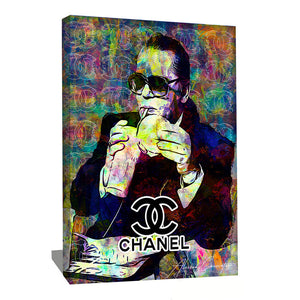
Icons that work well in street art: - Reappropriated Disney characters (Mickey, Minnie, Donald in urban versions) - Reworked brand symbols (Chanel, Louis Vuitton, Supreme) - Political or cultural figures (Che, Marilyn, Basquiat himself) - Reinterpreted superheroes (Batman, Superman in graffiti mode)
But the treatment is what matters. A simply reproduced Marilyn is a poster. A Marilyn splattered with tags, with fluorescent drips and a background of tagged bricks, is something else entirely.
Graffiti on Canvas vs. Luxury Street Art: Understanding the Nuances
There's a world of difference between graffiti on canvas and what's called luxury street art canvas. And it's not just a matter of price.
Pure graffiti retains that raw aesthetic: complex lettering, hip-hop culture codes, an artist's signature sometimes illegible to the average person. It's technical, tribal, sometimes hermetic.
Luxury street art, on the other hand, borrows visual codes from the street but refines them. Ultra-precise stencils, impeccable finishes, imposing formats, numbered limited editions. It's closer to Banksy than to Seen.
Which to Choose for Your Interior?
If you have an industrial loft, exposed concrete walls, minimalist furniture—go bold with authentic graffiti. Vibrant colors, jostling letters, overflowing energy: it will pop.
For a Haussmannian apartment, an executive office, a more classic space—luxury street art bridges the gap. Urban energy remains present, but domesticated just enough to coexist with moldings and herringbone parquet.
In my work, I navigate between the two. Some pieces are deliberately chaotic, others much more controlled. It all depends on where they will live.
Where to Place a Street Art Canvas for Maximum Impact

A poorly placed street art canvas is like wearing Louboutins with sweatpants—technically possible, but it lacks coherence.
The first rule: give it space to breathe. These works need air around them. A large street art format squeezed between two IKEA bookshelves loses all its power.
Effective Placements
In my experience (and that of my collectors), here's where street art canvases unleash their full potential:
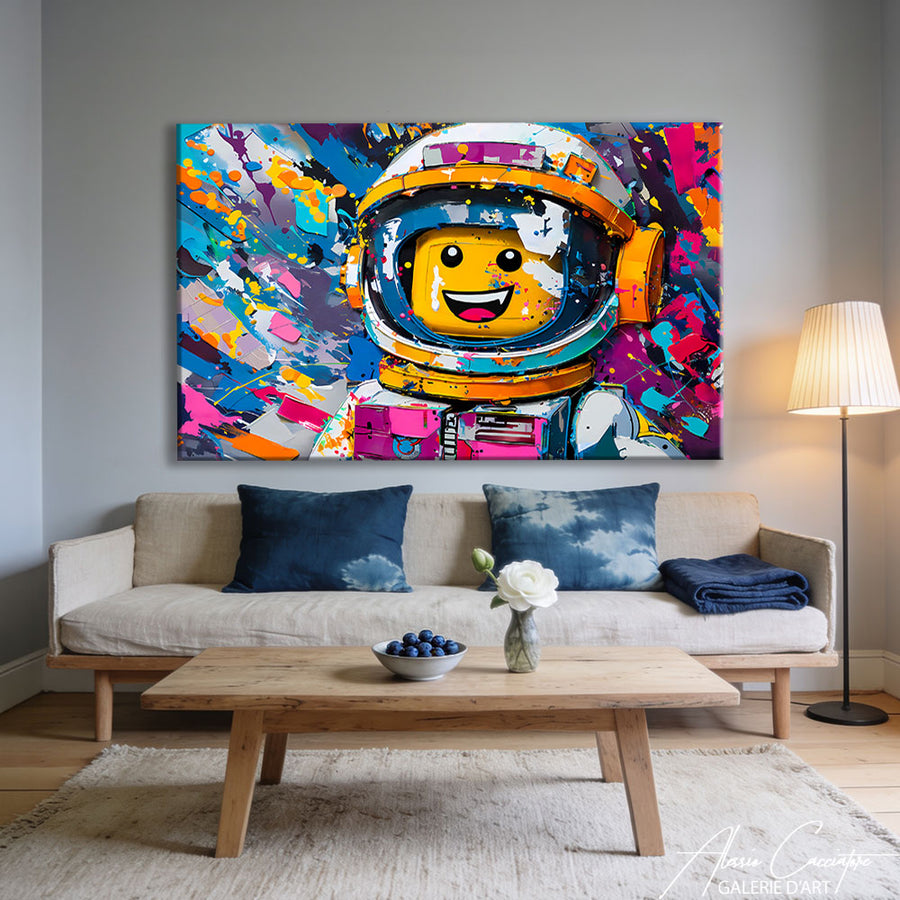
The main living room wall—facing the sofa or above it. It's the obvious spot, but there's a reason: it's where your gaze naturally falls. A large format here completely transforms the room's atmosphere.
The entryway—first contact with your world. A strong street art piece immediately sets the tone. You're not the white walls and orchids type, and it shows right from the door.
The office—especially if you work in a creative field. I've sold several works to art directors, architects, producers: they want that energy in their workspace.
The bedroom—more delicate, but it can work. Just avoid overly aggressive colors (fluorescent reds at 6 AM are harsh). Opt for blacks and whites, deep blues, more calming compositions.
What never works: hanging a street art piece in a narrow, dark hallway. It deserves better than that.
Formats and Dimensions: What Size for What Impact
Street art is meant to be seen from a distance. On a five-meter wall, a tag takes on its full dimension. On your living room wall, you have to adapt.
I have a simple rule: if your street art piece is less than 80 cm wide, it risks lacking presence. These compositions need scale to work. Details, superpositions, nuances—all of that gets lost in a small format.
Working Dimensions
For a standard living room (20-30 m²): aim for 100 × 100 cm minimum, ideally 120 × 80 cm or larger. The work must assert itself unequivocally.
For a large space (loft, open space): 150 × 100 cm or even 200 × 150 cm. Go bold. A timid street art canvas in a large volume is sad.
For an office or bedroom: 80 × 80 cm works well. Present enough to structure the space, not overwhelming.
“The format is part of the message. A 50 cm tag is more of a drawing than graffiti.”
Some of my collectors have opted for diptychs or triptychs—several canvases that respond to each other. This allows covering a large wall while maintaining some flexibility in the composition.
Color Palettes That Pop (and Those to Avoid)

Color in street art is rarely subtle. And that's a good thing.
But be careful: not all vibrant colors are created equal in an interior. What works on a Brooklyn wall can kill the ambiance of a Parisian living room.
My favorite combinations:
Black and white with splashes of color—a vivid red, an electric blue, an acidic yellow on a monochrome background. The impact of street art without the chromatic overdose. It fits almost anywhere.
Black, white, gold—luxury street art version. Metallic golds bring immediate sophistication. I often use gold leaf or metallic paints in my high-end pieces.
Urban monochromatic—concrete gray, industrial blues, touches of rust. For those who want the street spirit without the neon.
What Quickly Tires
Street art canvases all in fluorescent pink-green-yellow-orange—unless you have an already very colorful and confident interior, you will get tired of it. In six months, you'll want to hide it in the garage.
Fake aged effects ("torn" canvas, fake rust stains added to appear authentic)—it rings false. Wear must be real or absent, not simulated.
Authenticating and Choosing: Avoiding Market Traps
The street art canvas market is a bit like the Wild West. Between Aliexpress reproductions, "limited editions" printed in 5000 copies, and genuine unique pieces, it's easy to get lost.
First question to ask: is it an original work, a reproduction, or a limited edition? All three can coexist, but the price and value are radically different.
An original work is unique. Handmade. Signed on the back, numbered (1/1), sometimes accompanied by a certificate of authenticity. This is what I do: each piece is a unique creation, even if I revisit themes.
A limited edition (serigraph, giclée print) can be magnificent, but it exists in X copies. Beware of vague numbering: "limited edition 125/500" is borderline, "unnumbered limited edition" is nonsense.
Red Flags
Be cautious if: - The seller refuses to show the back of the canvas or give details about the technique - The price is abnormally low for a "unique work" by a known artist - There is no trace of the artist online (no website, no Instagram, nothing) - The description mentions "Banksy style" or "in the spirit of Basquiat"—that means it's neither
Personally, I always provide a certificate of authenticity with my works, photos of the creation process, and a signature on the back. Total transparency.
Integrating Street Art with Existing Decor
You already have a structured interior, and you want to integrate a street art canvas without it clashing? It's possible, but it requires finesse.
The key: play on controlled contrasts rather than perfect harmony. A street art canvas in an overly smooth interior is precisely the contrast that creates interest.
Some Successful Combinations
Minimalist Scandinavian furniture + black and white street art—the clash between Nordic simplicity and urban energy works very well. The clean lines of the furniture highlight the complexity of the work.
Industrial interior + colorful graffiti—a logical, almost too obvious, but effective association. Exposed bricks, metal, concrete: all naturally call for street art.
Classic Haussmannian + luxury street art—the contrast works if you stay in sophisticated tones. A gold and black street art canvas under a molding can be sublime.
What doesn't work: mixing flashy street art + an already very busy interior with colors and patterns. That becomes visual cacophony.
In my own apartment (which blends Bauhaus and street art), I've learned that you must let the work visually dominate. If you hang a powerful street art canvas, the rest should fade a little.
Investing in Street Art: What You Need to Know
Let's talk money, because it's a real question: is a street art canvas an investment or just decor?
Both, my friend. It depends on what you buy.
An industrial print bought for €200 on a decor website will never gain value. It's consumption, not investment. Nothing wrong with that, but you need to know.
An original work by an emerging artist (say between €800 and €5000) can potentially gain value—if the artist develops well, becomes known, enters collections. But it's a gamble.
Street Art Artists Who Are Valued
Banksy, of course (but we're talking hundreds of thousands of euros). JonOne, Shepard Fairey, Invader—pieces start at 5 figures minimum.
For emerging artists, look for those who: - Have a truly recognizable visual signature - Exhibit regularly (galleries, art fairs) - Have consistency in their approach - Don't ONLY do decorative street art for tourists
I myself fall into this middle zone: an established artist with fifteen years of career, international exhibitions, but not yet in Christie's auction rooms. My pieces sell between €1200 and €8000 depending on the format.
The advice I always give: buy first because the work speaks to you, the investment comes later. If in ten years it's worth nothing but you still love it, you haven't lost anything.
Frequently Asked Questions
What's the difference between street art and graffiti on canvas?
Graffiti focuses on stylized lettering, tags, and hip-hop culture codes—it's very technical and sometimes hermetic. Street art is broader: stencils, collages, pop icons, political messages. On canvas, graffiti often retains its raw aesthetic and vibrant colors, while street art can be more sophisticated and accessible. Both can coexist in the same work.
How do I know if a street art canvas is a true original work?
Check three things: the artist's handwritten signature (usually on the back), 1/1 numbering or no numbering for a unique piece, and a certificate of authenticity with a photo of the artwork. Also ask for information about the technique: a genuine piece will be made with spray cans, acrylics, stencils, markers. Beware of vague descriptions or abnormally low prices for a supposed unique work.
Is a street art canvas suitable for a classic interior?
Absolutely, and that's where the contrast is most interesting. In a Haussmannian or classic interior, opt for more sophisticated street art: black and white with touches of gold, balanced compositions, imposing but not garish formats. The clash between old moldings and contemporary urban energy creates a visual tension that adds character. Just avoid pieces that are too fluorescent or chaotic.
What's the minimum size for a street art canvas to have impact?
I recommend a minimum width of 80 cm, ideally 100 cm or more. Street art loses much of its power in small formats—details, superpositions, and textures are not easily discernible. For a standard living room, aim for 100 × 100 cm or 120 × 80 cm. For a large space like a loft, don't hesitate to go for 150 × 100 cm or even 200 × 150 cm.
Are Mickey or pop icon canvases real street art?
Yes, when they are well executed. Reworking commercial icons (Disney, luxury brands, political figures) has always been part of street art's DNA—it's pop art that grew up on the street. The important thing is the approach: a simply reproduced Mickey is a poster. A Mickey reinterpreted with tags, stencils, drips, and a subversion of the original meaning is true street art.
Can a street art canvas gain value over time?
If it's an original work by an artist who develops and becomes known, yes. But never buy solely for investment. Industrial reproductions will never gain value. For original works, look for artists with a genuine visual signature, regular exhibitions, and a consistent approach. And most importantly: buy primarily because the work speaks to you.
All works mentioned in this article are available on the gallery. Free worldwide shipping, satisfaction guaranteed or your money back within 30 days.