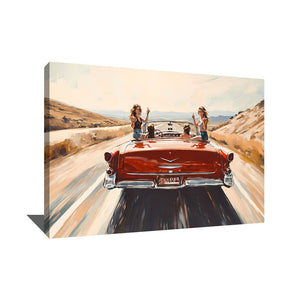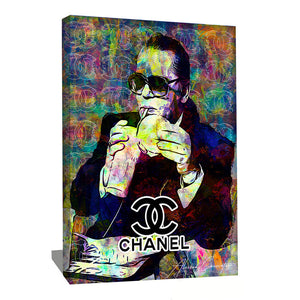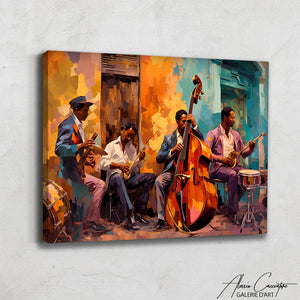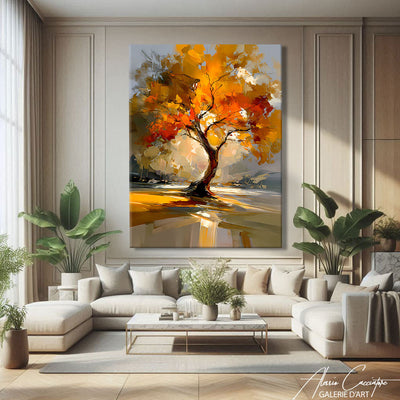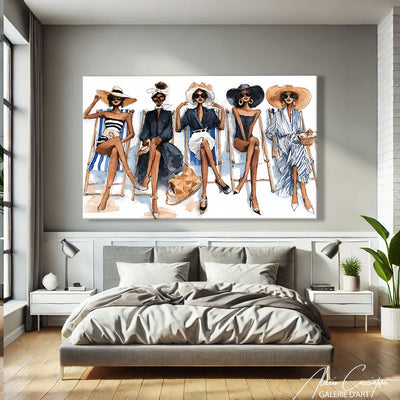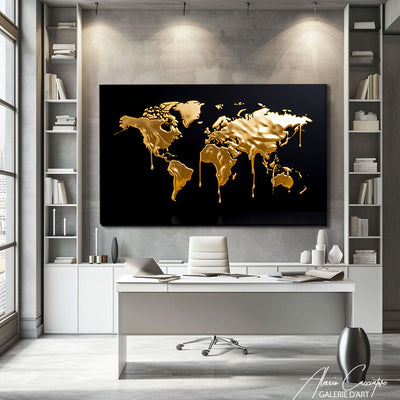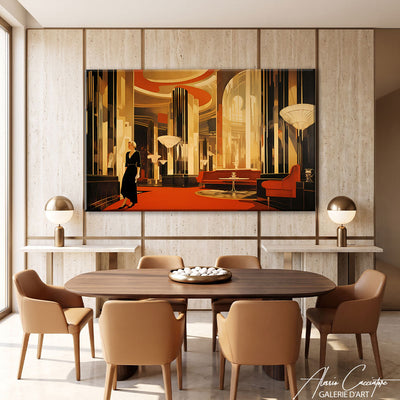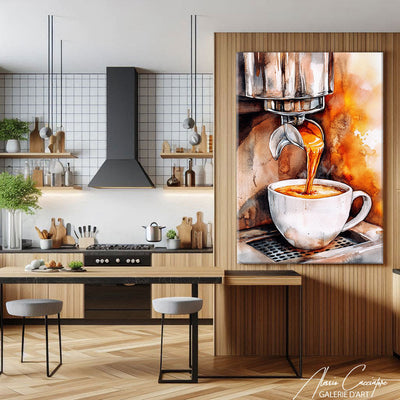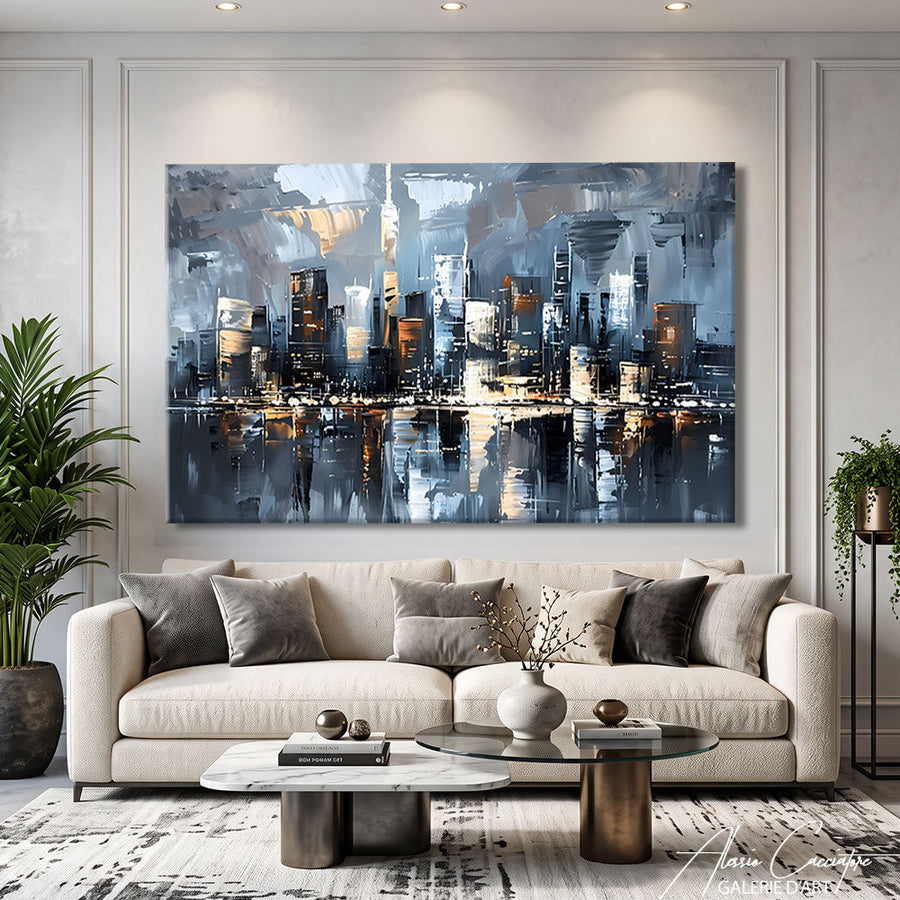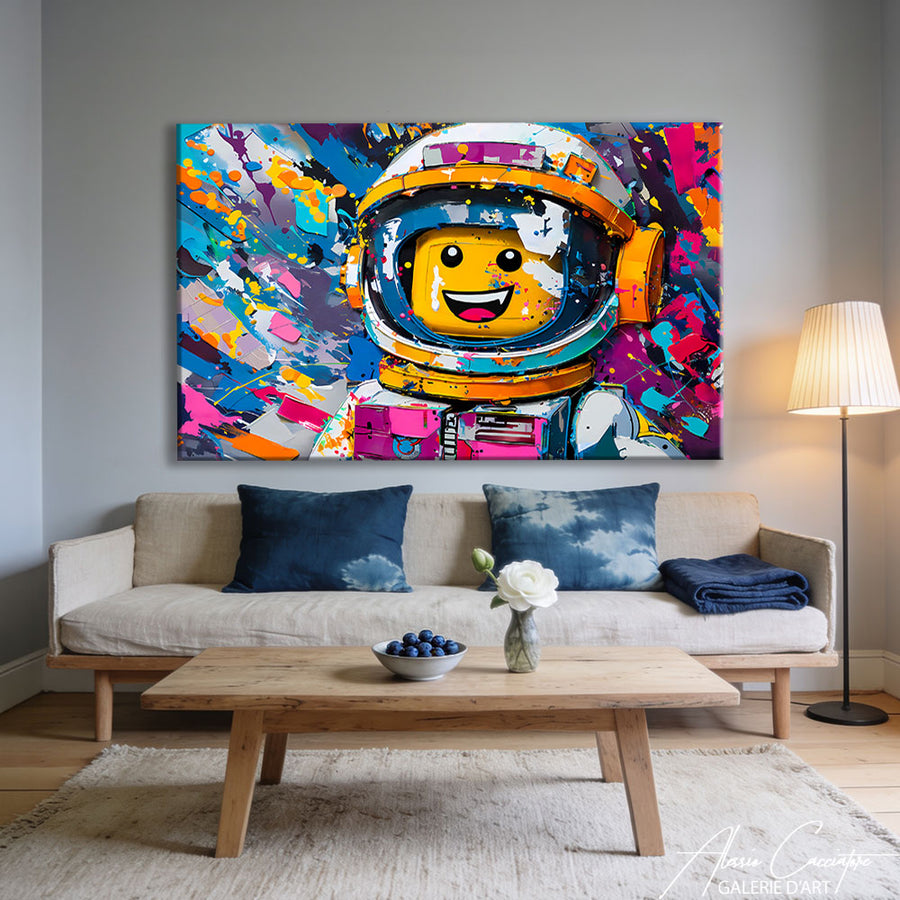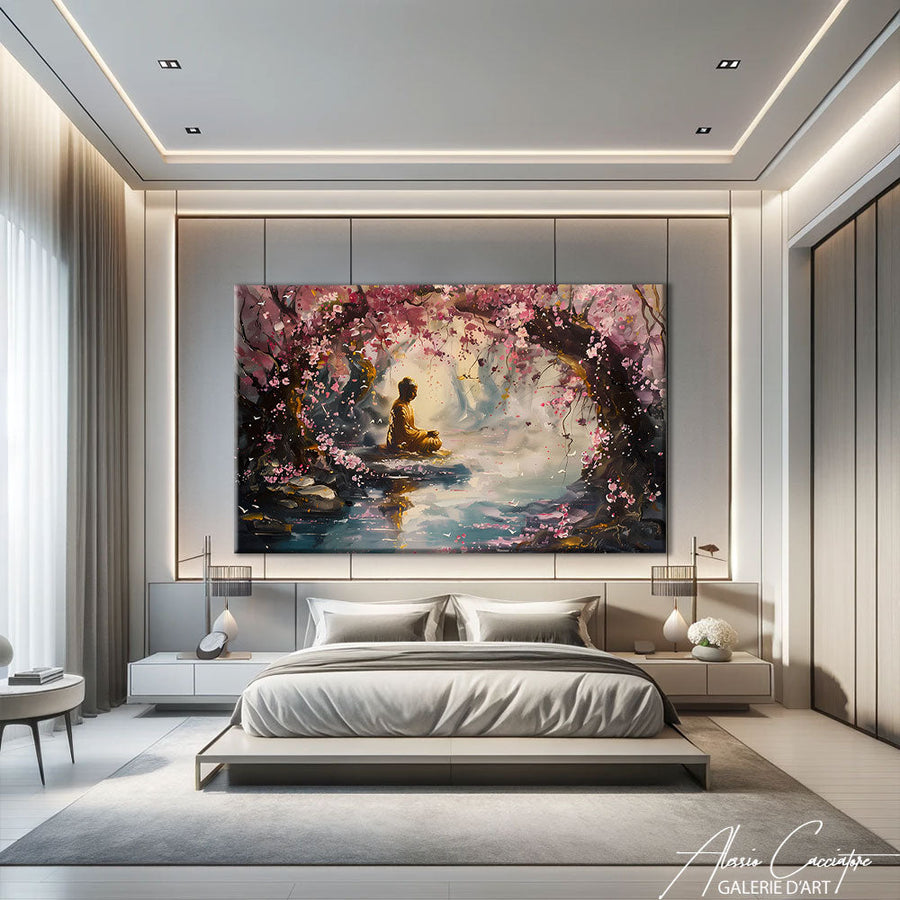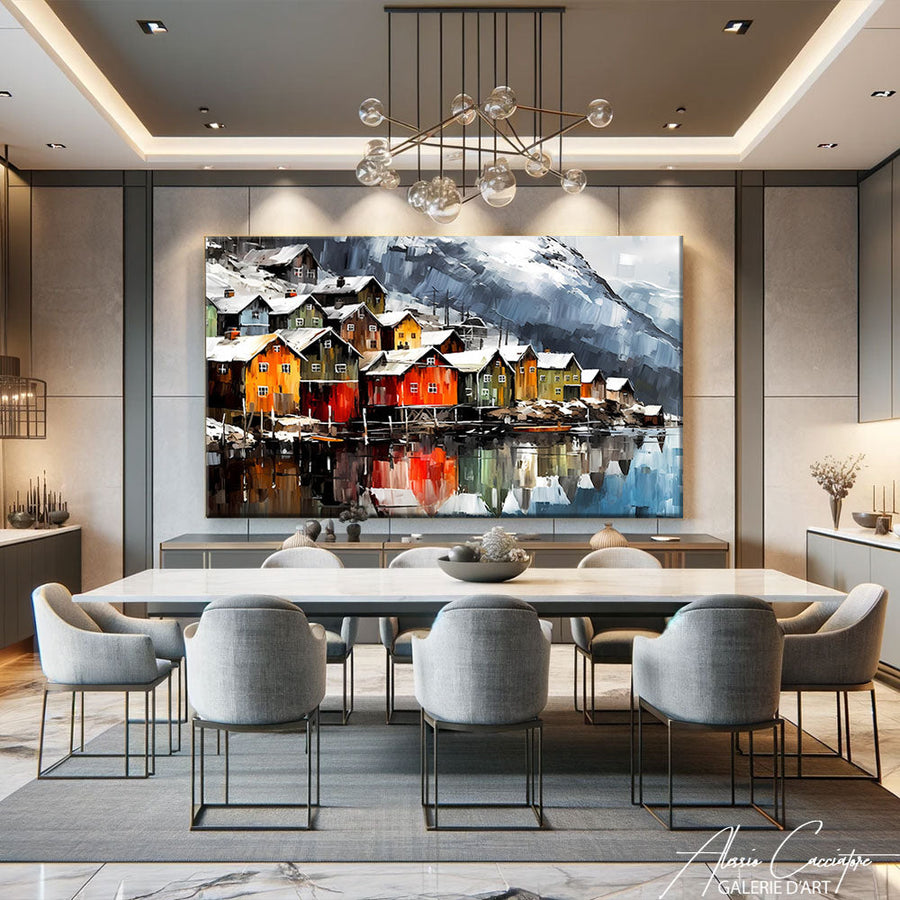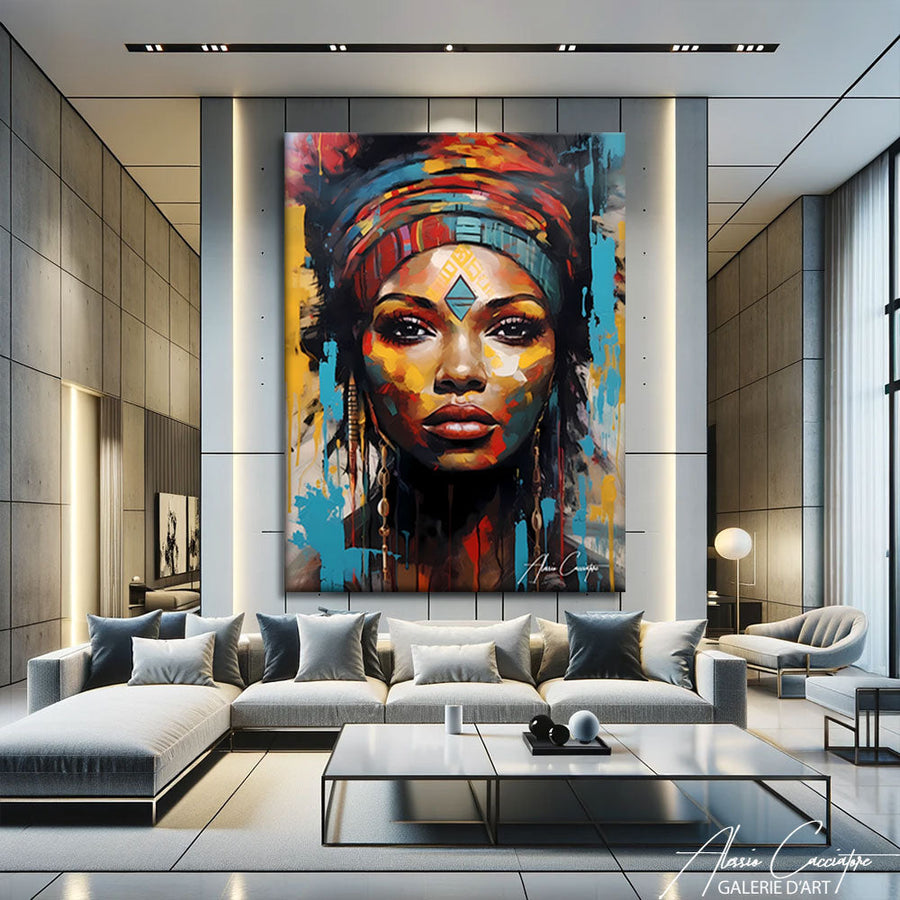

Last week, a collector asked me why I didn't offer canvas prints of my original works. My answer surprised him: because 80% of canvases sold online are technically catastrophic. Poorly printed, poorly stretched, with inks that fade after six months. However, when done well, a canvas print can transform a blank wall into a true personal gallery — provided you know what you're buying. Here's what I wish someone had told me before my first order ten years ago.
Photo on canvas print: how it really works
A photo on canvas print is nothing like a framed poster. It starts with a high-resolution digital file — usually 300 DPI minimum — which is printed directly onto a cotton or polyester canvas with special inks.
The process goes something like this: the inkjet printer (often a large-format HP or Epson) projects micro-droplets of pigment ink onto the canvas. These inks penetrate the fibers instead of remaining on the surface like on paper. The result: a matte, textile finish that absorbs light rather than reflecting it.
What truly makes a difference, frankly, is the quality of the base canvas. A 100% cotton canvas at 380g/m² does not age like a 280g/m² polyester blend. Cotton remains supple and retains its colors, while synthetic materials can yellow or crack over time.
The three types of inks found on the market:
- Pigment inks: last 75-100 years without fading, UV resistant, high cost
- Dye-based inks: vibrant rendering but a lifespan of 5-15 years maximum, fade quickly in direct light
- Latex inks (HP): good compromise between durability and cost, widely used by professionals, last 50+ years
In my studio, I regularly test samples from different printers. The difference between a cheap print and true gallery quality becomes apparent in less than three months: blacks turn gray, reds lean towards orange, whites take on a creamy tint. There's no miracle cure.
Decorative wall canvas vs. art reproduction: what's the difference

First thing to understand: not all decorative wall canvases are created equal.
An art reproduction — the kind found in serious museums or galleries — adheres to strict standards. Calibrated color profile, certified archival paper (or equivalent canvas), sometimes limited edition, artist's signature. It's an object intended to last and gain value.
A standard decorative canvas? It's often an image purchased from a stock photo library, mass-produced, sold without a certificate or guarantee of longevity. Nothing wrong with that — I even have some in my kitchen — but you need to know what you're buying.
What distinguishes a true art reproduction
The source file is at least 50 MB, often 200-300 MB for large formats. It was captured by a professional photographer with a medium format camera or scanned at ultra-high resolution. Colors are calibrated to exactly match the original.
Printing uses 10 to 12 colors (not the 4 of classic CMYK). This allows for ultra-fine transitions, deep blacks, and pure whites. The result? An image with depth that breathes.
“The difference between a museum-quality reproduction and a classic decorative print is like comparing a vinyl record to a 128 kbps MP3. Technically, it's the same song. But the experience is completely different.”
On alessiocacciatore.com, all my works are available as signed limited editions — not print-on-demand. It's a choice: I prefer to sell less but guarantee true collector quality. My limited edition pop art paintings are a good example.
Choosing your format: from 30×40 to XXL
Size is the thing everyone underestimates.
I regularly receive photos from clients who have hung a 40×60 cm piece in a 35 m² living room. The result: the artwork completely disappears, drowned in the space. Or conversely, a 150×100 cm piece in a 12 m² bedroom that overwhelms the entire room.
Empirical rule I use:
For a 3-meter wide wall, aim for an artwork width between 90 and 120 cm. For a 2-meter wall, between 60 and 80 cm. The artwork should occupy about one-third of the wall's width — no more, no less.
Standard sizes for canvas prints:
- 30×40 cm: entryway, hallway, small office
- 50×70 cm: bedroom, above a dresser
- 70×100 cm: living room, above a 2-seater sofa
- 100×150 cm: large living room, main wall
- 120×180 cm and larger: loft, open space, spacious entrance hall
Be careful with panoramic formats (like 40×120 cm). They look magnificent above a king-size bed or an XXL sofa, but are difficult to place elsewhere. I have one in my studio above my workbench — it works because the furniture is 2 meters long. On an empty wall, it would look strange.
The case of triptychs and multiple compositions
A trend I find interesting: dividing an image into 3 or 5 panels. It creates rhythm, it structures the space. However, it's technical to hang — the spacing must be perfect (5 to 10 cm between each panel) otherwise it looks shoddy.
Stretcher bars, tension, and finishes: the details that matter

We rarely talk about the stretcher bar. Yet, it's what makes the artwork last over time.
A canvas print is stretched over a wooden frame — the stretcher bar. This frame can be made of pine, spruce, or poplar. The thickness varies from 2 cm (thin stretcher bar) to 4 cm or even 6 cm (gallery stretcher bar).
My advice: always choose a stretcher bar of at least 3.5 cm for formats 70×100 cm and larger. Below 3 cm, the canvas can warp with humidity or loosen after a few months.
The three types of stretching:
- Standard stretching: the canvas is stapled to the side of the stretcher bar, the staples are visible on the edges
- Museum wrap (or gallery wrap): the canvas is folded and stapled at the back, the edges are clean, printed in continuity with the image
- Mirror wrap: the edges reproduce the pixels from the perimeter of the image, creating a symmetrical effect
Frankly, if you want a professional finish, go for museum wrap. It costs 10-15% more but it completely changes the final look. Visible staples on the sides, to my taste, look cheap.
For the canvas prints I offer, I exclusively use 4 cm FSC-certified pine stretcher bars, with gallery wrap. Non-negotiable. I've tested the low-cost alternatives: the wood warps, the corners misalign, the canvas loosens. After two years, it's ruined.
Lifespan and maintenance of a canvas print
How long does it last? That's the real question.
A quality photo on canvas print, with pigment inks and cotton canvas, easily lasts 50 to 75 years under normal conditions. Some manufacturers claim 100 years, but honestly, no one can really verify that.
However, a cheap print with dye-based inks? 5 to 10 years maximum, and that's if it's not in direct sunlight. I've seen canvases completely fade in less than two years in a very bright, south-facing apartment.
What damages a canvas:
- Direct sunlight: UV = enemy #1, even with pigment inks. If your wall gets sun 4 hours a day, plan for UV-protective glass or change the location
- Excessive humidity: bathroom, kitchen without an extractor fan, damp cellar — the canvas will mold or the colors will bleed
- Sudden thermal variations: near a radiator, air conditioning — the stretcher bar can warp, the tension loosens
- Repeated physical contact: fingers, ingrained dust, aggressive cleaning products
Recommended maintenance:
A quick dust with a feather duster once a month, that's all. If it's really dirty, a slightly damp microfiber cloth (pure water), without rubbing. Never use cleaning products, never alcohol, never Windex. It will dissolve the inks.
I have a canvas in my living room that's eight years old. It's impeccable because it's 2 meters from the window, not facing it, and I dust it regularly. However, the one I had placed above the stove? Dead in 18 months. Cooking fumes yellowed everything. Beginner's mistake.
Price: what to expect based on quality

Let's talk money. Because the price difference is enormous.
A 50×70 cm wall decoration canvas can cost between €15 (discount site) and €200 (high-end gallery). What's the difference?
Low-end (15-40€): 4-color print on polyester canvas, 2 cm pine stretcher bar, dye-based inks, lifespan 3-7 years. This is what you find on ultra-discount decor sites. Frankly, for a teenager's room or a temporary office, it does the job.
Mid-range (50-100€): 6-8 color print on cotton/poly, 3 cm stretcher bar, HP latex inks, lifespan 20-40 years. This is the sweet spot for quality/price for most people.
High-end (120-300€+): 10-12 color print on 380g/m² cotton, 4 cm gallery stretcher bar, Epson UltraChrome pigment inks, UV protective varnish, 75-100 year guarantee. This is what I use for my prints.
For a 100×150 cm format, multiply by 3 to 4. You'll easily reach 400-800€ for gallery quality. These large format works for offices and professional spaces are designed to last.
What justifies a high price:
- Ultra-high resolution source file (not an image grabbed from Google)
- Precise color calibration (cost of equipment and expertise)
- Premium canvas and inks (raw materials 3x more expensive)
- Handcrafted production (manual stretching, individual quality control)
- Limited and signed edition (collector's value)
On alessiocacciatore.com, my limited edition works are in this high range. I don't aim for volume; I aim for lasting quality. A client who buys a piece knows they can pass it on, resell it, or simply enjoy it for decades without seeing the colors fade.
Where to buy a quality canvas print
You have a choice of several channels. Not all offer the same guarantees.
Mainstream decor sites (Photobox, Cewe, Snapfish, etc.): convenient, fast, inexpensive. Perfect for printing your own vacation photos. However, the quality is what it is. Often polyester, standard inks, no advanced color control. For temporary decor, why not.
Professional online printers (WhiteWall, Saal Digital, Picanova): significantly higher quality. They use real pigment inks, offer cotton, and provide professional finishing options. Expect 50 to 150€ depending on the format. This is my recommendation if you want to print your own visual with good longevity.
Galleries and artists (like me): you are buying an original limited edition artwork. The price includes the artistic creation, not just the print. It's a different world. You get a certificate of authenticity, a signature, sometimes a value that evolves. And above all, you are directly supporting a creator.
Pitfalls to avoid:
- Sites that do not indicate the type of ink used (= it's probably low-end)
- No mention of stretcher bar thickness (= probably 2 cm)
- Blurry or low-resolution demo images on the site (= their print quality is similar)
- Suspicious express delivery times (24-48h): true quality requires drying time, control
When you purchase one of my pieces, you receive a certificate detailing the print number, date, technical specifications (inks, canvas, stretcher bar), and my signature. It's traceable, it's guaranteed. If in ten years you want to resell it, you have all the documentation. My contemporary black and white creations are among the most sought after.
Canvas print or other media: how to choose
Canvas is not the only medium. And frankly, it's not always the best.
When to choose canvas:
- You like the matte, textile, slightly raw finish
- You want an XXL format without a frame (the canvas is self-sufficient)
- The artwork has a pictorial, artistic style (not an ultra-sharp photo)
- You're looking for a light object that's easy to hang
When to choose aluminum Dibond: ultra-modern finish, glossy or satin, very resistant, ideal for architectural photography, urban landscapes, contemporary design. More expensive, heavier, but indestructible.
When to choose fine art paper under glass: you want the ultimate in color accuracy and detail. Hahnemühle or Canson Infinity papers are technically superior to canvas for pure art photography. But it requires a frame with a mat and anti-reflective glass. Total cost: often double.
When to choose acrylic (Plexiglas): spectacular depth effect, colors seem to float behind the pane. Very high-end, very expensive, very fragile during transport. For designer, minimalist interiors.
In my own collection, I have canvases (pop art series, expressive portraits), aluminum Dibond (urban series, contrasted black and white), and fine art paper (landscapes, pure photographic prints). I choose the medium based on the artwork, not by default.
The big advantage of a decorative wall canvas? The price. For equal dimensions, it's 30 to 50% cheaper than aluminum or paper under museum glass. And for 90% of people, the difference in rendering does not justify the extra cost. For a decorative canvas for a bedroom, it's often the smartest choice.
Frequently Asked Questions
What is the minimum resolution to print a photo on canvas?
Minimum 150 DPI at the final print size, ideally 300 DPI. For a 100×150 cm, this represents a file of 4500×3000 pixels minimum, or about 40 MB. Below that, you will have visible pixelation. Test with a printer that offers previews before validation.
Can a canvas print replace an original painting?
No, and that's not the goal. An original painting has a texture, reliefs, a physical materiality that no print can reproduce. However, a quality print of a work of art allows you to visually enjoy a composition at an accessible cost. These are two different objects, with two different values.
How long does it take to receive a canvas print?
Between 5 and 15 business days depending on the provider. A short delay (24-48h) often indicates a low-end industrial print. Pigment inks need 24-48h of drying, then it needs to be stretched on a frame, checked, and packaged. Allow a minimum of one week for true quality.
How to hang a canvas without drilling the wall?
Use Command adhesive strips from 3M, designed for pictures. They hold up to 7-8 kg depending on the model and remove without a trace. For XXL formats (over 5 kg), you will still need to drill — a falling canvas+frame causes damage. No miracle here.
Is a canvas print suitable for a bathroom?
Only if your bathroom is very well ventilated (effective VMC) and the canvas is not exposed to direct water splashes. Otherwise, opt for aluminum Dibond or acrylic, which are perfectly resistant to humidity. I made the mistake once: mold after six months.
What is the difference between a canvas and a framed poster?
Canvas is printed on textile (cotton or polyester), stretched on a frame, ready to hang, with a matte finish. A poster is printed on paper, requires a frame with glass, and has a sharper, shinier finish under glass. Canvas offers relief and texture, posters offer precision. It's a matter of taste and budget.
All works mentioned in this article are available on the gallery. Free worldwide shipping, 30-day money-back guarantee.