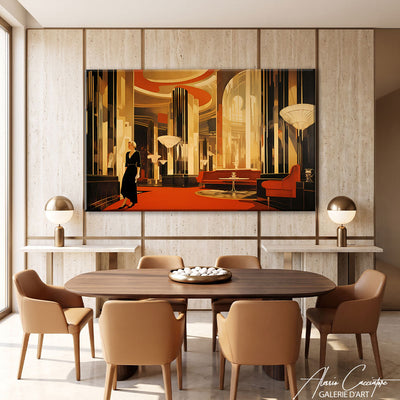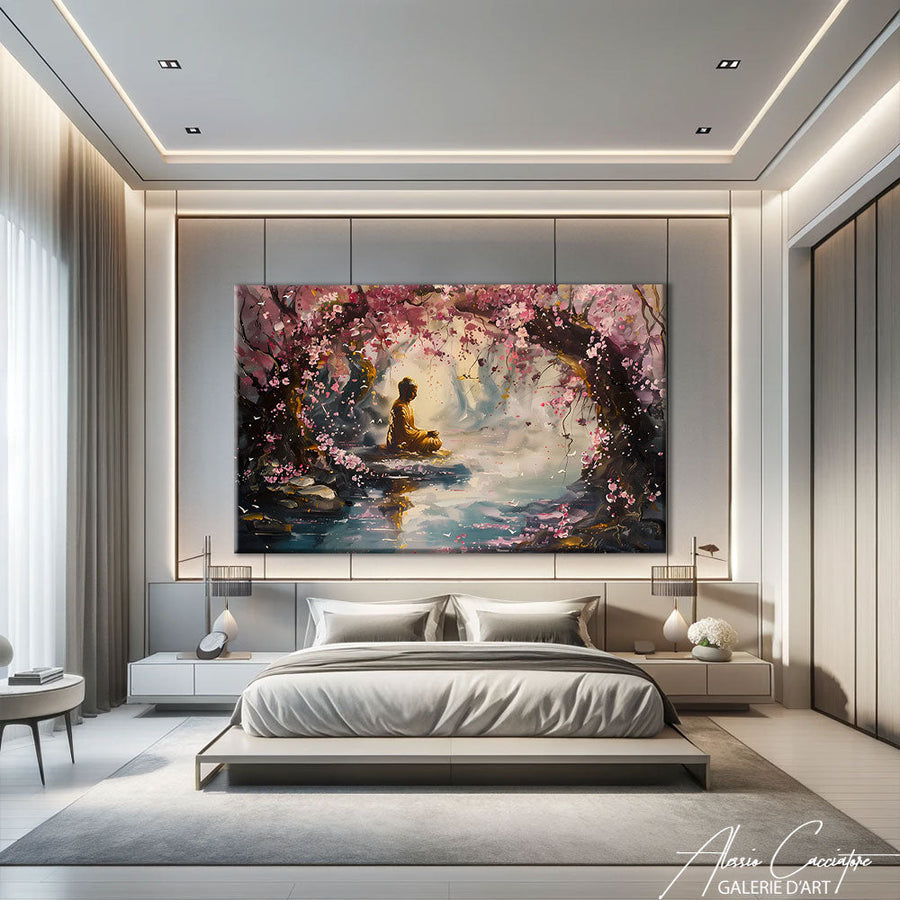

A cubist painting never leaves you indifferent. A face seen from the front and in profile at the same time, a guitar shattered into facets, a city reduced to interlocking planes: this style, invented by Picasso and Braque over a century ago, remains one of the most recognizable in art history. And yet, when it comes to hanging one in your home, questions abound. Won't it look like a "museum"? In which room? Portrait or landscape? What colors should I use so it goes with my sofa? After assisting dozens of clients who hesitated before a cubist canvas, here are my answers, straight to the point.
What is a cubist painting, in concrete terms?
Cubism was born in Paris around 1907. The foundational idea is simple and revolutionary: instead of painting an object from a single point of view, it is shown from several angles at once, cut into geometric facets. The name actually comes from a mockery by critic Louis Vauxcelles, who spoke of "little cubes." The artists kept the insult and turned it into a movement.
We generally distinguish two phases. Analytic Cubism (1909-1912) is austere, almost monochrome, in browns and grays where the form dissolves. Synthetic Cubism, which followed, reintroduced color, flat areas, and collages, and it is this style that inspired almost all the cubist canvases we hang in a living room today. If you like portraits with faces recomposed in bright colors, this second vein is the one that speaks to you.
On a canvas print stretched over a wooden frame, cubism takes on a particular presence: the texture of the canvas gives grain to the flat colors and avoids the "poster" effect. It is a style that gains a lot from being seen in physical form rather than on a screen. To locate cubism among other major pictorial families, our panorama of movements that define today's art will give you useful points of reference.
How to choose a cubist painting that you will still like in ten years?
My opinion is clear: a successful cubist painting is judged by the legibility of its subject, not the complexity of its fragmentation. A canvas where one immediately guesses a face, a couple, or a still life ages well. A canvas where everything is just triangles without a focal point eventually becomes tiresome.
The three criteria that really matter
- A subject identifiable from three meters away. A woman's portrait, a musician, an urban landscape: the motif must be readable from a distance. The fragmentation is then discovered up close, and it is this double level of reading that makes the charm of the genre.
- A limited palette. The best cubist compositions hold together with three or four bold colors plus a neutral one. Ochre, deep blue, brick red, and black, for example. Beyond that, the eye gets lost.
- Clear structural lines. Look to see if the facets are organized around a diagonal or a vertical axis. This hidden structure is what gives the canvas its stability despite the shattering of forms.
This logic of a readable subject and a controlled palette applies to all modern art, and our article on the eight criteria for a truly contemporary painting develops it point by point.

Cubist portrait or cubist landscape: which to choose?
This is the real dividing line in our collections. The cubist portrait, almost always a woman's or man's face recomposed, is a painting with character that draws the eye and gets people talking. The cubist landscape, a city or nature cut into planes, is more restful and easier to integrate with other works.
My personal rule: use a cubist portrait for a wall where you want a strong, unique piece, and a cubist landscape for a wall you want to enliven without dominating. If a recomposed face attracts you, take the time to read our advice on choosing a contemporary face painting: cubism is its direct ancestor and the same instincts apply.
In which room should you hang a cubist painting?
Cubism is an intellectual and structured style. It thrives in rooms where you are awake and attentive, and is less suitable for spaces of pure rest, unless you choose a soft palette.
The living room: the obvious choice
This is where most of our cubist canvases end up, and for good reasons. A large cubist portrait above a sober sofa, on a light-colored wall, becomes the center of gravity of the room. I have in mind a Haussmann-style apartment where a portrait of a woman with ochre and midnight blue facets held pride of place above an unbleached linen sofa: the old moldings and modern geometry complemented each other wonderfully. Our complete guide to living room paintings will help you calibrate the size and height.
The office: for concentration
Cubism was born from reflection on form, and it retains something of that. A cubist canvas in an office, placed on the wall you see when looking up from the screen, maintains a form of stimulating rigor. Here, prefer a cubist landscape or a portrait with muted tones rather than an explosion of colors.

The bedroom: possible, with a soothing palette
Contrary to popular belief, a cubist painting can find its place in a bedroom, provided you choose a composition with earthy or bluish tones, and hang it on the wall facing the bed rather than above the headboard. You contemplate it before sleeping, and it does not loom over your slumber. For the overall atmosphere of the room, our advice on choosing soothing artwork for the bedroom remains the reference.

What size, what format, and what colors around it?
Cubism loves space. A small cubist painting loses its faceted effect and looks like a postcard. On a standard living room wall, start with at least 60 x 90 cm, and dare to go for 80 x 120 cm or more if the wall exceeds three meters. The portrait format is naturally suited for faces, the landscape format for cities and still lifes that unfold in width.
Around the canvas, the golden rule is sobriety. Cubism already provides a great deal of lines and fractures: an off-white, pearl gray, or linen beige wall gives it plenty of room. Furniture with straight lines, light wood, or matte black, goes very well with it, and the Art Deco style, with its own geometries, forms a particularly elegant alliance. A single touch of echo is enough, such as a cushion or a vase in the dominant color of the canvas. The plexiglass option placed on the canvas accentuates the depth of the flat areas and gives the colors an almost lacquered shine, a choice I recommend for compositions with bold colors.
FAQ: your questions about cubist painting
Is cubist painting old-fashioned?
No. It is a 20th-century classic, just like the Barcelona chair or the Anglepoise lamp. It has survived all decor trends precisely because it belongs to none of them. Today, with the return of color and bold shapes in interiors, it is even making a strong comeback.
What is the difference between Cubism and abstract art?
Cubism always starts from a real subject that it decomposes; abstraction does without a subject. A cubist painting shows a fragmented face, an abstract painting shows shapes for their own sake. Both actually coexist very well on the same wall, provided they share a palette: our guide to abstract painting will help you compose this dialogue.
Can you combine two cubist paintings side by side?
Yes, if one is a portrait and the other a landscape, or if both share exactly the same colors. Two cubist portraits with different palettes compete with each other. When in doubt, one large format is better than two medium ones.
In summary: geometry at the service of character
A good cubist painting is a readable subject, a palette limited to three or four colors, a generous format, hung alone on a neutral wall in a living room or office. Respect these principles and the canvas will do what cubism has done best for a century: give an interior a backbone. To find yours, browse our collection of cubist paintings, all printed on canvas stretched over a wooden frame. And if it is the lines and facets that seduce you more than the subject itself, our collection of geometric paintings extends the same logic in a more refined vein.