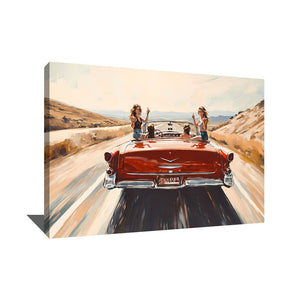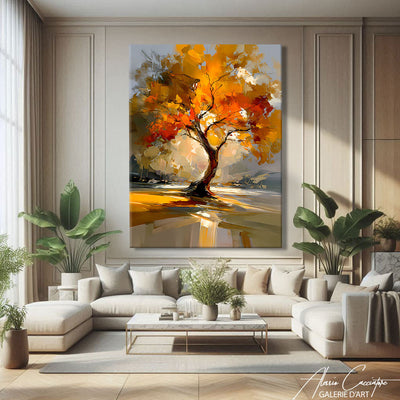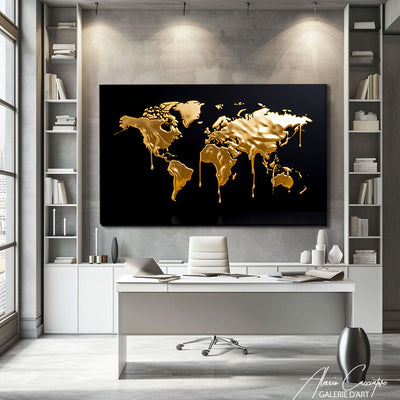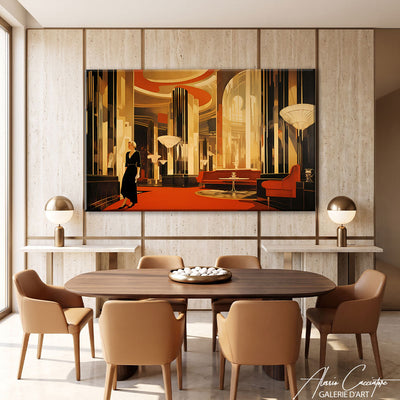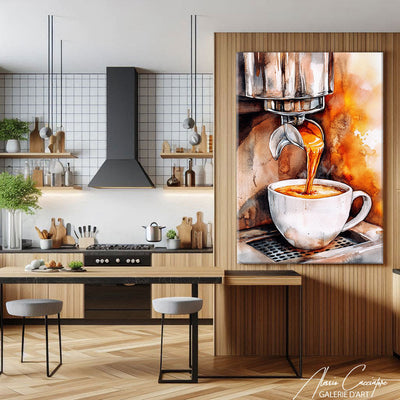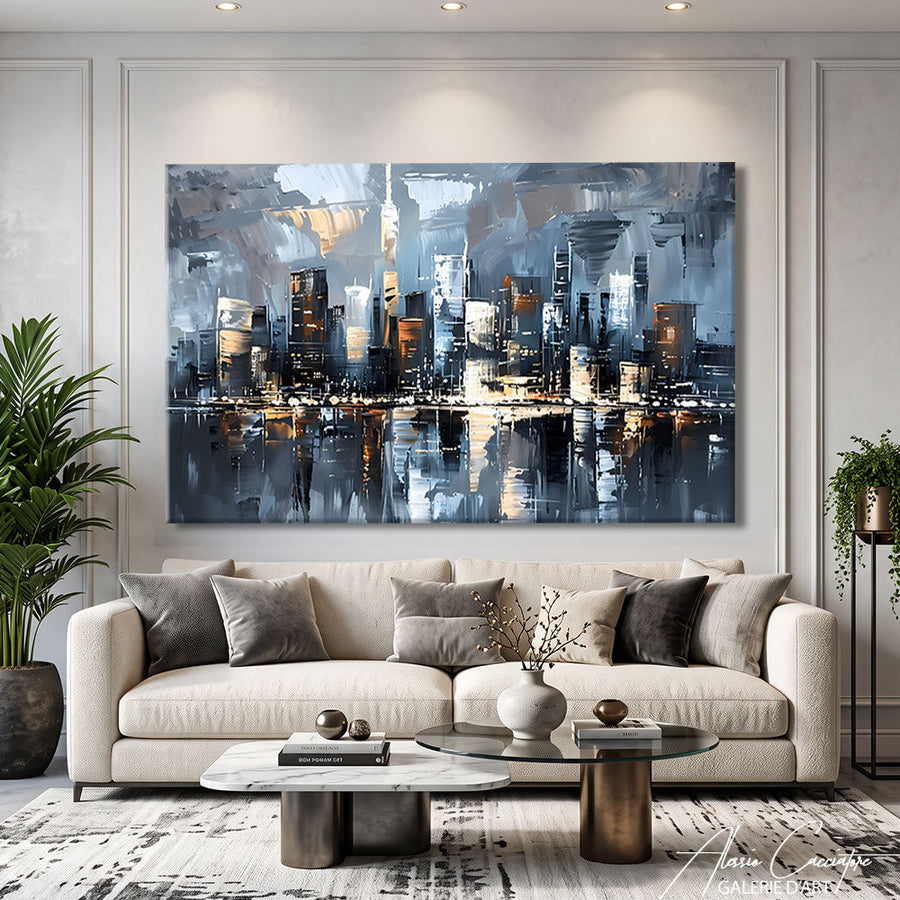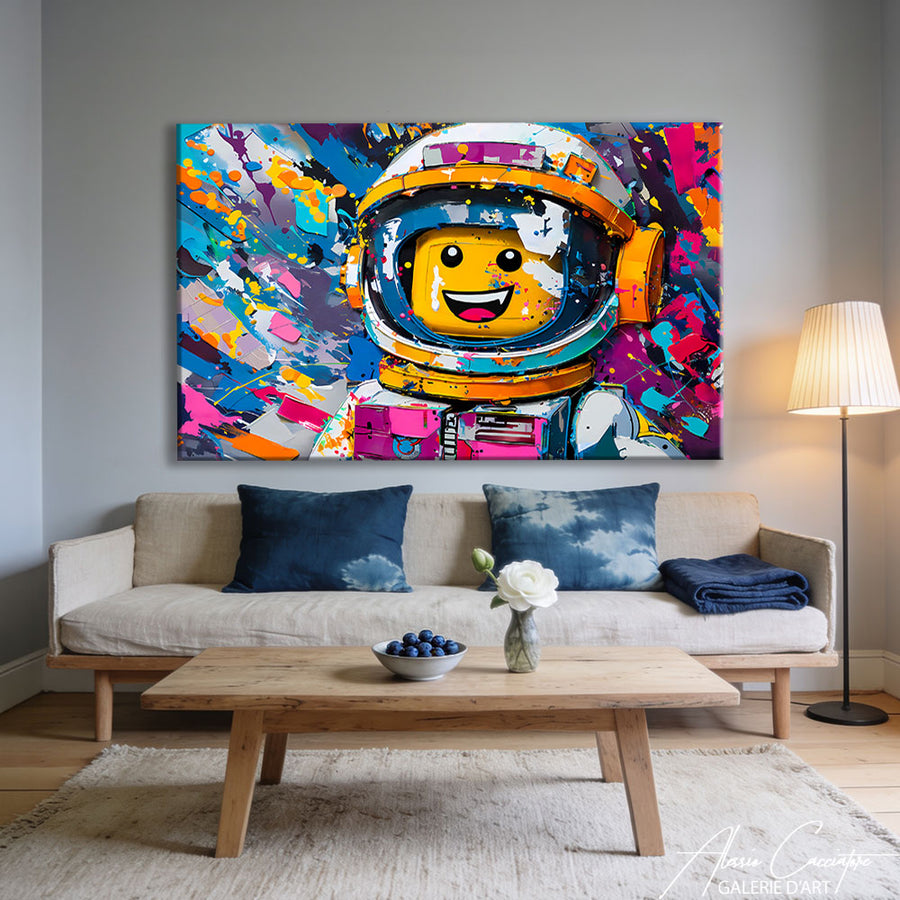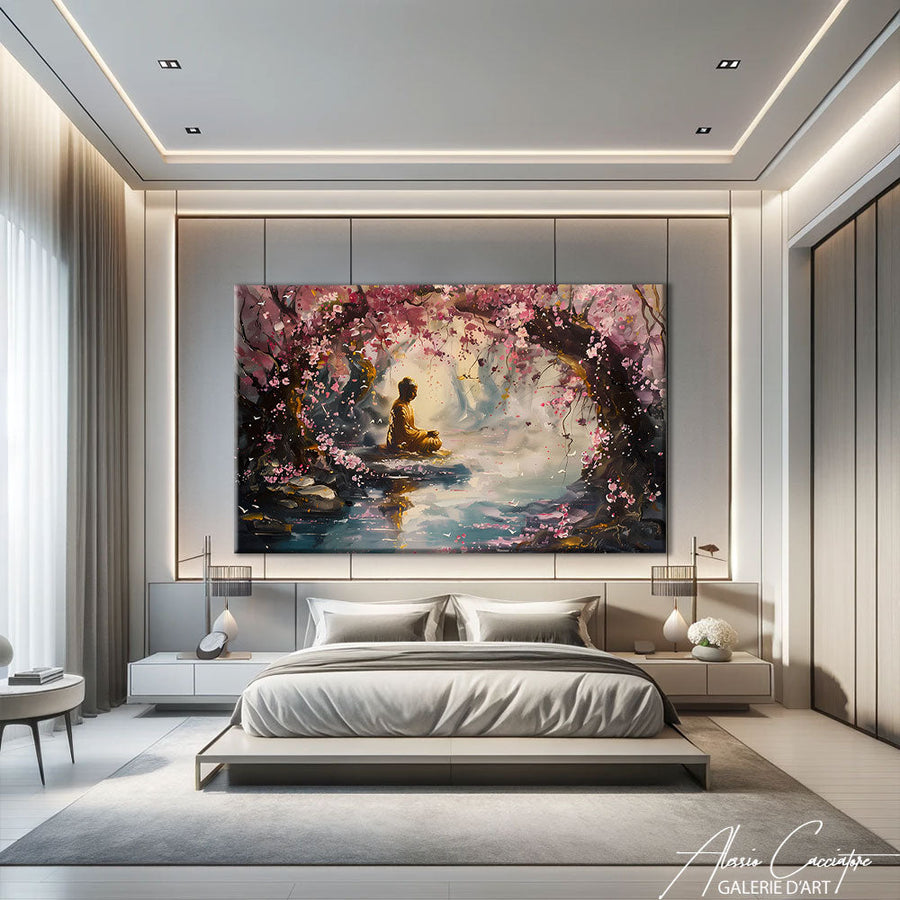

A question comes up almost every week at the gallery: "Is my wall really big enough for a large contemporary wall art piece?" Nine times out of ten, the answer is yes. And nine times out of ten, the person leaves with a more imposing piece than the one they initially had in mind. Large formats are intimidating on paper, then become an obvious choice once the frame is on the wall. What remains is to decide on three concrete things: what size to aim for, at what height to hang it, and in which room the very large format really changes the game. Here are our benchmarks, supported by figures, after more than ten years of hanging canvases in clients' homes.
What do we call a large contemporary wall art piece?
There is no official standard, and that is precisely the problem: every merchant sets the bar wherever they see fit. In our gallery, we consider a format to become "large" starting at 100 cm on its longest side, and "very large" (the famous XXL) beyond 140 cm. Below 80 cm, we refer to it as an accent format: perfect in a composition, but insufficient alone on a clear section of wall.
The word "contemporary" does not refer to a decorative style but to a relationship with the subject. A contemporary work embraces a bold graphic treatment: saturated flat areas, deliberate drips, typographic overlays, tight cropping. This is precisely what makes it compatible with a large format. A timid subject enlarged becomes a bland poster; an assertive subject enlarged becomes a centerpiece. If you are still hesitant about what distinguishes a good work from a simple decorative print, our article how to choose a contemporary art piece details the criteria to look for before buying.
At our gallery, all large formats are printed on canvas stretched over wooden frames, with a plexiglass option for those who want a smooth surface and extra color depth. It is the best compromise between weight, rendering, and ease of hanging — a point that becomes decisive starting at 120 cm.
What size should you choose based on the width of your wall?
The rule we systematically use: the artwork should occupy between 60% and 75% of the width of the visual support. The visual support is not the entire wall: it is the furniture piece below which the artwork is placed (sofa, sideboard, headboard) or, failing that, the free wall section between two obstacles.
- 220 cm sofa: aim for a canvas 140 to 165 cm wide.
- 180 cm sideboard: aim for 110 to 135 cm.
- 160 cm headboard: aim for 100 to 120 cm.
- Totally free 300 cm wall: don't be afraid, 180 cm or more works very well.
The most frequent mistake is not seeing too big, but too small. A 60 cm painting above a three-seater sofa always gives the impression of a postage stamp forgotten there. Our field advice: cut the intended size out of kraft paper, tape it to the wall, and live with it for two days. You will know.
A word on orientation: on a wall that is wider than it is high — the case for almost all French living rooms — it is the landscape format that works best. It extends the line of the sofa instead of clashing with it.

At what height should you hang a large contemporary wall art piece?
The museum reference is simple: the center of the work at 150 cm from the floor. This is the average eye level of an adult standing up, and it works in a hallway, entryway, or staircase.
But in a living room, we look at it while seated. We therefore intentionally lower the center to 140-145 cm, and above all, we respect a gap of 20 to 30 cm between the top of the sofa backrest and the bottom of the frame. Below 15 cm, the whole thing looks crushed; beyond 40 cm, the work floats and loses its connection to the furniture.
Two special cases are worth mentioning. With high ceilings (more than 2.80 m), raise the center to 155-160 cm: otherwise, the work seems to slide downwards. And if you are hanging it above a fireplace, simply align the bottom of the frame 12-15 cm above the mantel, without trying to respect the 150 cm rule — the fireplace imposes its own logic.
As for fixing, a large format on stretched canvas remains light: two X-hooks placed 30 cm from each end are enough for most partition walls. Provide suitable wall plugs for anything wider than 150 cm, and always check the level after placing both hooks, not before.
In which room should you dare to use a very large format?
Contrary to popular belief, large formats are not reserved for lofts. It is often in medium-sized rooms that they produce the best effect, because they structure the space instead of fragmenting it. Three small frames scattered around visually shrink a room; a single large canvas unifies it.
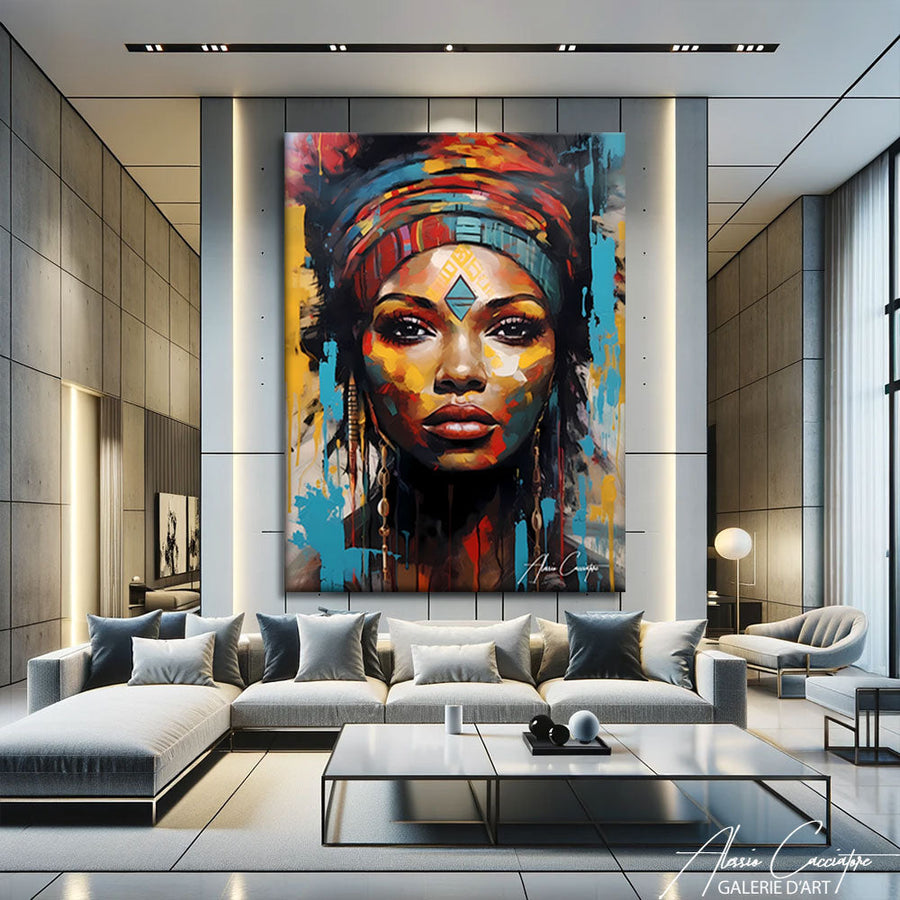
The living room remains the obvious playground: the sofa wall, the wall facing the entrance, or the blank section between two windows. This is where the scale relationship is in full effect.
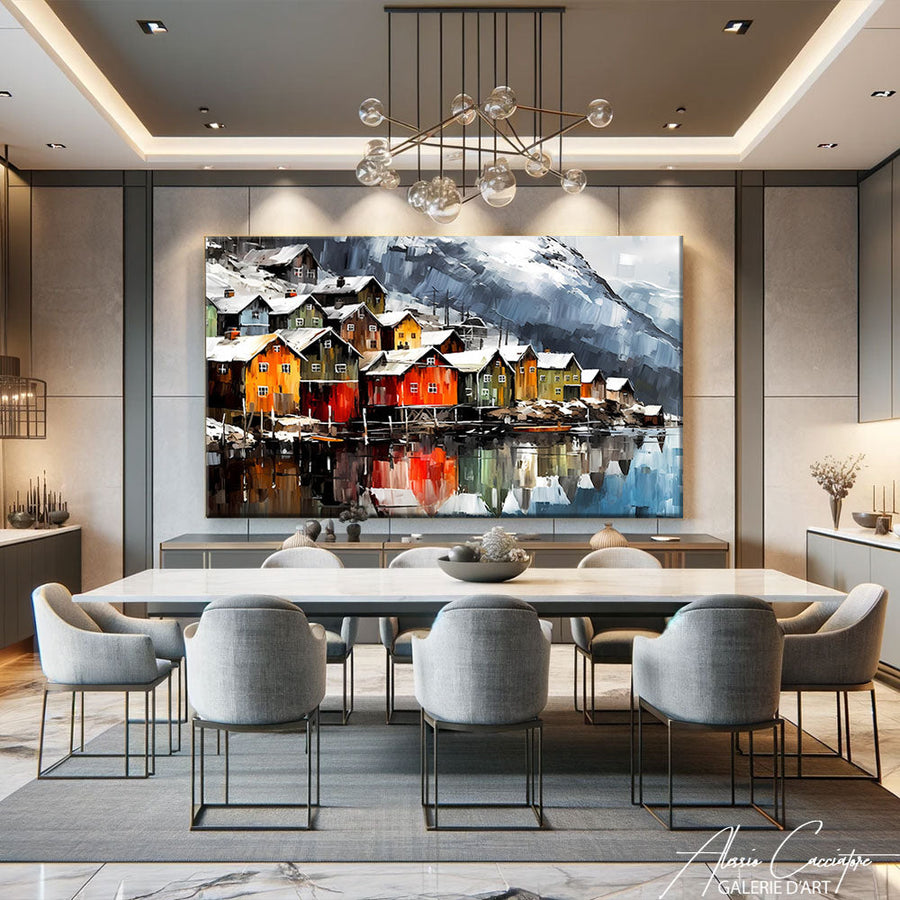
The dining room remarkably well supports strong subjects. We spend time there seated, the eye looks for an anchor point, and a graphic work fuels conversation better than a mirror.
The bedroom calls for more restraint: favor a tighter palette and a contemplative subject rather than a high-visual-density pattern. Large format works there, but in a calm version.

The office, finally, is the most underestimated room. A large format placed behind the screen or in the camera's field of view radically transforms the perception of a workspace — and avoids the bare wall background during video conferencing.

If your wall is instead narrow and slender — between two doors, in a stairwell — switch instead to the vertical wall art collection, designed for those proportions.
Stretched canvas or plexiglass: what to choose for a large format?
Canvas stretched over a wooden frame offers a matte, slightly textured material that absorbs light and is forgiving of difficult lighting conditions. It is our default recommendation beyond 140 cm: lightness, absence of reflections, and a finish that evokes painting.
Plexiglass, for its part, provides a perfectly smooth surface and superior saturation. It excels with highly colorful subjects and pop art flat areas, provided it is not placed opposite a south-facing bay window. Our firm opinion: plexiglass for graphic and saturated works, canvas for everything else.
Frequently asked questions
Does a large format overwhelm a small room?
No, provided it remains alone on its wall. It is the accumulation that overwhelms, not the size. A 120 cm canvas in an 18 m² living room works perfectly if the other three walls remain sober.
Can you combine a large format with other paintings?
Yes, but never on the same section of wall. Reserve the large piece for one wall, and perhaps compose a more modest set on another. To go further, read our guide XXL wall art: starting from what size and for what room.
How do you maintain a large canvas?
A dry microfiber cloth, laid flat, once a quarter. Never use cleaning products, never use water. On plexiglass, a slightly damp cloth is enough, using circular motions.
In summary
A successful large contemporary wall art piece comes down to three decisions: 60 to 75% of the furniture's width, a center at 140-150 cm from the floor, and a subject assertive enough to support the enlargement. The rest is pure pleasure. Browse our selection of large landscape formats to find the piece that will finally give your living space its backbone.