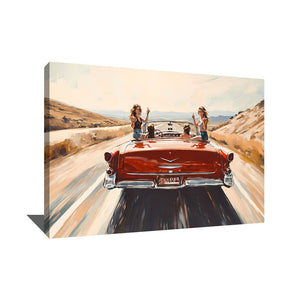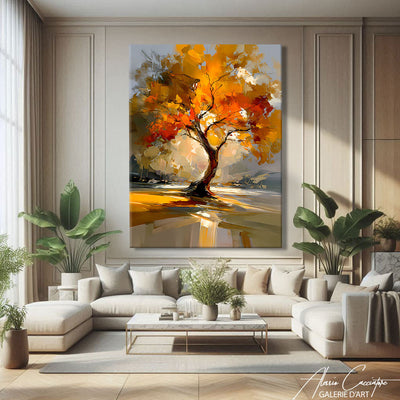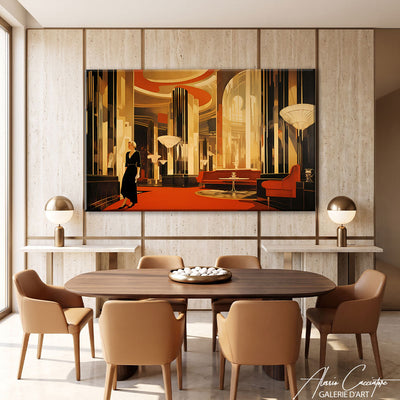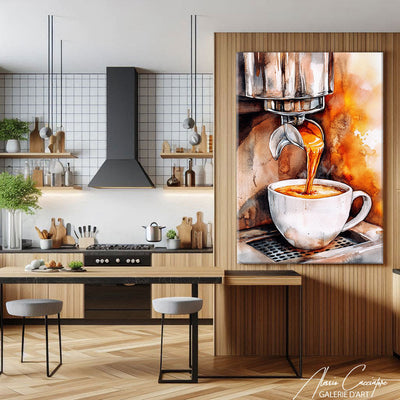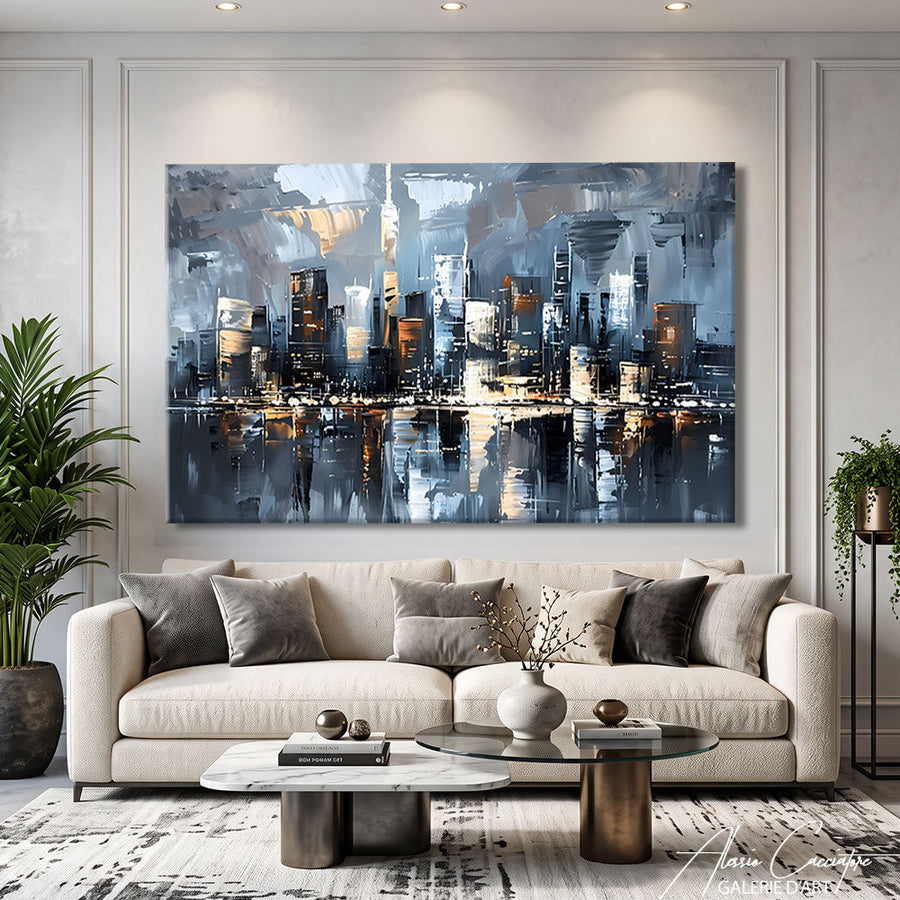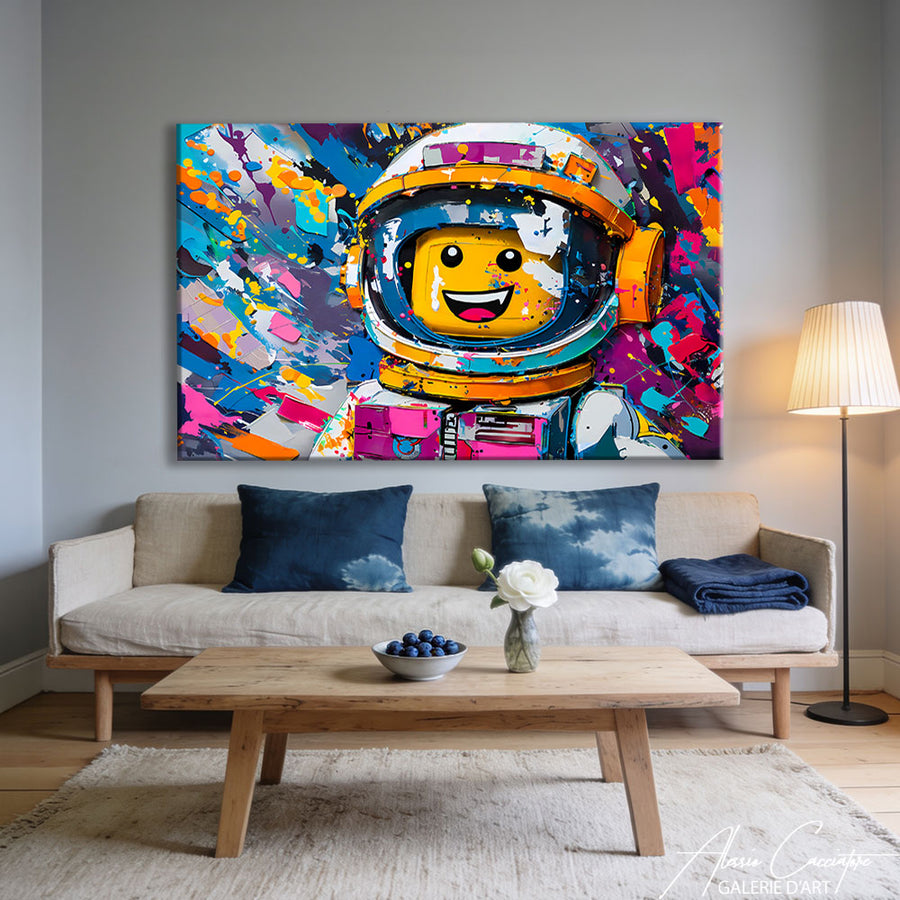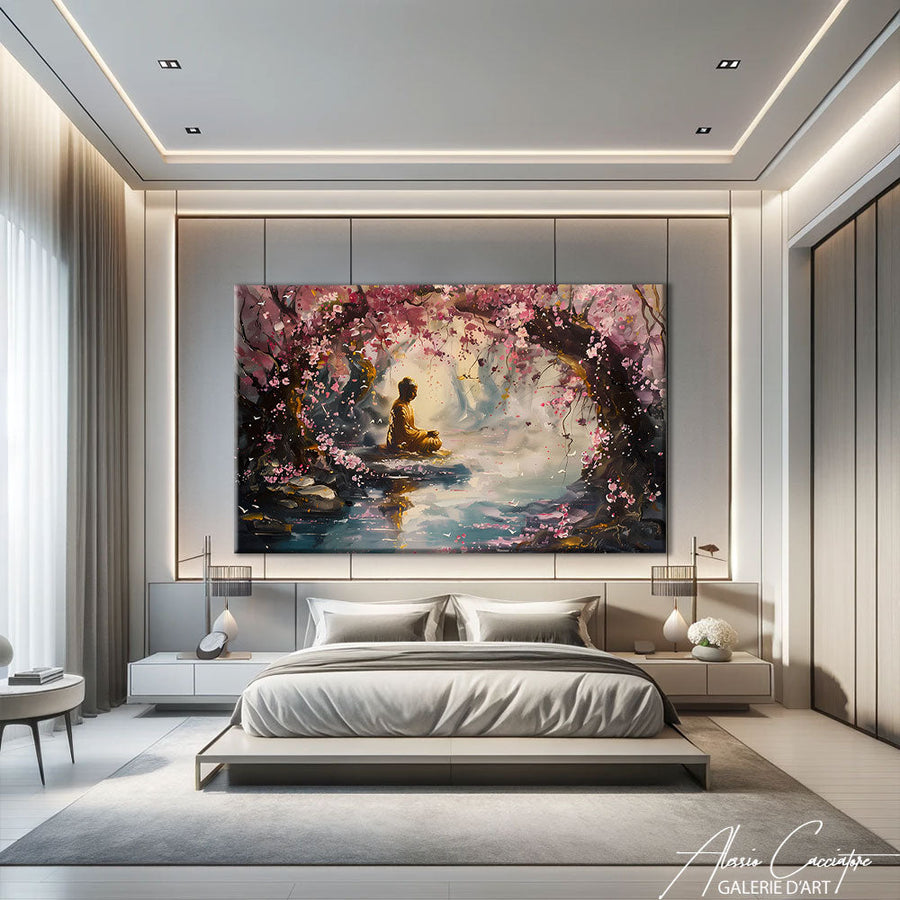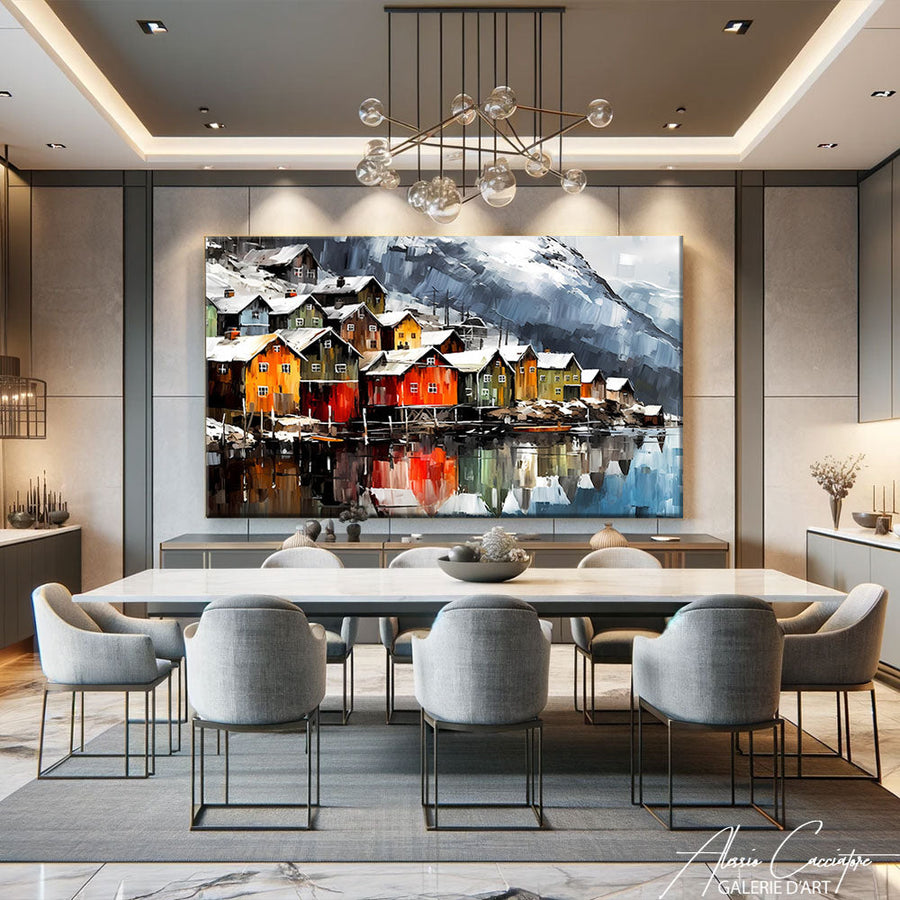

"XXL Wall Art": the phrase sounds great, but nobody ever tells you what size you actually need to enter that category. One meter wide? One meter fifty? And above all: will your wall handle it, or will the entire room seem to shrink? These are the two questions that come up most often when a client hesitates in front of a large format. The answer rarely fits in a single number—but it does fit into three simple benchmarks, which are as follows, room by room.
From what size do we talk about an XXL wall art piece?
There is no official standard, no label, and no commission that has settled the matter. In French market practice, we shift into XXL starting at 120 cm on the long side. Below that, we remain in the classic large format category, which hangs almost anywhere without making waves. Above 150 cm, we enter another category: the artwork no longer decorates the room, it structures it. The furniture is arranged around it, not the other way around.
- 80 to 110 cm: a comfortable large format. It fills an average wall section, is easy to transport alone, and is easy to move from one room to another.
- 120 to 150 cm: true XXL. You need a clear wall and a minimum amount of distance for viewing. This is the zone where the "gallery" effect begins.
- 160 cm and more: monumental format. Magnificent, but it forgives no placement errors.
My opinion, after seeing many interiors: the vast majority of people buy too small. The 60 cm painting lost above a 2.20 m sofa is the most common mistake—and the most frustrating, because it takes months to figure out what is wrong. It is neither the color nor the subject. It is the scale.
The two-thirds rule, and the two other benchmarks that count
First benchmark, the only one that really matters: your painting must occupy between 66% and 75% of the width of the piece of furniture it sits above. 220 cm sofa? Aim for a 145 to 165 cm piece, or a composition that reaches that width. 180 cm sideboard? Count on 120 to 135 cm. This ten-second calculation solves the vast majority of botched installations on its own. If you want to delve into the subject of the wall behind the sofa, our complete guide to living room wall art details the trickiest scenarios.
Second benchmark: height. The center of the artwork should be placed 150-155 cm from the floor, which is at eye level for a standing adult. Classic mistake: hanging it too high, out of reflex. Above a piece of furniture, you adapt—just leave 20 to 30 cm between the top of the furniture and the bottom of the artwork so they read as a whole rather than two objects that ignore each other.
Third benchmark, the most forgotten: distance. An XXL piece requires you to be able to step back about one and a half times its height to be seen correctly. In a one-meter-twenty hallway, a 150 cm format will never be perceived as anything other than at an angle. This isn't a dealbreaker—some hallway walls lend themselves very well to being viewed while walking—but you need to know this beforehand, not after.
In which room should you hang an XXL painting?
The living room is the obvious answer, and often the right one. But it is far from the only room that can support a large format—and the most successful results are rarely the most predictable.
The dining room: the most underrated room
You sit there, motionless, facing a wall for an hour or two. No other room offers as much time for contemplation. An XXL piece above a table gives the room a restaurant feel that we love, and it keeps the conversation going when things get quiet.

The office: the format that structures a video call
Since half of all meetings are held in front of a camera, the wall behind you has become a display wall. A large format creates a clean and intentional backdrop there, whereas three small frames give a cluttered impression on screen. Choose a subject that is legible from a distance, with strong contrasts.

The bedroom: yes, but above the headboard
Many don't dare. They are wrong. A 160 or 180 bed leaves a bare wall that calls for a generous format, and one single large painting is infinitely more restful there than a gallery of small frames. One rule only: favor muted palettes or monochromatic tones, and save the highly saturated compositions for daytime rooms.

Landscape or portrait: the choice that changes everything
Horizontal XXL format complements low furniture and visually widens a room: it is the natural choice above a sofa, sideboard, or headboard. You will find most of these large widths in our selection of landscape format paintings.
Vertical, on the other hand, does exactly the opposite: it draws the eye upward and lifts a low ceiling. This is the weapon of choice for stairwells, narrow entryways, and walls between two doors. If your wall is taller than it is wide, don't force a landscape onto it—look instead at our vertical paintings. And if neither is suitable, the solution often lies in a multi-panel composition: we detailed this approach in our article on the triptych wall art piece.
The constraints you always discover too late
A large format impresses on a screen, then arrives at your home. Three points to anticipate.
- Weight and mounting. A canvas stretched on a wooden frame remains surprisingly light, even at 150 cm—a few kilos at most. Two wall plugs adapted to the support are enough for a solid wall; for hollow partitions, use expansion anchors and try to aim for a stud.
- Access. Measure the stairwell, elevator, and hallway corner before ordering. It’s silly, but it’s the real limiting factor in Haussmann-style apartments.
- Finish. Stretched canvas absorbs light and reflects nothing, which is precious for a large format placed opposite a window. The plexiglass option adds depth and a more contemporary look, which is very clear on colorful subjects.
Frequently asked questions about XXL wall art
Is an XXL painting feasible in a small living room?
Yes, and it's often the best idea. Contrary to intuition, a single large piece calms a small space, whereas several small frames fragment and shrink it. The constraint is not the floor space; it is the length of the wall: keep at least 20 cm of bare wall on each side of the piece.
Should the painting be centered on the wall or on the furniture?
On the furniture, always. The eye reads the sofa and the painting as a single block; a 15 cm shift from the center of the wall will go completely unnoticed, whereas a shift relative to the sofa will be immediately obvious.
Can an XXL painting be combined with other works?
It's possible, but you must accept a clear hierarchy: the large format dominates, while the other pieces remain significantly smaller and are placed on a different wall, never right next to it. Two large formats facing each other in the same room, however, almost always neutralize each other.
To conclude
An XXL painting is not a question of taste but of geometry: 120 cm minimum, two-thirds of the width of the furniture, center at 150 cm from the floor, and enough distance to see it in its entirety. Once these four benchmarks are in mind, the choice becomes what it should always be—a matter of falling in love with a piece. Take the time to browse our large format painting collection with your measurements in hand: you will know right away which ones are made for your wall.