
I get asked this question almost every week, often by people who come home from work and find their living room "restless" without knowing why. A zen painting is very often the quickest answer: a single, well-chosen canvas brings down the visual tension of an entire room. But not everything is soothing just because it features a Buddha. What is truly calming are the color relationships, the space left for emptiness, and the exact spot where you hang the work. Here, in concrete terms, is how to go about it.
What makes a zen painting truly soothing?
The word "zen" comes from a Japanese Buddhist school focused on seated meditation and simplicity. Translated into painting, this results in three very identifiable markers. First, a restrained palette: two or three colors maximum, generally earth tones, sand, warm grays, sometimes a gold accent or ink black. Next, intentional emptiness—what the Japanese call ma, the space between things. A zen canvas is not afraid of almost bare areas; it is precisely this graphic silence that rests the eye. Finally, a stable subject: a face with closed eyes, a seated silhouette, a lotus flower, a horizontal composition. Nothing that moves, nothing that shouts.
My take, quite firmly: beware of paintings sold as zen that pile orchids, pebbles, bamboo, and candles into the same image. This decorative overload produces the opposite effect. A true zen painting holds to a single idea, treated with precision. This is also the rule I reiterate in our guide how to choose your painting: a work that tries to say everything says nothing.

What colors should you choose for a zen painting?
The short answer: stick to warm, desaturated tones and let your room's natural light decide the rest.
- Beige, linen, sand, taupe: the safest base. These hues work with light hardwood floors just as well as with a gray sofa and will not date.
- Patinated gold and bronze: they bring depth without breaking the calm, especially in a north-facing room where whites tend to pull blue.
- Ink black on a light background: very graphic, very Japanese. Perfect in a minimalist interior, but you must be comfortable with the contrast.
- Sage green, soft terracotta: the nature option, ideal if you already have plants in the room.
What I avoid in a zen project: fuchsias, electric turquoises, and acidic yellows. They are cheerful, but they constantly demand attention—keep them for a hallway or a creative office. If you like bold color, prefer a colorful but harmonized version, where the hues stay within the same chromatic family.
In which room should you hang a zen painting?
Not all rooms are equally suitable, and this is where most people go wrong.
The bedroom: the most obvious place
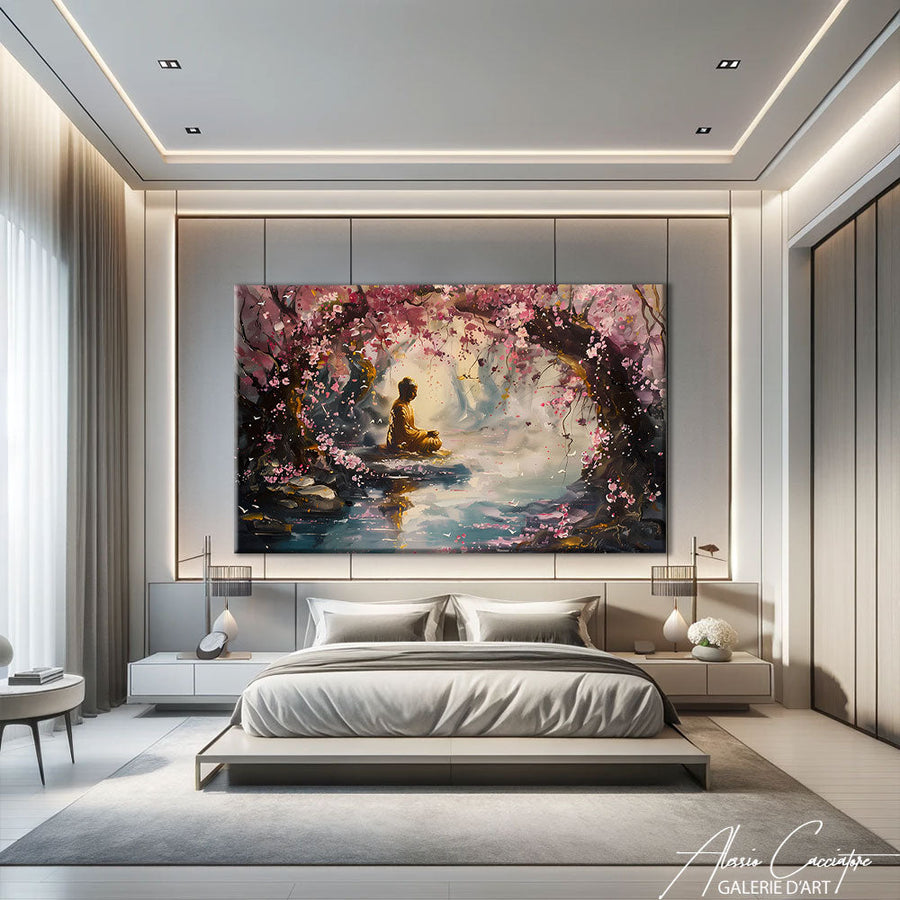
It is the best location, without hesitation. A horizontal format centered above the headboard, with 15 to 25 cm between the top of the headboard and the bottom of the canvas. Choose a subject with closed eyes or a very abstract composition: you will look at it right before sleeping. Our complete advice for this room is detailed in how to decorate a zen bedroom.

The living room: the wall you don't see from the television
A zen painting in a living room works on one condition: do not make it compete with the screen. Place it on the perpendicular wall, the one you see when sitting down, or above the sofa. Large format recommended—a 25 m² living room literally swallows small canvases. Aim for about two-thirds of the width of the piece of furniture below it.
The office and the entryway: two underestimated uses
Facing a workspace, a calm canvas serves as a resting point for the eyes between two tasks. And in an entryway, it sets the tone as soon as the door is opened: it is the first message your guests receive.

The bathroom: yes, but with caution
It is possible if the room is well-ventilated and the canvas is not exposed to direct splashes. Keep it away from the shower and avoid the wall directly behind the bathtub.
What size and hanging height?
The museum rule remains the most reliable: the center of the work at 150-155 cm from the floor. This is the average eye level of an adult standing. Two nuances, drawn from experience: in a bedroom or living room where you are seated, go down to 140-145 cm; under a high ceiling (more than 2.80 m), move it slightly higher, otherwise the canvas seems to slide downward.
For the format, measure your free wall and aim for 55 to 75% of its width. Below 50%, the work floats. A piece of advice I always give: cut a template out of kraft paper to the exact dimensions, tape it to the wall, and live with it for two days. You will immediately know if the size is right.
Canvas or plexiglass: what to choose for zen decor?
Our works exist in canvas stretched on wood frames and in a plexiglass version. The canvas has a matte grain that absorbs light: it is the most consistent choice with a zen atmosphere, especially in a bedroom where reflections are a nuisance. Plexiglass brings shine and depth, particularly flattering on gilding and in a dim room. When in doubt, and especially for a bedroom, choose the canvas.
Frequently asked questions
Is a zen painting necessarily a Buddha painting?
No. The Buddha is the most readable motif, but an abstract composition in shades of sand, a stylized lotus, or a minimalist landscape produce the same soothing effect. Zen is a matter of treatment, not an imposed subject.
Can you combine several zen paintings?
Yes, provided you unify them. Two or three canvases of the same height, same finish, spaced 5 to 8 cm apart, are read as a single horizontal band. What breaks the calm is mixing formats and styles on the same wall.
Does it work in a modern interior?
Very well, and that is actually where these works are strongest. Polished concrete, a straight-lined sofa, a zen canvas with earthy tones: the contrast between contemporary rigor and the softness of the subject is superb.
Where to start
If you only remember one thing: choose the room first, then the format, and only after that the motif. It is the reverse order of what most people follow, and that is why so many paintings end up poorly placed. Our selection of zen and Buddha paintings is designed for this: generous formats, mastered palettes, canvas or plexiglass finishes. And if the Japanese aesthetic attracts you more than the Buddha figure, take a look at our Japanese paintings, more graphic but just as contemplative. To extend the reflection to the entire room, our article how to decorate a zen living room usefully complements these tips. Take your time: a well-chosen canvas is something you will look at every day for years.