
Panda painting
13 œuvresDes œuvres en édition limitée, pensées par l'artiste pour illuminer votre intérieur.
Fait main en AllemagneLivraison offertePrêt à accrocher30 jours pour changer d'avis
-
Add to Wishlist PANDA PAINTINGDès 89 €
-
Add to Wishlist COLORFUL PANDA PAINTINGDès 89 €
-
Add to Wishlist CHILDREN'S PANDA PAINTINGDès 89 €
-
Add to Wishlist PANDA CHESS PAINTINGDès 89 €
-
Add to Wishlist GOLDEN PANDA PAINTINGDès 89 €
-
Add to Wishlist CHINESE PANDA PAINTINGDès 89 €
-
Add to Wishlist PAINTING WITH PANDADès 89 €
-
Add to Wishlist PANDA PAINTINGDès 89 €
-
Add to Wishlist PANDA MOON PAINTINGDès 89 €
-
Add to Wishlist NATURE PANDA PAINTINGDès 89 €
-
Add to Wishlist WINTER PANDA PAINTINGDès 89 €
-
Add to Wishlist PINK PANDA PAINTINGDès 89 €
-
Add to Wishlist PANDA POP ART PAINTINGDès 89 €






Chargement des œuvres suivantes…
Vous avez vu 13 œuvres sur 13


In decorative iconography, the panda occupies a truly singular place that no other animal can genuinely claim, for three reasons that exist nowhere else in the animal kingdom. First, it is the only animal in the world that is simultaneously a state diplomatic instrument and the global emblem of nature conservation: since 1972, China has loaned its pandas to countries with which it wishes to seal a privileged relationship, without ever giving them away—a practice known worldwide as "panda diplomacy." Since 1961, the panda has also been the emblem of the world's largest nature conservation organization, visible on millions of documents across the planet. No other animal bears both of these symbolic charges simultaneously. Next, it is the most graphic animal in the entire kingdom: its coat is a perfect natural black-and-white design—a black mask over the eyes, black ears, white body, black limbs—immediately legible even when stylized into three shapes, which explains its absolute reign over animal pop art, minimalist illustration, and all contemporary visual culture. Finally, it is the only large ursid that has become a vegetarian: an animal that is a carnivore by anatomy and dentition, yet eats 99% bamboo—up to thirty-eight kilograms per day—and spends fourteen hours a day eating while sitting in the misty forests of Sichuan. This paradoxical gentleness, in a one-hundred-kilogram animal capable of snapping bamboo stalks with a single hand, makes it the universal symbol of placid tranquility and the undisputed king of kawaii culture. The panda is also one of the rare great successes of global conservation: moved from the "endangered" category to "vulnerable" on the International Union for Conservation of Nature's Red List in 2016, it is the animal that proves a species can be saved. It is precisely this dimension of graphic gentleness iconography that our collection of panda paintings brings together: a selection of wall art printed on premium canvas and glossy plexiglass in our German studio, chosen for their ability to bring to a wall that presence which is both graphic and endearing, something only the panda can offer.
Giant pandas in front-facing portraits with their iconic black masks and calm gaze, pandas sitting in Sichuan bamboo forests chewing on a stalk with application, baby pandas rolling in the grass in an endearing composition, pandas climbing trees in the misty morning of the Chinese mountains, pop art pandas with vibrant solid colors, pandas in minimalist compositions reduced to their three black and white shapes, urban street art pandas with glasses and a quirky attitude, delicate watercolor pandas for nurseries, pandas sleeping curled up in the fork of a tree, mother pandas with their cub in an affectionate composition, red pandas with fiery colors in the foliage, stylized kawaii-inspired pandas with round shapes, pandas in Chinese-ink-style compositions on a bamboo background, pandas in timeless photographic black and white, pandas in contemporary geometric compositions, bamboo forests in vertical graphic compositions: each painting in this gallery has been designed as a decorative object charged with palpable graphic gentleness, capable of becoming the visual anchor for a child's bedroom, a nursery, a graphic black-and-white-themed living room, an office that appreciates a touch of irony, or a space that fully celebrates this unique animal in all its dimensions of tranquility and natural design.
Why the panda holds a unique decorative place
In recent years, the panda painting has undergone a particularly interesting cultural consolidation that is essential to understand to fully appreciate its decorative value. Long confined to children's bedrooms with a "plush toy" aesthetic, for the past decade the panda has conquered contemporary adult interiors, driven by several cultural convergences that are important to measure precisely. First is the recognition of its graphic dimension by contemporary illustrators and designers: the panda is likely the animal that best supports extreme stylization, recognizable in three black shapes on a white background, which has made it a favorite subject of animal pop art, Scandinavian minimalist illustration, and the graphic black-and-white decor that dominates contemporary interiors. Next is the global explosion of kawaii culture from Japan and China, that aesthetic of "assumed cuteness" which has conquered social media, fashion, and decor, and of which the panda is the king with its round shapes, black mask, and placid air. There is also the conservation dimension, which has become a decorative argument in its own right for a generation sensitive to ecology: hanging a panda is also displaying one's attachment to species protection, and the panda is the animal that embodies the successful realization of this protection, with its reclassification from endangered to vulnerable in 2016 and a wild population that has climbed back to approximately 1,860 individuals in the mountains of Sichuan. Then there is the exceptional media coverage of pandas in France: the arrival of a pair of pandas loaned by China in 2012, followed by the birth of the first baby panda on French soil in 2017, were followed by millions of people, making the panda one of the most popular animals in the country. Finally, there is the animal's paradoxical gentleness—this hundred-kilogram large ursid that has become a vegetarian, spending its days eating and sleeping—which makes it a symbol of tranquility particularly sought after in an era that values slowing down and letting go. For those who particularly love the animal world in its widest diversity, our animal collection offers an umbrella universe that admirably extends the spirit of this collection to other species.
Our selection process favors three essential qualities for this subject with specific requirements. Naturalistic accuracy first, because even with an animal that is so stylizable, enthusiasts recognize approximations: the exact layout of black spots (mask around the eyes and not over the whole face, ears, shoulders connected to the forelimbs by a black band, hind limbs), the round and massive morphology of the giant panda compared to the slender, red silhouette of the red panda which is an entirely different species, the characteristic sitting posture for eating, the specific bamboo-holding thumb. This precision distinguishes a refined panda from a generic stuffed animal. Mastery of graphic design second, because the panda calls for a very particular visual grammar based on black and white contrast: balance of black and white masses, legibility of the silhouette even when stylized, dialogue with the green of the bamboo which constitutes the only natural color of the subject, or conversely, an assumed chromatic explosion in pop art treatments. This orchestration requires true mastery so that the panda remains immediately recognizable regardless of the treatment. Gentleness third, because a successful panda painting does not just represent an animal: it must convey that particular quality of amused placidity, this blend of tranquility and tenderness that constitutes the very soul of the subject and which makes one smile while soothing. It is this purely affective quality that transforms a panda painting into a true benevolent presence in the home.
The major families of our panda collection
Our gallery explores all the great possible iconographies of this animal. Here are the main families that make up the selection.
The panda in the bamboo forest
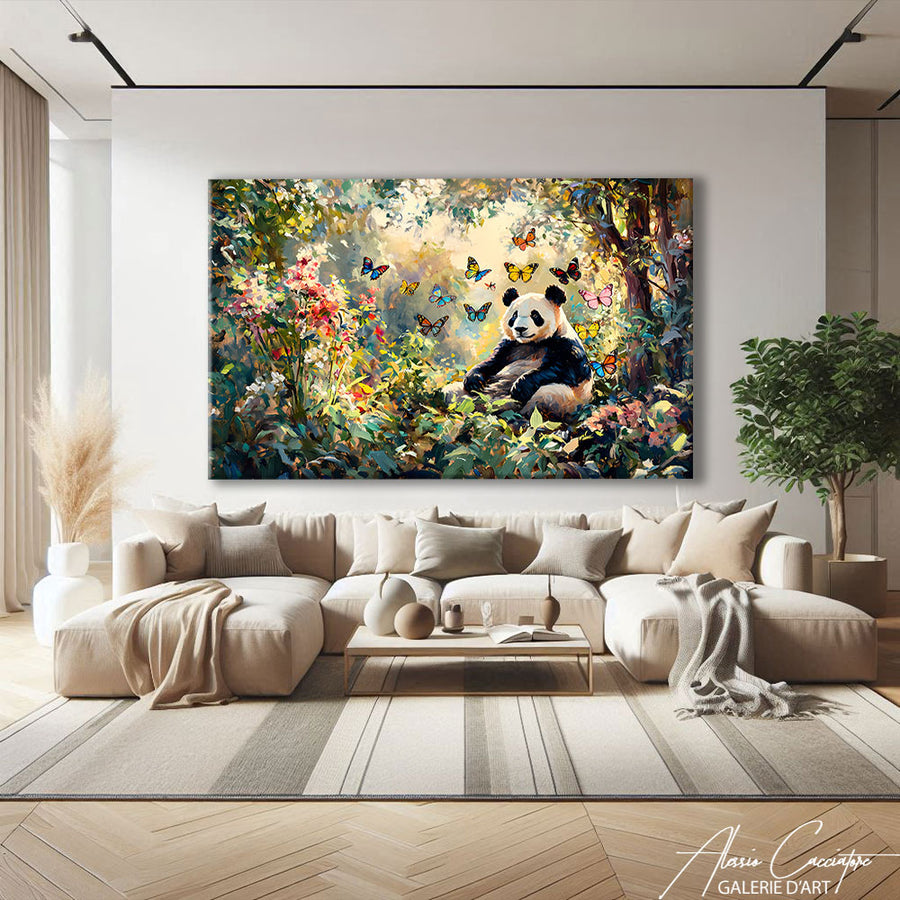
Probably our most naturalistic family. The panda in its habitat, the misty bamboo forests of the mountains of Sichuan, Shaanxi, and Gansu, between 1,200 and 3,000 meters in altitude, offers compositions of great poetry: a black and white mass amidst green stalks, mist filtering through the bamboo, a panda sitting and chewing a stalk with application, a panda climbing a tree for a nap. Our compositions celebrate this dimension in various treatments: panda facing forward in the bamboo, panda in profile eating, panda in the morning mist, Chinese-ink-style composition on a bamboo background. On matte canvas, which softens contrasts and respects the mist, the effect is particularly contemplative. To be combined admirably with our nature collection to extend the universe of great preserved habitats.
The black and white panda portrait
A particularly graphic family. The panda is the animal of black and white par excellence since its coat already is: the monochrome treatment only reveals what nature has designed. Frontal portrait in close-up on the mask, calm gaze in an intimate composition, panda in a timeless photographic composition, silhouette in maximum contrast. These compositions integrate with particular obviousness into contemporary black and white interiors and minimalist graphic decor. To be combined admirably with our black and white collection to explore this aesthetic more broadly.
The pop art panda
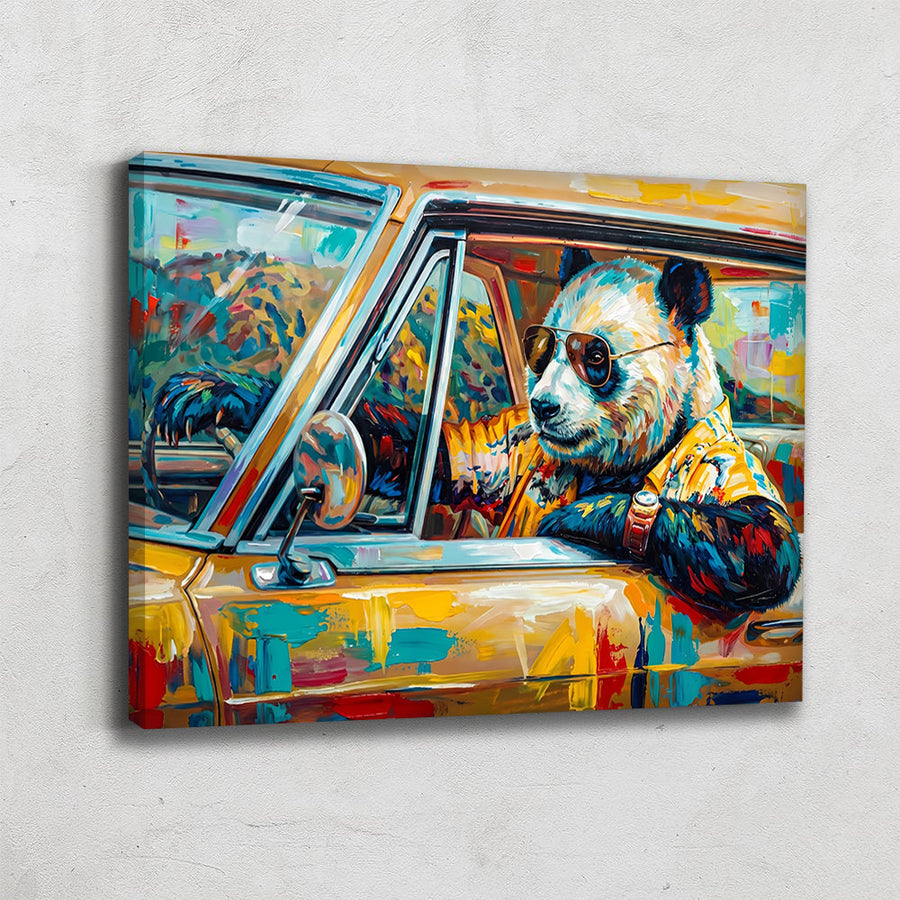
Particularly vitalized compositions. Pop art finds an ideal subject in the panda: its black and white silhouette lends itself admirably to saturated colored backgrounds, grid repetitions, and vivid flat tints that contrast with the natural sobriety of the animal. Our compositions celebrate this dimension in varied treatments: panda on a pink, turquoise, or yellow background, panda in a repetition of four or six colorful portraits, panda with sunglasses in a quirky composition, panda in modern silkscreen style. These paintings bring to an interior that dimension of graphic humor particularly adapted to kitchens, creative offices, and teenagers' bedrooms. To be combined admirably with our pop art collection to explore this aesthetic more broadly.
The street art panda
A particularly urban family. The panda has become one of the favorite animals of contemporary street art, precisely because its black and white silhouette reads on a wall like a natural stencil. Panda with a cap and urban attitude, tagged panda on a graffiti background, panda stenciled on brick, panda in a quirky composition with contemporary accessories. Our compositions celebrate this dimension in varied treatments that particularly speak to teenagers and urban loft interiors. To be combined admirably with our street art collection to extend this universe.
The baby panda and childlike gentleness
Particularly tender compositions. The baby panda, which is born pink and blind, the size of a stick of butter before becoming the most endearing black and white ball in the animal kingdom within a few months, has become one of the favorite subjects for nurseries and children's bedrooms. Our compositions celebrate this dimension in varied treatments: baby panda rolling in the grass, little panda clinging to its mother, baby panda in pastel watercolor, panda sleeping curled up in a soft minimalist composition. These compositions bring to a child's bedroom that reassuring and amusing presence that accompanies the early years.
The kawaii and stylized panda
A particularly contemporary family. Kawaii culture—the aesthetic of assumed cuteness that came from Asia and became global—has made the panda its king: exaggerated round shapes, enlarged eyes, plush proportions, pastel colors. Our compositions celebrate this dimension in varied treatments that remain original and not derived from licensed characters: kawaii panda in a minimalist composition, stylized panda in round geometric shapes, panda in a gentle contemporary Japanese-style illustration. To be combined admirably with our Asian collection to extend the spirit of this visual culture into other expressions.
The red panda
Particularly colorful compositions. The red panda, an entirely different species from the giant panda despite its name, with its flamboyant red coat, white mask, ringed tail, and silhouette like a small climbing fox, offers the subject a warm palette that the giant panda does not possess. Living in the same Himalayan and Chinese forests, it too is a threatened species. Our compositions celebrate this dimension in varied treatments: red panda in autumn foliage, red panda sleeping on a branch, close-up portrait on the white mask, red panda in a minimalist composition on a neutral background.
The minimalist and geometric panda
Particularly refined compositions. For the most demanding design interiors, our minimalist compositions reduce the panda to its essential forms: three black masses on a white background, silhouette in a continuous line, panda in a geometric composition of circles and ovals, panda in a single flat tint with a Scandinavian feel. These approaches allow the panda to enter refined decor without disrupting the general aesthetic of the space.
Bamboo forests
A particularly contemplative family. Bamboo, the exclusive setting for the panda, constitutes a major decorative subject on its own: vertical stalks in a graphic composition, bamboo forest crossed by light, bamboo in the mist, Chinese-ink-inspired composition. These compositions admirably accompany panda portraits as complementary hanging and also work alone in Zen interiors.
Ambience and style determine your choice
The panda comes in several distinct decorative registers depending on the sought-after atmosphere. Here are our guidelines to identify the painting that corresponds exactly to your project.
For a gentle and childlike atmosphere
Favor baby pandas, pastel watercolors, stylized kawaii pandas, and pandas sleeping curled up. On glossy plexiglass for easy maintenance. Particularly suitable for nurseries and children's bedrooms.
For a graphic and contemporary atmosphere
Turn to black and white portraits, minimalist compositions, and geometric pandas. On matte canvas for restrained elegance. Particularly suitable for design living rooms, minimalist offices, and Scandinavian interiors.
For a playful and quirky atmosphere
Opt for colorful pop art, urban street art, and pandas with glasses and accessories. On glossy plexiglass which intensifies the colors. Particularly suitable for kitchens, teenage bedrooms, and creative offices.
For a naturalistic and contemplative atmosphere
Choose pandas in bamboo forests, Chinese-ink-inspired compositions, and Sichuan mists. On matte canvas. Particularly suitable for Zen-inspired living rooms, soothing bedrooms, and meditation spaces.
The panda painting, room by room
Each room calls for its ideal panda painting depending on its use and the sought-after atmosphere. Here are our decorative recommendations.
In a child's bedroom or nursery
This is the historical favorite location for the panda painting, and it remains the most obvious. The panda is probably the most reassuring animal in the children's decorative bestiary: round, soft, placid, without the slightest worrying dimension. Baby panda, watercolor panda, kawaii panda, panda sleeping curled up. Size 60x40 cm or 80x60 cm, on glossy plexiglass for resistance to fingerprints. Our children's collection offers other complementary subjects adapted to this age.
In a teenager's bedroom
Configuration particularly adapted to quirky treatments. Street art panda with a cap, pop art panda on a saturated background, panda with sunglasses speak to this age that likes irony. Size 80x60 cm on glossy plexiglass. Our bedroom collection offers other complementary subjects for this room.
In a graphic-inspired living room
More unexpected but very successful. The black and white panda portrait in a large 120x80 cm format integrates with particular obviousness into contemporary monochrome living rooms, where it brings a presence that is both graphic and endearing, causing guests to react.
In a soothing bedroom
Contemplative configuration. The panda in misty bamboo, the Chinese-ink-inspired composition, the panda sleeping in a minimalist composition install an atmosphere of placid tranquility particularly conducive to sleep. Size 80x60 cm on matte canvas.
In an office or home office
Particularly relevant configuration for those who like irony. The panda, an animal that spends fourteen hours a day eating and the rest sleeping, has become an ironic icon of "letting go" in contemporary professional culture. Pop art panda, minimalist panda, panda with glasses. Size 60x40 cm or 80x60 cm.
In a kitchen
Playful configuration. The inveterate eater panda finds an amusing resonance in the kitchen. Colorful pop art on glossy plexiglass for easy maintenance.
In a bathroom
Graphic configuration. The black and white of the panda dialogues naturally with white tiles and sanitary ware. Plexiglass required in this humid room.
In a professional space with a children's or Asian vocation
Pediatric and pediatric dentistry offices, daycare centers and kindergartens, speech therapists, toy stores, Asian restaurants, Japanese or Chinese-style tea rooms, bubble tea shops, travel agencies specializing in Asia: the panda painting imposes itself as an obvious decorative choice that reassures children and amuses adults.
Choosing the format to magnify the panda
The format particularly conditions the effect of a panda painting because this round portrait subject benefits from being treated in proportions that respect its shape.
The compact size (60x40 cm) is ideal for intimate compositions (baby panda, close-up of the mask, watercolor) or in a series of three to create a coherent panda wall (for example, three pandas in three poses: eating, sleeping, climbing, or three treatments of the same portrait: naturalist, black and white, pop art). Particularly successful when hung in a row in a child's bedroom.
The medium size (80x60 cm) remains the versatile go-to size. Suitable for all compositions, from portraits to scenes in the bamboo. Above a child's bed, as an accent in an office, in a teenager's room: it provides a strong presence without dominating the room.
The large size (120x80 cm) is particularly well-suited for frontal black and white portraits for graphic living rooms and for bamboo forest scenes in an immersive composition.
The square size (60x60 cm or 80x80 cm) is arguably the most fitting format for the panda, whose round head and massive body fit naturally into a square. It is the format we recommend for all frontal portraits and kawaii compositions.
The panda triptych is a configuration particularly suited to this subject. Three panels that can feature three panda poses, three graphic treatments of the same portrait, or one panda surrounded by two bamboo panels. An immediately playful and graphic effect.
Premium canvas or glossy plexiglass: enhancing the natural black and white
The medium determines how your panda painting will render the subject's natural contrast and durably dress your wall.
Printing on premium canvas
Our canvas is hand-stretched over a 2 cm thick FSC-certified spruce wood frame. Its matte, delicately textured finish is particularly suited to naturalist compositions in misty bamboo, photographic-style black and white portraits, compositions inspired by Chinese ink, and delicate watercolors, whose softness it extends. It gives the panda's fur a velvety quality and softens contrasts. This is the choice we recommend for living rooms, calm bedrooms, and Zen-style interiors.
Printing on glossy plexiglass
Plexiglass makes pop art and street art compositions with saturated colors vibrate and gives black and white contrasts a sharp and spectacular rendering. It is also the preferred material for children's rooms due to its resistance to fingerprints, for kitchens for its easy maintenance, and for bathrooms for its moisture resistance. This is the choice we recommend for the majority of compositions intended for children and teenagers.
In both cases, our prints use high-definition, odorless, solvent-free ink, which is perfectly safe even in a child's room. The printing technology we use preserves contrasts and color fidelity for several decades. Each painting is delivered to you ready to hang, with a mounting system included.
Matching the panda to your existing decor
The panda is one of the easiest animal subjects to integrate because its natural black and white acts as a neutral. Here are a few paths depending on your style.
In a Scandinavian or minimalist interior
The perfect match. Light wood, white, gray, clean lines: the minimalist or black and white panda integrates with particular ease into this universe whose palette it shares.
In a Zen or Japandi interior
A natural configuration. Raw materials, a calm palette, plants: favor pandas in bamboo, compositions inspired by Chinese ink, and graphic bamboo forests.
In a pop and colorful interior
Colored walls, vivid furniture, playful spirit: favor pop art pandas on a saturated background and grid repetitions.
In a loft/urban interior
Concrete, brick, metal: favor street art pandas, stencils, and compositions with graffiti.
In a soft child's room
Pastels, natural wood, soft textiles: favor baby pandas in watercolor, kawaii pandas, and sleeping pandas.
In a contemporary black and white interior
A particularly sophisticated configuration. In a monochrome interior, the large-format panda portrait becomes the only living presence and brings a touch of tender humor to a rigorous decor.
Frequently asked questions about panda paintings
Do your panda paintings reproduce movie characters or logos?
Out of strict respect for copyright and trademark law (several famous pandas are licensed animated movie characters, sports event mascots, or protected organization logos), our compositions never reproduce any identifiable character, mascot, or logo. Our panda paintings are original creations that celebrate the real animal in its variety of treatments: naturalist, graphic, pop art, original kawaii.
Are all your panda paintings prints?
Yes, these are high-definition prints on premium canvas or glossy plexiglass, manufactured in our workshop in Germany. Our compositions are designed and printed with gallery quality, which allows us to offer highly refined work at an accessible price.
Is the panda painting suitable as a gift?
It is one of the most universally appreciated gifts one can give, for all ages. Ideal for a birth or baptism (baby panda for the nursery), a child's birthday, a gift for a teenager who loves street art, a present for someone sensitive to species conservation, a gift for an Asian culture enthusiast, or a housewarming for a graphic-style apartment. The 60x40 cm size on glossy plexiglass remains one of our most gifted items.
Is the panda painting suitable for a baby's room?
It is actually one of the most suitable subjects. The panda is round, soft, placid, without the slightest worrisome dimension, and its natural black and white contrast is particularly stimulating for the vision of infants, who distinguish strong contrasts long before colors. Favor soft compositions (baby panda, watercolor, sleeping panda) and glossy plexiglass for ease of maintenance. Our inks are solvent-free and odorless.
What is the difference between the giant panda and the red panda?
These are two entirely different species that only share a name and a bamboo-based diet. The giant panda is a 100-kilogram ursid with a black and white coat, living in the bamboo forests of Sichuan. The red panda is a small, 5-kilogram mammal with a fiery red coat, a white mask, and a ringed tail, related to raccoons, living in Himalayan forests. Our collection offers both: the giant panda for black and white graphic art, the red panda for a warm palette.
At what height should I hang a panda painting?
Center the painting at about 1.50m from the floor, the average eye level, to establish a face-to-face encounter with the animal's placid gaze. In a child's room, lower it to about 1.20m-1.30m so the child can also meet the panda's gaze.
Are your paintings delivered ready to hang?
Yes. The canvas is delivered stretched over its frame, with hooks fixed to the back. The plexiglass is delivered with its invisible mounting system. In both cases, installation takes less than five minutes.
How do I maintain my panda painting?
A quick wipe with a dry or slightly damp cloth is sufficient for both supports. Avoid abrasive products and prolonged exposure to direct sunlight to preserve the sharpness of the black and white contrast and the brilliance of the palettes that give these compositions all their charm.
Questions fréquentes
Quels sont les délais de livraison ?
La livraison est offerte dans le monde entier, sous 4 à 7 jours. Vous pouvez suivre votre colis à tout moment depuis la page « Suivre le colis ».
Le tableau est-il prêt à accrocher ?
Oui, le système d'accroche est inclus. Les toiles sont tendues sur un châssis en bois d'épicéa de 2 cm (4 cm en option) et les plexiglas sont livrés avec des rails d'accroche en aluminium invisibles.
Toile ou plexiglas : quelle différence ?
La toile est une vraie toile tendue sur un châssis en bois. Le plexiglas est incassable, protégé des rayures et du vieillissement, et travaillé à la main par nos artisans en Allemagne.
Puis-je retourner mon tableau ?
Oui, vous avez 30 jours pour changer d'avis : contactez-nous par e-mail ou par le chat. Et si votre œuvre arrive abîmée, nous la réimprimons, sans retour à faire.
Livraison offerte sous 4 à 7 jours
Fabriqué à la main en Allemagne
30 jours pour changer d'avis