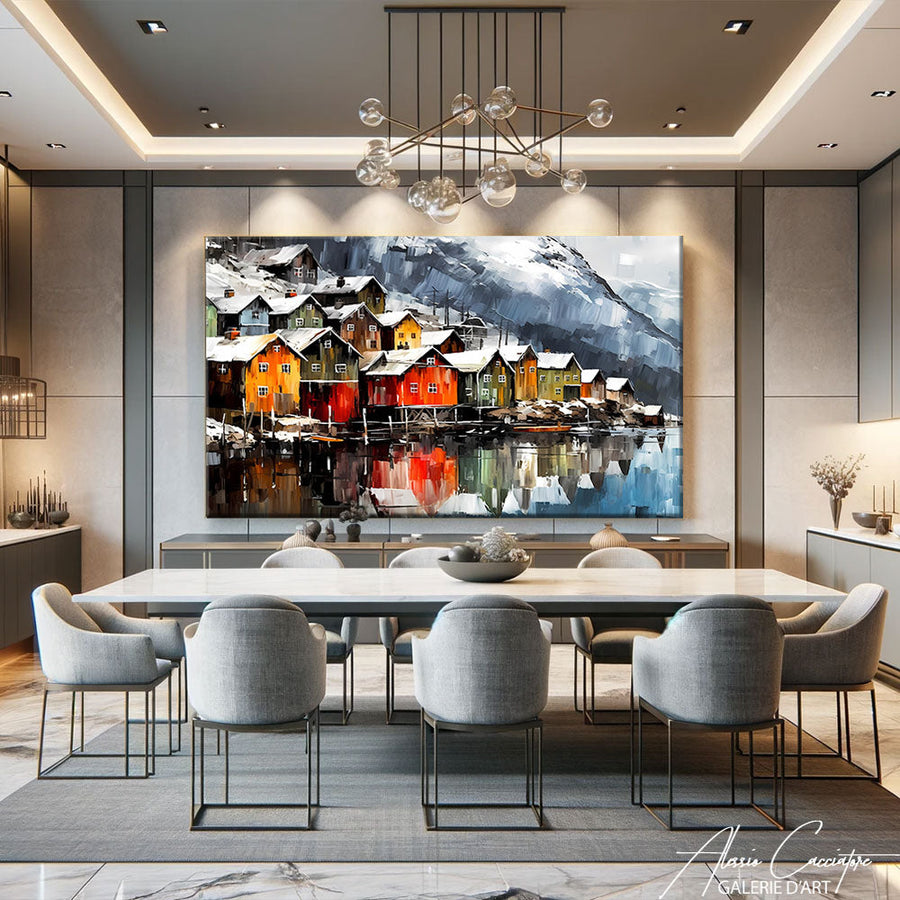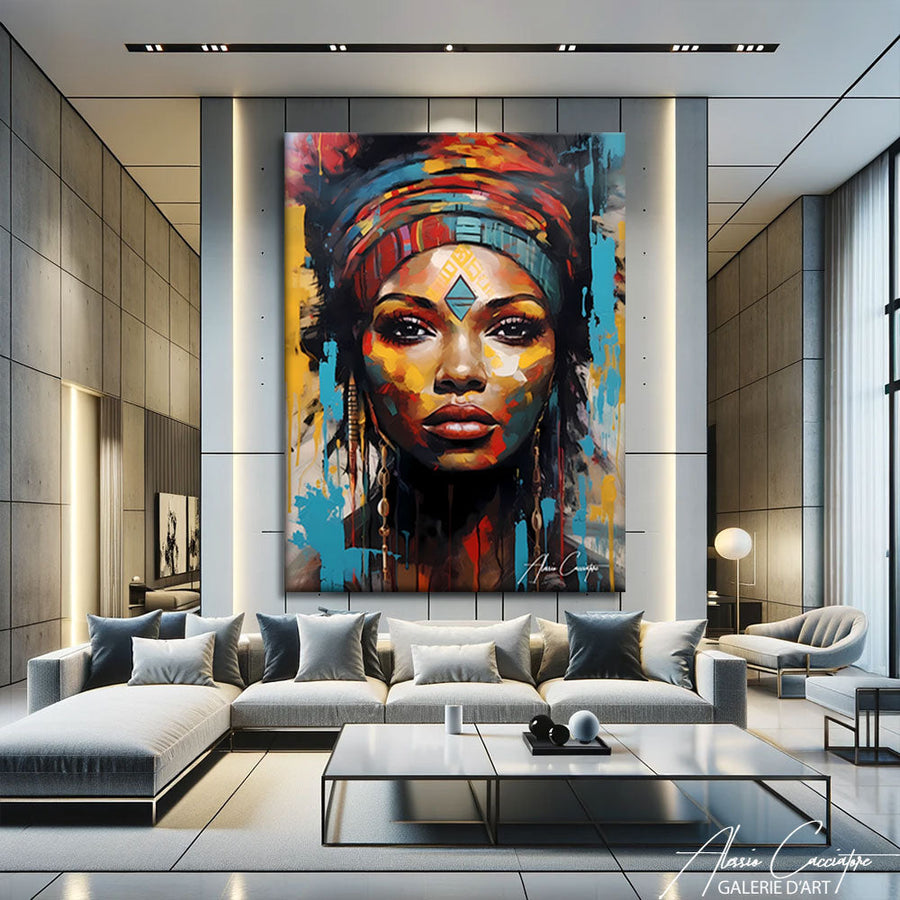

Imagine an old family photo taken in the 50s. Huge grain, faded colors, torn edges. You hesitate to enlarge it to 120×80 cm for the living room. Yet, once printed on canvas with the right settings, this kind of photo can become one of the most moving pieces in an interior. Because a photo print on canvas, when done well, is not just an enlarged print — it's an intention, a deliberate artistic choice.
Why canvas changes everything (and not classic photo paper)
Photo paper, even museum quality, remains paper. It shines under the light, catches reflections, ages quickly if you hang it facing a window.
Canvas, on the other hand, absorbs light differently. No unwanted reflections. A physical texture that gives body to the image. When you walk past it, you feel the material.
And then there's this strange thing: a photo on canvas becomes mentally a "work of art", not just "an enlarged photo". Guests stop in front of it. They ask where you found it. It has a different status in the space.
The three real technical differences
- Resistance over time: a canvas stretched on a wooden frame breathes, does not warp with humidity. Paper, even framed, remains fragile.
- Visual depth: the canvas texture gives a third dimension to the image, especially on portraits or landscapes with relief.
- Architectural integration: a frameless canvas (printed edges) integrates into a modern interior without weighing down the wall. Framed paper, it remains... framed.
In my opinion, if you have a photo that really matters — not the vacation selfie, but the one where your kid looks at the ocean at three years old — canvas is the only medium that does it justice.
Choosing the right format: not the one you think

Classic mistake: taking the format of the original photo. Your iPhone shoots in 3:4, so you order 60×80. Except that in your living room, between the sofa and the bookshelf, you need 100×70 so it can breathe.
Cropping a photo before printing is not damaging it — it's revealing it.
The formats that really work for people
Square format (50×50, 80×80, 100×100): ideal for centered compositions, tight portraits, abstractions. It works well in a series of three above a sideboard. But beware, square is demanding — if your composition is off-balance, it shows.
Classic landscape format (80×60, 120×80, 150×100): the standard for a reason. It naturally follows the human gaze, integrates above a sofa, a bed, a desk. It's my favorite format for city scenes, coastal landscapes, group photos.
Panoramic format (150×50, 180×60): spectacular, but difficult. You need a fairly long wall, a truly horizontal photo (not a forced crop), and a composition that guides the gaze from left to right. When it works, it's magnificent. When it fails, it looks like a stretched piece of photo.
Portrait format (60×90, 80×120): underestimated. Perfect for hallways, entrances, narrow walls between two doors. And frankly, a vertical portrait of 80×120 cm in a living room imposes a different rhythm — it breaks the monotony of horizontals.
My advice: measure the available wall space first, then choose the format. Not the other way around.
The quality of your photo: let's be honest for two minutes
Here's what annoys me: printing sites that let you order anything, even a 2015 Instagram photo in 120×80. They take your money, you receive a pixelated mess, and then you think that "canvas printing is not great".
No. It was your photo that wasn't good.
For a quality canvas print, you need at least 300 DPI at the final size. What does that mean concretely?
- For 60×80 cm: file of 7087×5315 pixels minimum
- For 80×120 cm: file of 9449×14173 pixels minimum
- For 100×100 cm: file of 11811×11811 pixels minimum
Your recent iPhone photos (since iPhone 12) are about 4000×3000 pixels. So for 60×40 cm, it works. For 120×80, forget it.
Exceptions that still work
Sometimes, a "technically" insufficient photo gives a magnificent result. This is often the case with old film prints, like the family photo mentioned at the beginning: the grain, the harsh contrasts, the slight blur — all of this can serve the image once printed large.
If your photo is graphic (strong contrasts, simple composition, saturated colors), it forgives low resolution better. If it is detailed (landscape with trees, crowd, complex architecture), it will be unforgiving.
My trick: I slightly blur the eyes, I zoom to 100% in Photoshop. If I see the pixels, it's dead for large format. If I still see sharp details, we can go for it.
Wall decorative canvas: the three mistakes that kill the effect

You can have the best print in the world, if you place it badly, it disappears. Or worse, it weighs down the space.
Mistake 1: Hanging too high
The golden rule: the center of the image at eye level (about 1.50 m from the floor). Not the top of the image — the center. People systematically hang too high, as if they were aiming for the ceiling. Result: you have to raise your head to see the image, it's uncomfortable, no one really looks at it.
Mistake 2: Choosing an image that clashes with the atmosphere
An example: a saturated tropical beach photo in an all-gray and light wood Scandinavian living room. It screams. No matter how perfect the print is, the image has no place there.
Your wall decorative canvas must dialogue with the room. Not necessarily match perfectly — but dialogue. A timeless black and white works everywhere. An explosion of colors requires a decor that can absorb it.
Mistake 3: Forgetting natural light
A canvas facing a window, even of good quality, will eventually lose its shine under the effect of UV rays. If you absolutely insist on this location, choose a high-contrast image where the loss of saturation will not be dramatic. Or put a sheer curtain.
What works every time
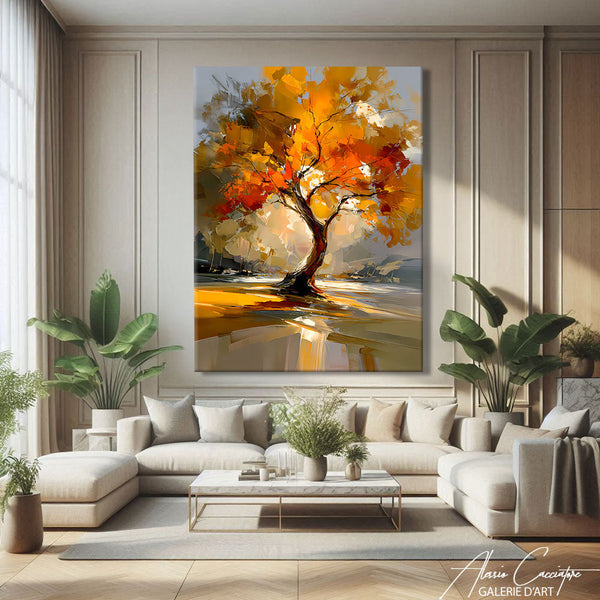
A wall decoration canvas above the sofa, 20 cm above the backrest, width between 50% and 75% of the sofa's width. It's the most visually balanced configuration, and one of my reflexes for contemporary artworks in a living room. There's no denying it, it works.
Canvas photo print artwork: when your photo becomes a piece of art
There is a difference between "printing a photo on canvas" and "creating a canvas print artwork". The latter implies an artistic intention. A treatment choice. A visual signature.
To transform a photo into a statement piece, three steps make the difference:
1. Chromatic treatment (not just an Instagram filter)
I push the contrasts, I desaturate some colors, I saturate others. The idea: so the eye feels that there was an artistic gesture. A raw photo, even beautiful, remains a photo. A worked photo becomes a piece.
Concrete example: a street photo in New York. I desaturate the yellows/greens (taxis, signs), I push the blues and reds. The image becomes more graphic, less documentary.
2. Deliberate cropping
I don't necessarily keep the whole image. Sometimes, the best artwork is 60% of the original photo. I zoom on a detail, I recenter, I cut what does not serve the composition.
An example: a family photo, three sisters still children in a garden. Cropped tightly on the three laughing faces, converted to black and white with a film grain, it's no longer a family photo — it becomes a timeless childhood portrait.
3. Thick frame (4 cm minimum)
If you want a "artwork" effect, take a frame of at least 4 cm thickness. It gives volume, physical presence. A canvas on a thin frame (2 cm) remains more discreet. A canvas on a thick frame becomes an architectural piece.
Frankly, these 15€ difference changes everything.
Canvas prints in series: composing a wall

One canvas is good. Three canvases that respond to each other is an installation.
I love composed walls — but it's difficult to get right. Here are three ways to do it when you want several canvas prints in the same space.
Option 1: Classic triptych
Three canvases of the same format (for example 60×80 each), spaced by 5-10 cm. The image can be a single photo cut into three, or three distinct but coherent photos (same palette, same light, same treatment).
What DOES NOT work: three random photos taken at different times. The eye looks for the link, does not find it, and it's uncomfortable.
Option 2: Organized multiple formats
A large central canvas (100×80) + two small side ones (50×40). Or a horizontal one (120×60) above, two squares (60×60) below. The important thing: keep a common vertical or horizontal axis. If everything floats in all directions, it's chaos.
I always draw the plan with a pencil before hanging. I stick masking tape on the wall to materialize the locations. It takes 10 minutes, it avoids three hours of hassle and ten holes in the wrong place.
Option 3: Gallery wall (for the brave)
5 to 9 canvases, various formats, spaced by 8-12 cm, which occupy an entire wall section. It's spectacular when done well. It's catastrophic when it fails.
My rule: all canvases must share at least two common points (same chromatic palette + same treatment / or same theme + same frames / etc.). Without that, it's just visual noise.
And honestly? If you hesitate between 2 and 5 canvases, start with 2. You can always add.
Maintenance and lifespan: what they don't tell you
A quality photo print on canvas, well hung, in good conditions, lasts 20 to 30 years without flinching. But there are conditions.
Regular dusting
Once a month, a quick dusting with a duster or dry microfiber cloth. No product, especially no Pledge or other spray that will clog the pores of the canvas. Just remove the dust before it gets embedded.
Avoid direct humidity
No canvas in the bathroom (unless excellent ventilation). Repeated water vapor will deform the wooden frame, make the canvas warp.
Protect from UV
If your canvas is facing a full south window, either you put a sheer curtain, or you accept that it will gradually lose its saturation. Modern inks are much more stable than before, but they remain sensitive to UV.
Repaint the edges if necessary
On a frameless canvas (printed edges), the edges can slightly wear over time if you handle it often. It's not serious — a touch of matching acrylic paint, no one sees anything.
What annoys me: people who invest 200€ in a beautiful print, and who leave it to rot in a damp corner because they didn't know. Take care of it, it will outlive you.
The steps of a successful photo print on canvas
To summarize, here is how to proceed concretely, from the choice of the wall to the hanging.
-
Define the need. Ask yourself the right questions: which room, which specific wall, what dominant colors in the decor, what desired atmosphere. Not "a beautiful canvas". But "a piece that gives character to my too tame living room" or "something that calms in my bedroom".
-
Source image selection. Check the resolution, mentally test the format.
-
Lightroom + Photoshop treatment. Adjust the contrasts, the saturation, the sharpness. Crop if necessary. A slight film grain can soften the digital on portraits.
-
Validation in the room. Before ordering, visualize the image in situation: a visual mockup, or a template with masking tape at the final size.
-
Professional printing. Favor pigment inks and a thick wooden frame, for the color retention and the presence of the canvas.
-
Hanging. Center of the image at eye level, and take the time to adjust before drilling.
Frequently asked questions
What minimum resolution for a photo print on canvas of 100×100 cm?
For an optimal result, you need a file of at least 11811×11811 pixels (that is about 140 megapixels). Below 7000×7000 pixels, you risk seeing pixels or an unsightly blur. If your photo is slightly below but the composition is graphic (strong contrasts, few fine details), it can still pass — but it's borderline.
How long does a printed canvas last hung in full sun?
With quality pigment inks, count about 5 to 8 years before visible fading if the canvas is exposed full south without protection. With a sheer curtain or by avoiding direct exposure, you easily get to 20-30 years. UV rays are the main enemy of canvas prints, much more than humidity or heat.
Can you print an Instagram photo on canvas in large format?
Technically yes, practically it's rarely a good idea. Instagram photos are often compressed and rarely more than 1080×1080 pixels. For a small format (30×30, 40×40 cm), it can pass. Beyond that, you will see the compression defects and the pixelation. If you absolutely insist on this image, limit yourself to 50×50 cm maximum.
Is it better to choose a frame of 2 cm or 4 cm thickness?
The 4 cm gives much more presence and "artwork" effect. The 2 cm remains more discreet, visually lighter. For a wall decorative canvas of more than 80 cm, I always recommend the 4 cm — it really changes the perception of the room. For small formats (40×50 cm), the 2 cm is more than enough.
Should you varnish a canvas print after receiving it?
No, modern professional prints do not need varnish. Varnish was necessary 15 years ago when inks were unstable, but today it's useless — and it can even alter the colors or create unwanted reflections. Just dust regularly with a dry cloth.
Can you transform several photos into a single large panoramic print?
Yes, provided that the photos were taken with sufficient overlap and identical light conditions. But beware: if the photos are taken at different times (changing light), the joints will be visible. In this case, better a composition of several distinct canvases than a forced assembly.
All the works mentioned in this article are available on the gallery. Free worldwide delivery, satisfied or refunded within 30 days.