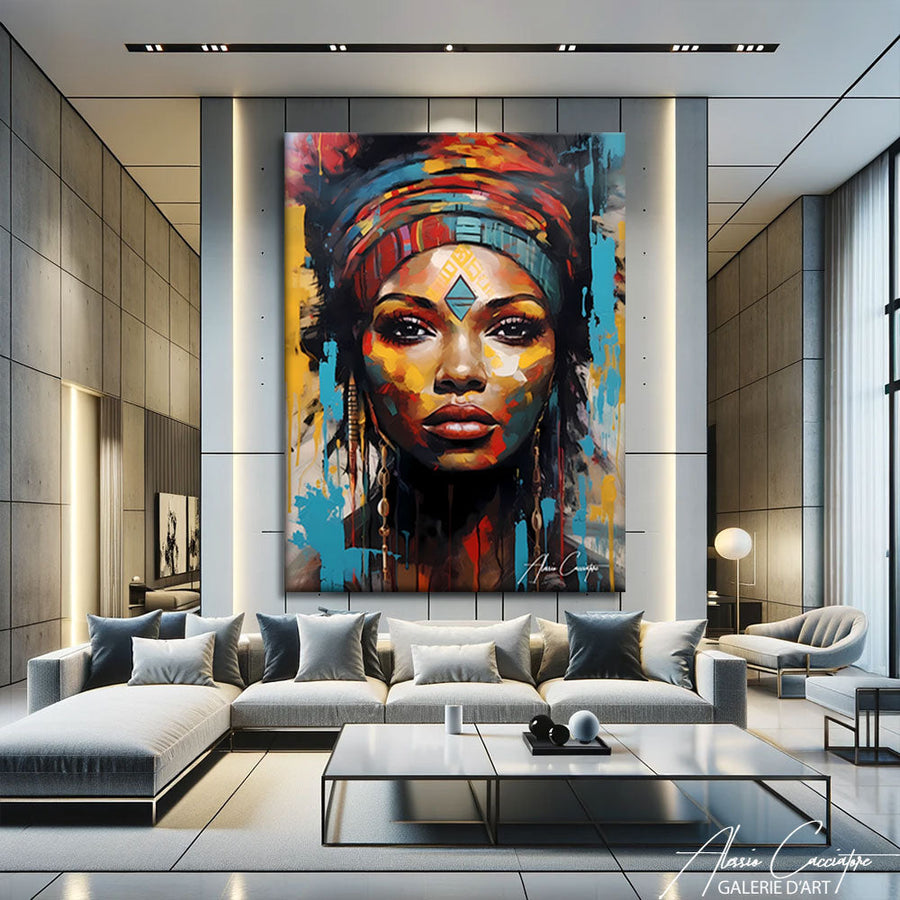

Many people search for “modern art, but not too weird.” Except that “modern,” in art, doesn’t mean what most people think it does. Modern art isn’t just a recent canvas with bright colors. It’s a specific period, with identifiable movements, that broke away from 19th-century academic art. And above all, it’s very different from contemporary art. In this article, I’ll give you 8 concrete criteria for recognizing, choosing, and hanging a modern-style painting in your home.
Modern vs. contemporary: the difference no one knows (and why it changes everything)
Let’s start by clearing up a common misconception.
In art, “modern” does NOT mean “recent.” Modern art refers to a historical period: roughly from 1860 (the Impressionists) to 1945–1950. Everything that came after 1945 is contemporary art.
So yes, when you search Google for “modern painting,” you’ll find current works. But technically, you’re looking for contemporary art.
Why does this matter?
Because the aesthetic rules are different. A true modern painting—a Cubist Picasso, an abstract Kandinsky, a Fauvist Matisse—has specific formal characteristics. It broke away from academic realism, but it remained rooted in painting: canvas, color, composition.
Contemporary art, on the other hand, can be a printed photograph, an installation, digital art, or mixed media. Frankly, anything goes.
So when you want “a chic modern painting” for your living room, ask yourself first: do I want a modern style (Cubism, Fauvism, abstract expressionism) or a recent work inspired by contemporary aesthetics (minimalism, street art, current geometric abstraction)?
This distinction completely changes your search.
Criterion 1 — The art movement: if you can’t name it, it’s probably not modern

Here’s a simple test.
Look at the painting you like. Can you say, “it’s Cubist,” “it’s Fauvist,” or “it’s abstract expressionist”?
If so, congratulations. You’re probably looking at a work that belongs to modern art or draws on its principles.
If you just say “it’s colorful” or “it’s abstract,” you might be looking at décor.
The major modern movements you should know
- Impressionism (1860–1886): visible brushstrokes, plays of light, outdoor scenes. Monet, Renoir.
- Fauvism (1905–1910): pure, non-naturalistic colors, bold flat areas. Matisse, Derain.
- Cubism (1907–1920): geometric fragmentation, multiple perspectives. Picasso, Braque.
- Expressionism (1905–1930): emotional distortion, raw colors. Munch, Kirchner.
- Lyrical and geometric abstraction (1910–1950): Kandinsky, Mondrian, Malevich.
- Surrealism (1920–1950): dreams, the unconscious, illogical juxtapositions. Dalí, Magritte.
- Abstract expressionism (1940–1960): gesture, materiality, large format. Pollock, Rothko.
If your painting belongs to one of these movements—or clearly engages with them—you have a modern-style work.
If it’s just “pretty and recent,” you might have a work that is primarily decorative.
Criterion 2 — The break from realism: a modern painting distorts, simplifies, and abstracts
Modern art is, above all, a rebellion against academic art.
Before 1860, a good painting had to be highly realistic, finely finished, and feature a noble subject (mythology, history, religion). The Impressionists said, “who cares, we’re painting light, not details.” The Cubists said, “we’re going to show a face from three angles at once.” The Fauves said, “a tree can be purple if we feel it’s purple.”
So a truly modern painting never tries to reproduce reality as it is.
It transforms it:
- Through color (Fauvism, Expressionism)
- Through form (Cubism, geometric abstraction)
- Through gesture (abstract expressionism, Tachisme)
- Through symbolism (Surrealism)
If you see a hyperrealistic landscape painted in 2024, it’s technically contemporary, but it’s NOT modern in style. In fact, it’s the opposite.
An abstract series often starts with a real form—a body, a movement—and simplifies it until only the emotion remains. That’s the modern spirit.
Criterion 3 — Technique: visible gesture, meticulous finish

Historically, a modern painting is pure painting.
Canvas, paint (oil, acrylic, tempera), and a human gesture.
That gesture, in fact, is often visible. Brushstrokes are not smoothed over, the paint is thick (impasto), and the marks of creation are embraced. Look at a Pollock: you can see the movement. Look at a Soulages: you can see the tool that scraped the surface.
For a work in your home today, what matters is that this gesture remains legible: precise details, deep blacks, true colors.
How to check
- Always check the support: canvas stretched over a wooden frame, plexiglass, exact dimensions
- Check the finish: canvas tension, frame quality, clean edges
- Look at close-up photos: precision of details, depth of blacks, color nuances
- Find out how the colors hold up over time and what the seller’s return policy is
At alessiocacciatore.com, every work is on canvas stretched over a wooden frame or plexiglass, and you have 30 days to change your mind.
Criterion 4 — The description: knowing exactly what you’re buying
A serious work is clearly described.
The product page should state:
- The style or movement that inspired the work
- The support and finish (canvas stretched over a frame, plexiglass, etc.)
- Delivery and return conditions
- Exact dimensions
With this information, you can judge the work before buying it: its style, its actual size on your wall, the quality of the canvas and frame.
Otherwise, you’re buying blindly.
Criterion 5 — Modern flower paintings and decorative motifs: watch out for traps

“Modern flower paintings” are a hit on Google (390 searches/month). No wonder: flowers always work in décor.
But here, you need to be very careful.
True modern paintings with flowers—think of Van Gogh’s sunflowers, Monet’s water lilies, Matisse’s floral compositions—are never just pretty. They experiment. They distort. They reinvent color, composition, and light.
Most of the “modern flower paintings” you find online are generic decorative motifs: stylized tulips, pastel peonies, “in the style of” bouquets.
How to tell the difference?
- See if the flower is reinterpreted (non-naturalistic colors, abstract form, expressive gesture) or just neatly depicted
- Look at the treatment of color: nuances, contrasts, boldness
- Look for the artistic intention: why this flower, why this color, why this format?
For example: a rose that isn’t treated “like a rose,” but through the tension of the stem, the stark contrast of red on matte black, the deconstruction of the petal. That’s a modern painting—even with flowers.
Criterion 6 — Chic modern painting: the balance between boldness and elegance
“Chic modern painting” is searched 720 times a month. And I understand why.
People want a work that makes a statement without falling into gaudiness or bland décor.
Chic in modern art is a subtle balance:
- Formal boldness (abstraction, unconventional color, asymmetrical composition)
- But restraint in execution (no over-the-top elements, no easy solutions, no kitsch)
A Rothko is chic. Two huge rectangles of color, nothing else. But the emotional intensity is incredible.
A Mondrian is chic. Three black lines, three primary colors, a meticulously balanced composition.
A Soulages is chic. Black on black, but with infinite depth.
What is NOT chic in modern art
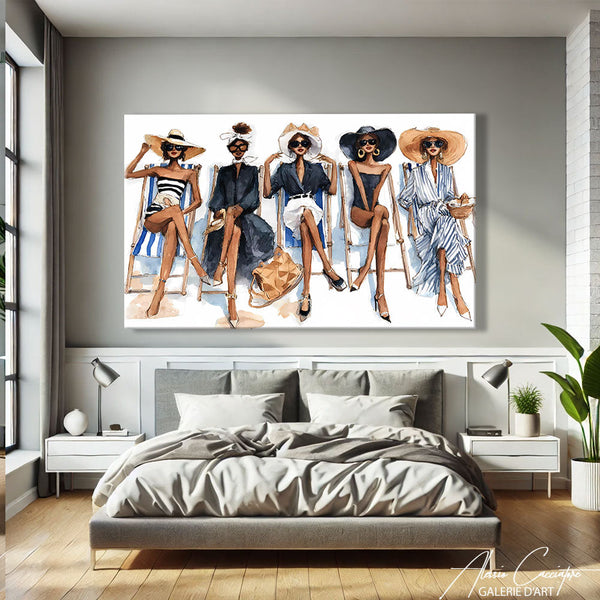
- Works that are too illustrative (“a painting of an elegant woman drinking champagne”)
- Repetitive motifs without intention (polka dots, stripes, logos)
- Overly saturated colors without nuance
- Standardized formats sold in sets of three on Amazon
Chic is character + sobriety. Easy to say, hard to find.
But when you come across it, you feel it immediately.
Criterion 7 — Format and hanging: a modern painting owns its presence
Modern paintings, especially after 1945, often play with large formats.
Pollock painted several-meter canvases on the floor. Rothko wanted his works to envelop the viewer. American abstract expressionists said, “forget small bourgeois living room formats, we want monumentality.”
So if you want a true modern painting for your interior, don’t be afraid of the size.
120x100 cm is a minimum for a main wall. 150x200 cm is even better if you have the space.
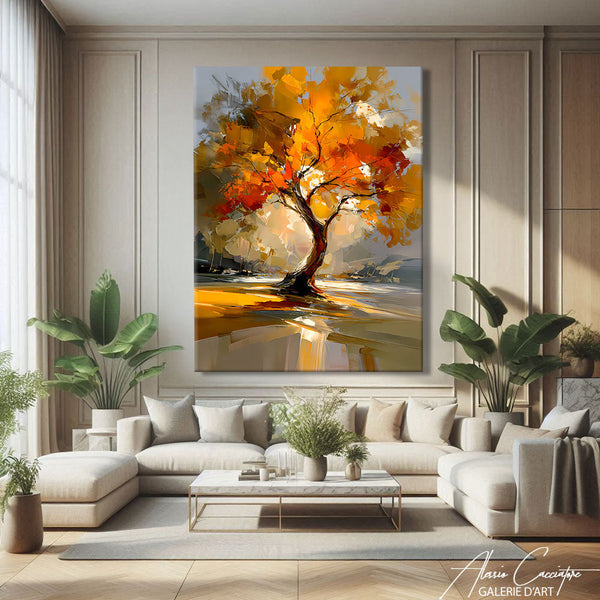
Obviously, not everyone has a New York loft. But even in a classic apartment, a well-chosen large format transforms the space.
Hanging rules
- Center the painting at eye level (1.50 m–1.60 m to the center of the work)
- Let it breathe: at least 20–30 cm around, with no furniture cutting it off
- If you have several paintings, avoid piling them up in an “Instagram gallery wall” style—that’s the opposite of the modern spirit
- One large painting > five small ones
I’ve seen too many beautiful works drowned in cluttered arrangements. A modern painting is enough on its own.
Criterion 8 — Price: how much to budget for a modern painting?
Let’s be honest.
An original—a unique piece by a living or recently deceased artist—rarely starts below €500–800.
For an emerging artist, budget €800–3000 depending on the format.
For an established artist (exhibitions, press, collections), budget €3000–15,000.
For a living legend or a major 20th-century name, it’s €50,000 and up.
Why these prices?
Because an original painting is:
- Dozens of hours of work
- Quality materials (canvas, frame, pigments)
- Technical expertise
- An artistic approach developed over years
- A unique piece that will never be reproduced
A quality print, however, allows for a large format at an affordable price: at alessiocacciatore.com, works start at €89, on canvas stretched over a wooden frame or plexiglass.
Judge it by concrete criteria: precision of details, depth of blacks, how the colors hold up over time, the quality of the canvas and frame, and the seller’s return policy.
If you have a limited budget, don’t give up on a large format: size is often what gives a modern painting its presence (see criterion 7).
How to choose YOUR modern painting: my 3 questions to ask yourself before buying
Okay. You’ve read all this. You now know how to tell the difference between modern and contemporary, recognize a movement, and avoid the traps.
But ultimately, how do you choose the work that’s right for you?
Here are my three questions.
1. Does this work move me emotionally, or is it just “nice with my sofa”?
If it’s just to fill a wall, get a mirror. A painting should provoke something: a punch in the gut, curiosity, a desire to look again.
2. Can I tell someone about this work?
You should be able to say, “It’s a lyrical abstraction, with a lot of black and red, and I love the tension it creates.” If all you can say is “it’s beautiful,” you haven’t found your work yet.
3. In 5 years, will I still be proud to have it in my home?
Modern art transcends eras. Décor trends come and go. You’ll love a good painting even more over time. A décor product, you’ll put in the basement after 18 months.
If you answer yes to these three questions, go for it.
Otherwise, keep looking.
Frequently asked questions
What’s the difference between modern art and contemporary art?
Modern art covers the period from roughly 1860 to 1945 (Impressionism, Cubism, Surrealism, abstract expressionism). Contemporary art refers to everything created after 1945. So when you search for a “modern painting” for your living room, you’re often actually looking for a contemporary work inspired by modern principles.
Original or reproduction: how to choose?
Both have their place. An original generally costs more; a quality print allows for a large format at an affordable price. In both cases, judge the precision of details, the depth of blacks, how the colors hold up, the quality of the canvas and frame, and the seller’s return policy.
What budget should I set for an original modern painting?
For an emerging artist, budget between €800 and 3000 depending on the format. For an established artist with a solid track record, between €3000 and 15,000. A quality print allows for a large format at an affordable price: judge it by the precision of details, how the colors hold up, and the quality of the canvas and frame.
Which modern art movements are most sought after for décor?
Geometric abstraction (Mondrian, Malevich) and abstract expressionism (Pollock, Rothko) work very well in contemporary interiors. Cubism and Fauvism bring color and dynamism. It all depends on your interior and your sensibilities, but avoid choosing solely to “make it look pretty.”
Can you mix modern art with contemporary décor?
Absolutely, and it’s even recommended. A minimalist contemporary interior is enhanced by a bold large modern painting. The important thing is to let the work breathe: a single large format on a clean wall will have much more impact than five small paintings crammed together.
Are modern paintings with flowers really modern art?
It all depends on the treatment. A decorative, realistic floral motif is not modern at all. On the other hand, an expressionist, abstract, or Fauvist reinterpretation of flowers (like Matisse or Van Gogh) fits well within modern art. Ask yourself: is the artist reinventing the motif, or simply reproducing it nicely?
All the works mentioned in this article are available in the gallery. Free worldwide shipping, 30-day money-back guarantee.