
A Buddha wall art piece is probably the most requested wall décor for zen interiors—and, let's be frank, one of the most poorly chosen. Many buy it as a "spa ambiance" accessory, then are surprised that the room lacks a certain something. Yet, a Buddha face hanging on the wall is not a neutral motif: it carries thousands of years of symbolism, it imposes its own palette, and it sets the tone for the entire room. What does it really mean? In which room should you hang it, at what height, and in what colors? Here are our practical answers, fueled by years of advising clients on our Buddha wall art collection.
What does a Buddha painting symbolize in a home?
The Buddha represents enlightenment—the state of one who has calmed their mind. In an interior, his image is primarily an invitation to tranquility: the face with half-closed eyes, a subtle smile, a meditative posture. It is a visual cue that says, "slow down here." It’s no wonder we find it in spas and yoga studios all over the world.
The details matter. The Buddha’s hands form codified gestures, known as mudras: hands joined on the lap for meditation, palm raised for protection, hand touching the ground for grounding. A face alone, in close-up, tends to evoke introspection. You don't need to be Buddhist to hang such a piece—most of our clients are not—but choosing a gesture that speaks to you gives the artwork a depth that a simple decorative motif will never have. A little workshop anecdote: the models where the face is slightly gilded sell twice as fast as the others. The gaze seeks light, even in serenity.
In which room should you hang a Buddha painting?
Anywhere you want to lower the tension a notch. Three rooms are particularly well-suited.
In the living room, as a centerpiece
Above the sofa or facing the room's entrance, a large Buddha immediately structures a zen living room. It advantageously replaces an accumulation of small frames, which only clutters the message. We have detailed this approach in our guide how to decorate a zen living room: a strong focal point, natural materials around it, and that’s all.

In the bedroom, to invite rest
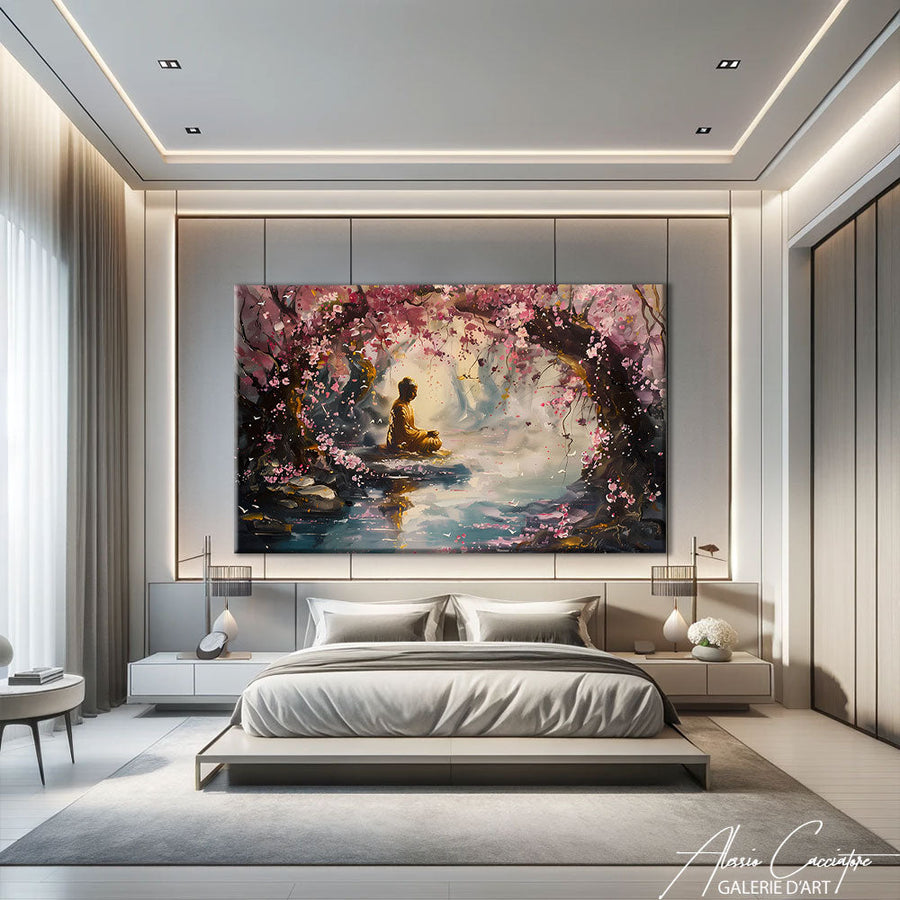
This is the most obvious—and most effective—location. A Buddha above the headboard visually calms the space even before you turn off the lights. Opt for versions with soft tones or blended colors here, and avoid jarring contrasts. Our article how to decorate a zen bedroom is a great complement to this topic if you are rethinking the entire room.

In the office or entryway, to mark a transition
Less expected, but incredibly effective: a Buddha in an office serves as a reminder to breathe between video calls, and in an entryway, it sets the tone from the moment you step inside. In these often narrow spaces, a vertical format works better than a panoramic one.

Which colors and style of Buddha painting should you choose?
Three main families dominate. The gilded or warm-toned Buddha brings a precious, almost solemn touch—stunning on a dark wall or in an interior with raw materials. The monochromatic gray or black-and-white Buddha offers absolute sobriety and fits with any style, from Scandinavian to industrial. Finally, the colorful Buddha, with its almost pop-art accents, breaks up an overly reserved look: it is our favorite for contemporary interiors that want zen without the full incense-and-pebble look.
A clear piece of advice: choose the painting's palette based on what already exists in the room, not the other way around. Picking up one or two shades present in your cushions or rug is enough to anchor the piece. And if you are drawn to Asian aesthetics beyond the Buddha, take a look at our Japanese wall art collection—waves, cherry blossoms, and prints dialogue beautifully with a Buddha in the same home.
What size and at what height should you hang it?
The rule that never fails: above a piece of furniture, the artwork should occupy about two-thirds of its width. For a 220 cm sofa, aim for 140 to 160 cm in width—an XXL format or a triptych. On a bare wall, the center of the painting should be at eye level, which is about 1.65 m from the floor. Above a headboard, leave 15 to 25 cm between the bed frame and the bottom of the frame.
Don't think too small. A 30 cm Buddha lost on a large wall produces the opposite of the desired effect: instead of soothing, it becomes an eyesore. When in doubt, go one size larger—cut out a newspaper template in the intended dimensions and tape it to the wall for a day; you'll know for sure.
Stretched canvas or plexiglass finish?
Our Buddha paintings are available as prints on canvas stretched over wooden frames, the classic, matte, and warm finish suitable for most zen interiors. The plexiglass option, on the other hand, brings depth and shine: the golds gain brilliance, and the contrasts gain intensity. It is especially justified in bright rooms and contemporary interiors—and can be wiped clean with a soft cloth.
FAQ: your questions about Buddha wall art
Does a Buddha painting bring good luck?
No work of art will change your destiny, let's be honest. However, in both Asian traditions and feng shui, the image of the Buddha is associated with harmony and the protection of the home. A respectful convention: avoid hanging it too low or in a neglected thoroughfare—place it high up, in a tidy space.
Can you hang a Buddha painting in a bedroom?
Yes, it is actually one of the best places for it. Choose soft tones, a format proportional to the headboard, and hang it securely above the bed or on the wall facing you when you wake up.
Which Buddha painting for a modern living room?
A close-up face, graphic treatment, or slightly gilded, in a large format. It’s the ideal compromise between a contemporary presence and serenity—without slipping into massage parlor décor.
A final word
A successful Buddha painting combines symbolism that speaks to you, a palette that matches the room, and a well-proportioned size. Take the time to compare postures, colors, and sizes in our Buddha wall art collection: the right model is the one in front of which you find yourself already breathing more slowly.