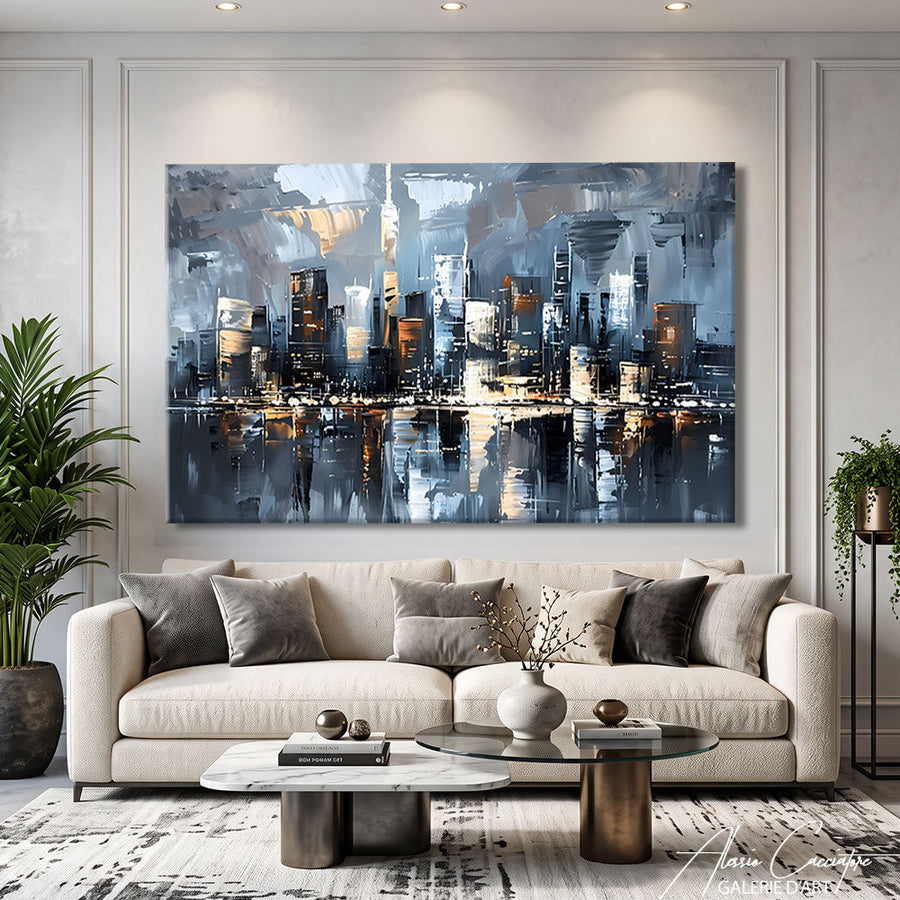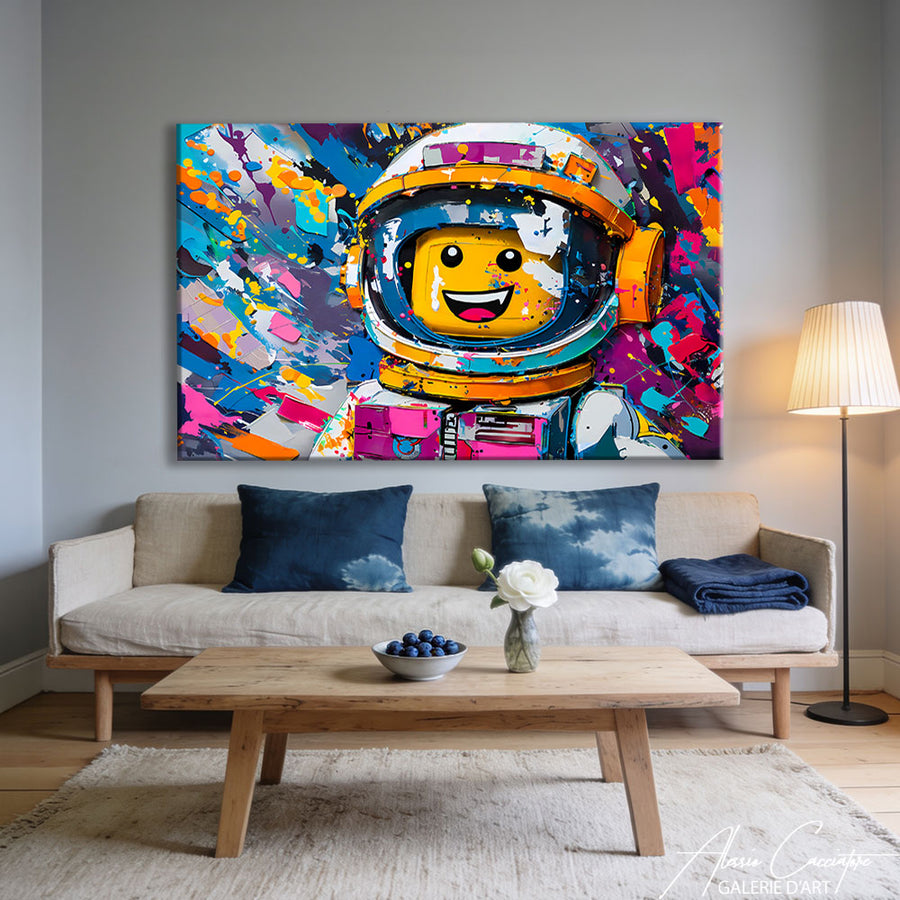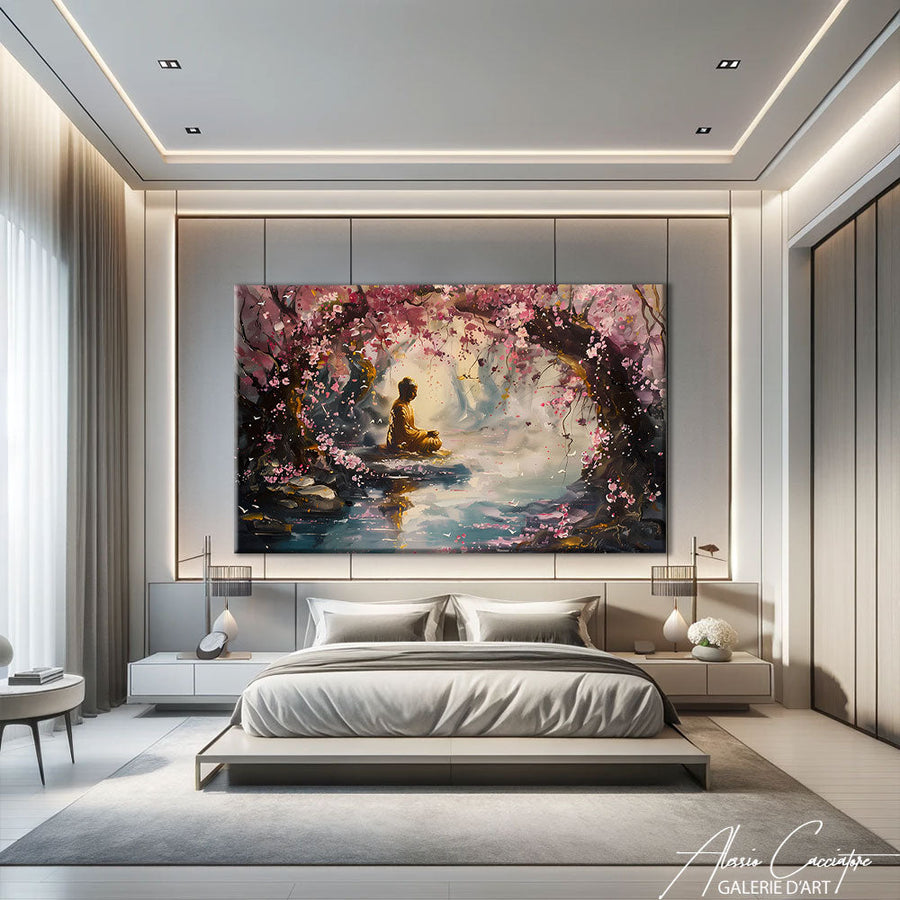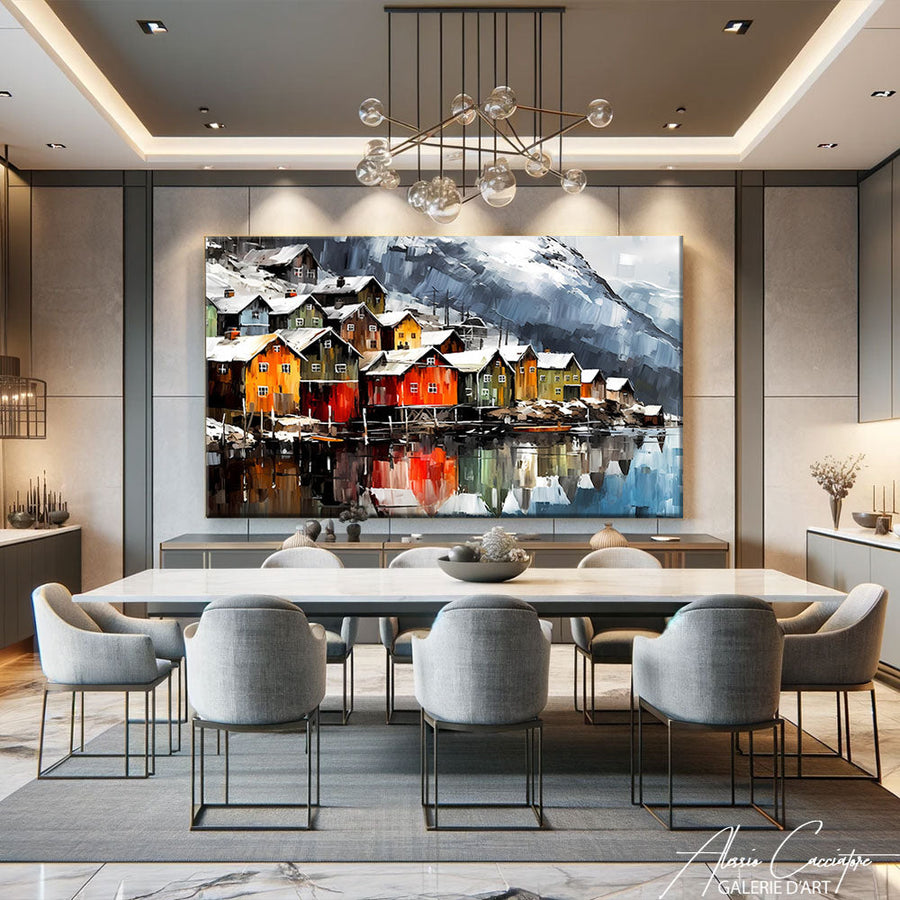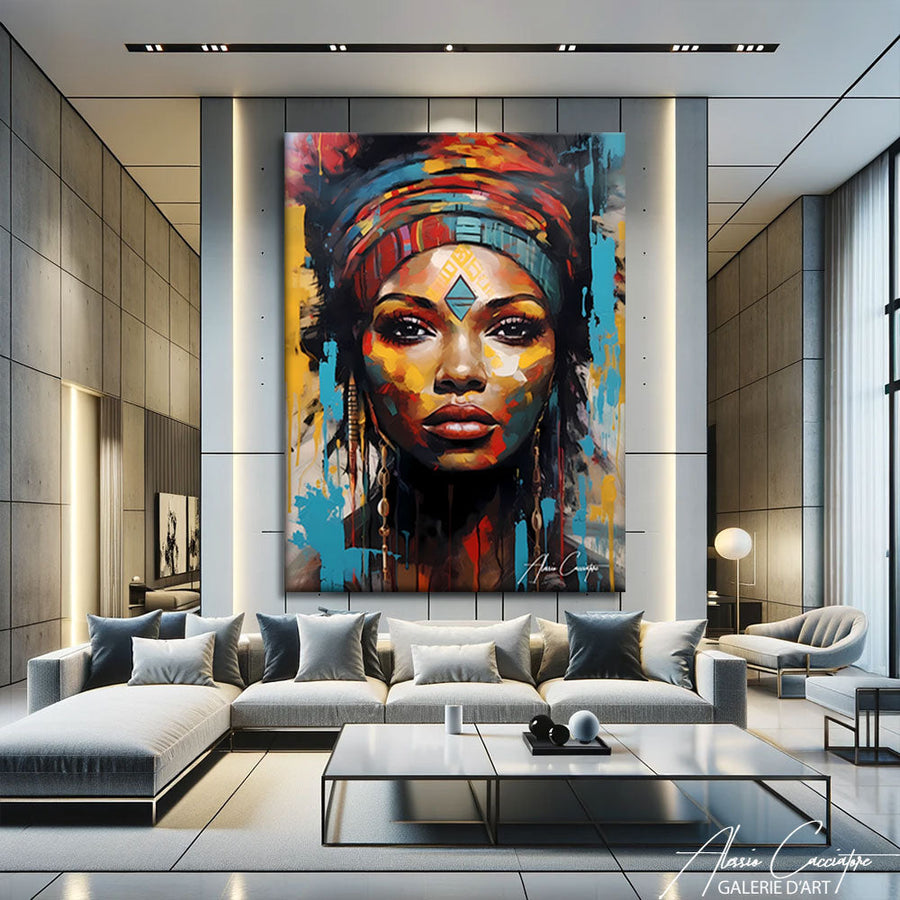

A single feminine portrait dresses a wall; several transform it into a personal gallery. This is the whole promise — and the whole difficulty — of modern women's paintings: as soon as you hang two or three, you must compose, balance, and make the styles dialogue without falling into clutter. How do you choose works that respond to each other rather than competing for the eye? Which room for which portrait, what size, what spacing between the canvases? After years of advising clients on this specific subject, one conviction has taken hold: success depends less on each individual work and more on the coherence of the whole. Here is the complete method, room by room, with concrete examples drawn from our collection of women's paintings.
What exactly does the term "modern women's paintings" cover?
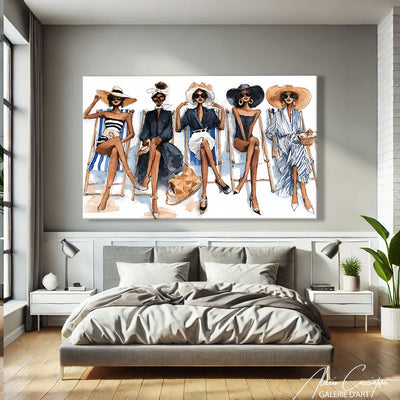
Under this heading, very different universes coexist. The graphic portrait first, often reduced to a few lines and flat tints of color, heir to the minimalism of the 2010s. The abstract silhouette next, where the female body is guessed at rather than shown — a genre of wild elegance when well executed. The glamorous, assertive, almost cinematic figure. And figures inspired from elsewhere: stylized African woman, Indian portrait with saturated colors. All these works share the same support with us: a print on canvas stretched over a wooden frame, with a plexiglass option for a more contemporary and brilliant rendering. My firm opinion: it is precisely this diversity of styles that makes the female subject so interesting to feature in several canvases — provided you keep a common thread.
How to combine several modern women's paintings without overloading?
The golden rule: a common point, a variation. Your canvases must share at least one element — a color palette, a graphic treatment, an emotion — and differ on the rest. Three identical portraits are boring; three portraits without any link are exhausting.
- The chromatic thread: a powdery beige or a deep black that recurs from one canvas to another is enough to unify very different styles.
- The odd number: two canvases compare, three compose. On a large wall, three works of different sizes create a natural rhythm.
- The breathing space: count 8 to 12 cm between two close canvases, more if the formats are large. A saturated wall suffocates even the most beautiful works.
- A single star: choose the dominant work — the largest or the most colorful — and let the others accompany it.
Anecdote from experience: a client from Lyon had lined up five feminine portraits of the same size with millimeter precision, like a frieze. The effect was strangely bureaucratic. We kept three canvases, staggered the heights, and the wall began to come alive. Sometimes, removing is better than adding.
Which room for which feminine portrait?
The living room: make way for pieces of character
This is where one dares to use large formats and compositions. A watercolor work in soft tones works wonderfully above a light-colored sofa, alone or flanked by a smaller canvas.

The bedroom: intimacy above all
In the bedroom, favor suggested subjects rather than frontal ones. A woman from behind, for example, brings a muted sensuality that imposes nothing — it is the choice I most often recommend for a headboard wall.

The entryway and office: the portrait that sets the tone
A modern female face in an entryway literally welcomes your guests; in an office, it stimulates without distracting. Opt for a medium vertical format, a strong gaze, a mastered palette.

What size and what hanging height?
For a single work above furniture, aim for about two-thirds of the width of the piece: a 210 cm sofa calls for a canvas or a composition of about 140 cm. The center of the work (or composition) should be placed 160-165 cm from the floor, the average eye level. For a set of several modern women's paintings, think in terms of a "block": it is the imaginary rectangle encompassing all the canvases that must respect these proportions, not each canvas individually. And if you are hesitating between two sizes, take the larger one — the classic mistake, which we detail in our guide how to choose a modern woman's painting, is undersizing.
Can one mix feminine styles with other universes?
Yes, and it is often what gives relief to an interior. A sleek feminine portrait coexists very well with a more striking work from our pop art paintings: the contrast between softness and energy creates an interesting visual tension, provided you keep a color connection between the two. To explore the path of colorful faces, our article on the colorful woman's face painting delves deeper into the subject.
FAQ: your questions about modern women's paintings
Can you combine a black and white portrait with colored canvases?
Absolutely, black and white acts as a visual breath between two colored works. Just ensure it is not the smallest canvas in the set, otherwise it disappears.
How many paintings on the same wall?
Three is the magic number for a wall of 3 to 4 meters. Beyond five, you shift into a "gallery wall" spirit, which requires real alignment rigor and is better suited to small formats.
Classic canvas or plexiglass finish?
Canvas stretched over a wooden frame offers a matte, warm, non-reflective finish — ideal in a bedroom. Plexiglass intensifies colors and brings a contemporary art gallery touch, superb in a bright living room or an entryway.
In summary: compose your feminine gallery
Choosing modern women's paintings means composing a choir rather than lining up soloists: a common thread, a star work, breathing spaces, and subjects adapted to each room. Take the time to visualize the whole before hanging — and trust yourself: the portrait that stops you for more than ten seconds is rarely a bad choice. To find the pieces for your future composition, browse all the women's paintings in the gallery: graphic portraits, abstract silhouettes, and glamorous figures are gathered there, all printed on canvas with a plexiglass option.