
Islam Table
142 œuvresDes œuvres en édition limitée, pensées par l'artiste pour illuminer votre intérieur.
Fait main en AllemagneLivraison offertePrêt à accrocher30 jours pour changer d'avis
-
Add to Wishlist ISLAMIC ABSTRACT PAINTINGDès 89 € 71,20 €
Dès 89 €
-
Add to Wishlist ISLAM CALLIGRAPHY PAINTINGDès 89 € 71,20 €
Dès 89 €
-
Add to Wishlist ISLAM LIVING ROOM TABLEAUDès 89 € 71,20 €
Dès 89 €
-
Add to Wishlist MODERN ISLAMIC PAINTINGDès 89 € 71,20 €
Dès 89 €
-
Add to Wishlist ARABIC CALLIGRAPHY PAINTING WITH FLUID LETTERSDès 89 € 71,20 €
Dès 89 €
-
Add to Wishlist ORIENTAL ARABESQUE PAINTINGDès 89 € 71,20 €
Dès 89 €
-
Add to Wishlist ABSTRACT MOSQUE PAINTINGDès 89 € 71,20 €
Dès 89 €
-
Add to Wishlist ABSTRACT ORIENTAL PAINTINGDès 89 € 71,20 €
Dès 89 €
-
Add to Wishlist ORIENTAL PAINTINGDès 89 € 71,20 €
Dès 89 €
-
Add to Wishlist ORIENTAL DESIGN TABLEAUDès 89 € 71,20 €
Dès 89 €
-
Add to Wishlist BLACK AND WHITE ORIENTAL PAINTINGDès 89 € 71,20 €
Dès 89 €
-
Add to Wishlist MOROCCAN WOMAN PAINTINGDès 89 € 71,20 €
Dès 89 €
-
Add to Wishlist ORIENTAL WATERCOLOR PAINTINGDès 89 € 71,20 €
Dès 89 €
-
Add to Wishlist ORIENTAL GOLDEN PAINTINGDès 89 € 71,20 €
Dès 89 €
-
Add to Wishlist MODERN ARABIC PAINTINGDès 89 € 71,20 €
Dès 89 €
-
Add to Wishlist ORIENTAL WOMAN PAINTINGDès 89 € 71,20 €
Dès 89 €
-
Add to Wishlist ISLAMIC CRESCENT CHARTDès 89 € 71,20 €
Dès 89 €
-
Add to Wishlist EXOTIC ORIENTAL PAINTINGDès 89 € 71,20 €
Dès 89 €
-
Add to Wishlist HORIZONTAL BLUE MOSQUE ISLAMIC WALL ARTDès 89 € 71,20 €
Dès 89 €
-
Add to Wishlist ARAB RELIGIOUS PAINTINGDès 89 € 71,20 €
Dès 89 €




Chargement des œuvres suivantes…
Vous avez vu 100 œuvres sur 142


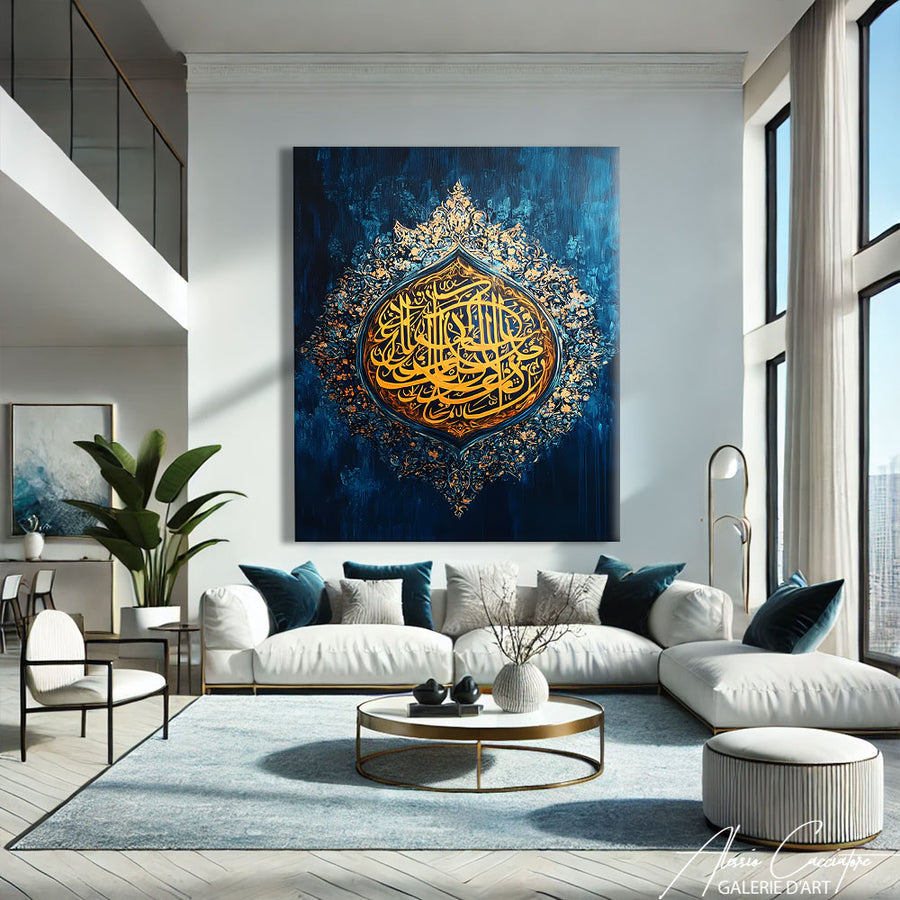
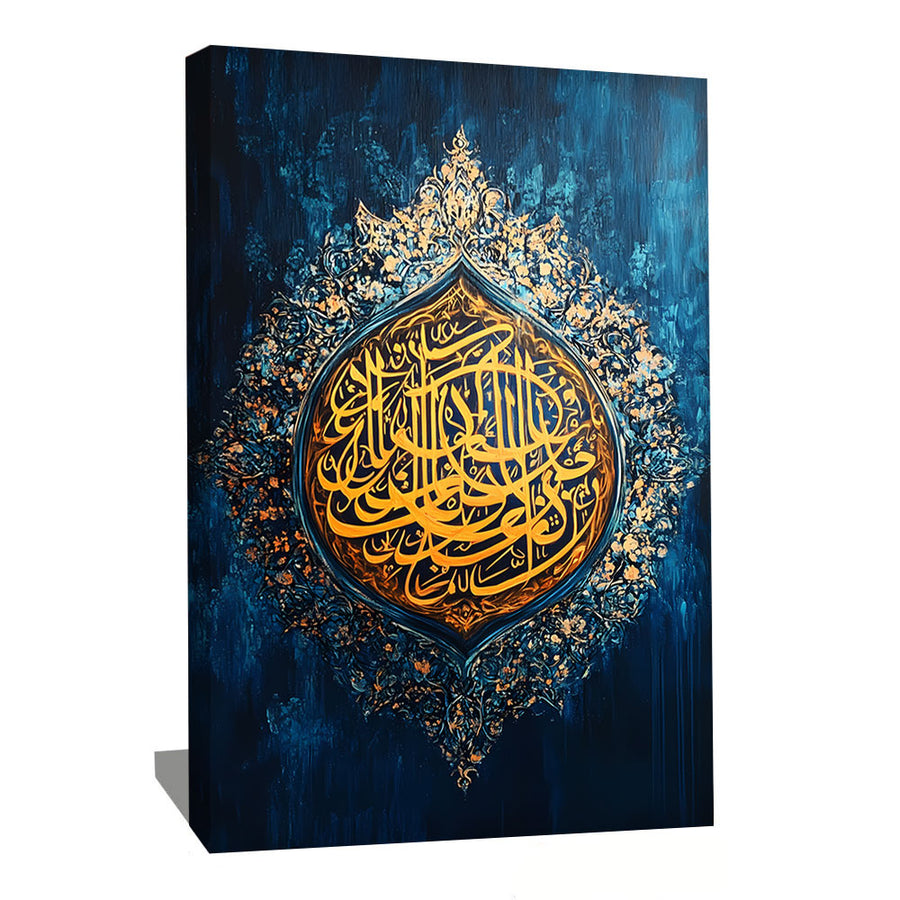
Islamic art holds a unique place in wall decoration. Islamic art is the only major religious art without images. Tradition forbids the depiction of God and the prophets. Faith is therefore expressed in three forms, and only three. First, writing: the Arabic calligraphy of Quranic verses, the names of Allah, and invocations. Next, geometry: stars, polygons, and infinite interlacing patterns that express the unity and infinity of God. Finally, the arabesque: tendrils and foliage that evoke the gardens of paradise. This rule, aniconism, has produced one of the most refined arts in the world. An Islamic artwork is by nature a picture of words and shapes, never of figures. In a Muslim home, it has a specific function. Remembrance, dhikr, with the name of Allah or an invocation on the living room wall. Protection, with the Throne Verse, Ayat al-Kursi, placed near the entrance. Blessing, with the Bismillah above a door. Beauty that uplifts, with a mosque or sacred geometry. Our collection of Islamic art brings together all this Islamic decoration, with the respect it demands. Each Islamic artwork is printed on premium canvas or glossy plexiglass in our workshop in Germany. Each canvas is chosen for its accuracy, its beauty, and its place in the home.
Our gallery brings together all the families of Islamic decoration. Calligraphy of the name of Allah in gold on a black background. Bismillah in modern calligraphy. Ayat al-Kursi, the Throne Verse, in a complete composition. Shahada, the profession of faith. Surahs and verses of the Quran in classical or contemporary calligraphy. The ninety-nine names of Allah in a golden composition. Everyday invocations: Alhamdulillah, SubhanAllah, MashAllah. The Kaaba and Masjid al-Haram in Mecca, by day and by night. The Prophet's Mosque in Medina and its green dome. The Dome of the Rock in Jerusalem. The Blue Mosque in Istanbul. Minarets and domes at sunset. Sacred geometries: eight-pointed stars, interlacing patterns, mosaics. Arabesques and gardens of paradise. Crescents and Ramadan lanterns. Eid Mubarak compositions for Eid. Islamic artworks in black and gold, blue and gold, minimalist or classical. Islamic triptychs for the living room. Each Islamic wall artwork brings remembrance, protection, and beauty to the home.
Why Islamic decoration has a place in the home
An Islamic artwork is not a decoration like any other. In Muslim tradition, the home is a place of faith as much as of life. Calligraphy on the wall reminds one of God daily. This is the meaning of dhikr, remembrance. Several reasons explain the growing place of Islamic art in interiors. First, tradition: for centuries, Muslim homes have adorned their walls with verses and the names of Allah, from the Maghreb to Indonesia. Modern Islamic art extends this tradition with today's codes. Next, function: the Throne Verse protects the home, the Bismillah blesses the entrance, the names of Allah accompany prayer. An Islamic artwork has a role, not just beauty. Then again, aesthetics: Arabic calligraphy and Islamic geometry are among the most beautiful arts in the world, and their modern versions, in black and gold, minimalist, harmonize with contemporary interiors. Then occasions: Ramadan, Eid al-Fitr, Eid al-Adha, a wedding, a birth, a return from pilgrimage, a housewarming are all moments when an Islamic artwork is given as a gift. Finally, transmission: hanging a verse in the living room is also teaching it to the children. For those who wish to explore Arabic writing beyond religious texts, our Arabic calligraphy collection offers first names, proverbs, and poems.
Our selection of Islamic artworks rests on three absolute requirements. Accuracy of the text first. A Quranic calligraphy must be exact: every letter, every dot, every sign. An error in a verse is not a matter of taste, it is a serious fault. Our calligraphies reproduce the texts with the greatest rigor. Respect for the rules next. No human or animal figures in religious compositions. No sacred text placed inappropriately. Holy places represented with dignity. Beauty finally. Islamic calligraphy must uplift the gaze: balance of full and thin strokes, harmony of gold and black, purity of geometry. It is this beauty that makes an Islamic artwork an object to be contemplated with the heart.
The major families of our Islamic collection
Our gallery explores all forms of Islamic art. Here are the main families of the collection.
Calligraphy of the name of Allah
This is the most requested family. The name of Allah in calligraphy is the Islamic artwork par excellence. In gold on a black background, in white on a midnight blue background, in black on a white background, in classical thuluth style or in a sleek modern style. Our compositions celebrate this name in varied treatments: Allah in golden calligraphy, Allah in a minimalist composition, Allah and Muhammad in a diptych, Allah surrounded by arabesques. These artworks are suitable for the living room and the entrance. To be combined with our golden collection to extend the radiance of gold.
Ayat al-Kursi and verses of protection
The Throne Verse, Ayat al-Kursi, is the verse most hung in Muslim homes. It protects the house. It is placed near the entrance, in the living room, or in the bedroom. Surahs Al-Falaq and An-Nas, the two protective ones, and Surah Al-Ikhlas complete this family. Our compositions celebrate these verses in varied treatments: complete Ayat al-Kursi in golden calligraphy, Throne Verse in a modern black and gold composition, verse in a circle, verse in a triptych. These artworks are suitable for the entrance and the living room.
The Bismillah and everyday invocations
Bismillah ar-Rahman ar-Rahim, in the name of God, the Clement, the Merciful, opens every action of the Muslim. It is hung above a door, in the kitchen, in the entrance. Alhamdulillah, SubhanAllah, MashAllah, Allahu Akbar complete this family of invocations. Our compositions celebrate these words in varied treatments: Bismillah in circular calligraphy, modern Bismillah on a solid background, Alhamdulillah in a golden composition, the four invocations in a series. These artworks are suitable for all rooms.
The ninety-nine names of Allah
The most beautiful names of God, Asma ul-Husna, gathered on a single canvas form one of the richest Islamic artworks. Our compositions celebrate this family in varied treatments: the ninety-nine names in a golden grid on a black background, in a spiral, in a circle around the name of Allah, in a triptych. These artworks are suitable for the living room and the prayer room.
The Kaaba and Mecca
The Kaaba in the center of Masjid al-Haram is the most universal image of Islam. Seen at night, illuminated, surrounded by pilgrims in tawaf. Seen by day, under the sun. Seen from above, with the minarets. Our compositions celebrate this place in varied treatments: Kaaba at night in a luminous composition, Kaaba in black and gold, Mecca in a panoramic view, Kaaba in a minimalist composition. These artworks are suitable for the living room, and are the ultimate return-from-pilgrimage gift.
Mosques and holy places
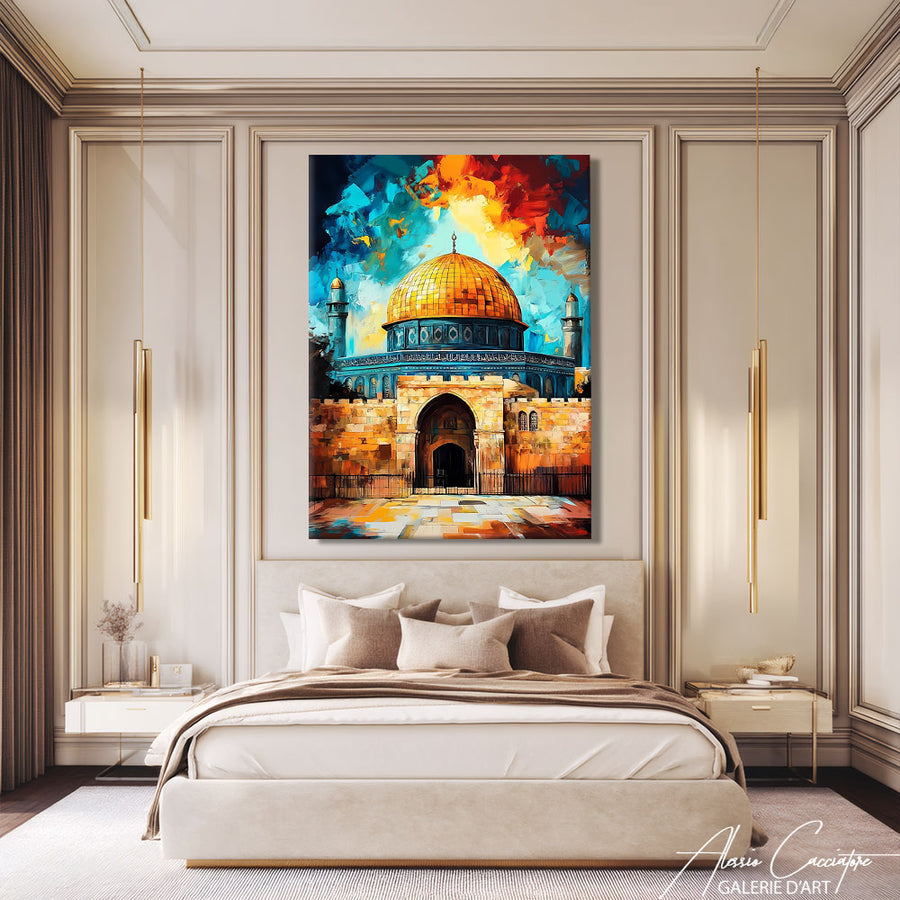
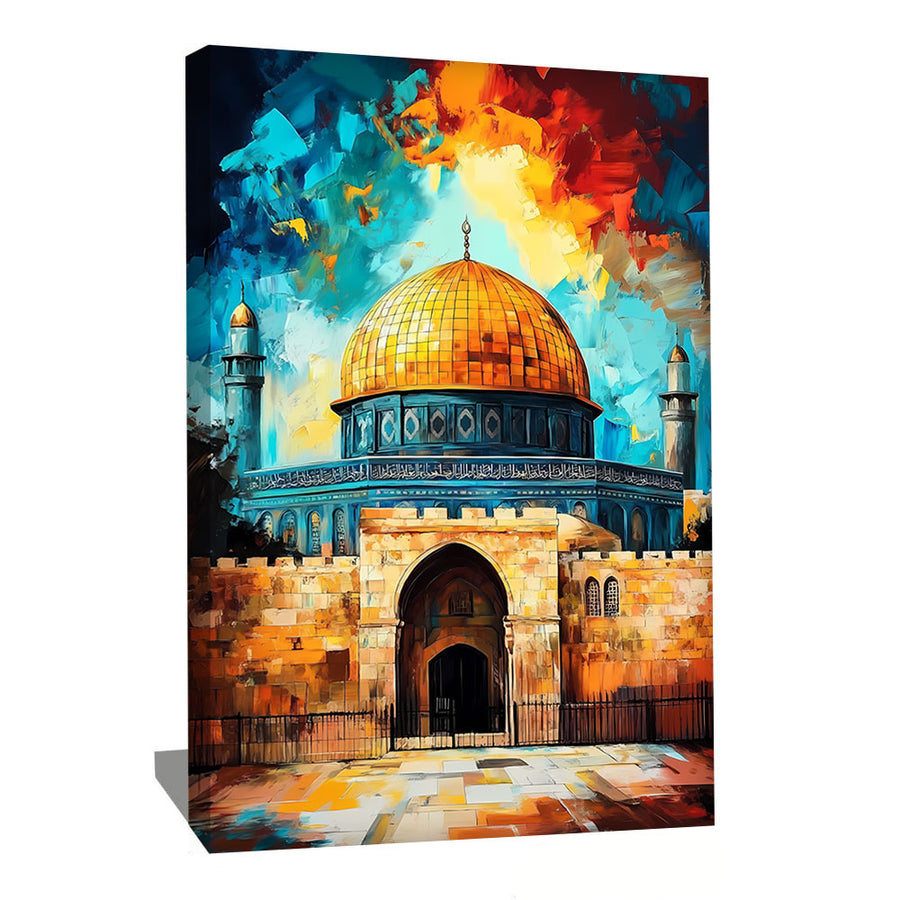
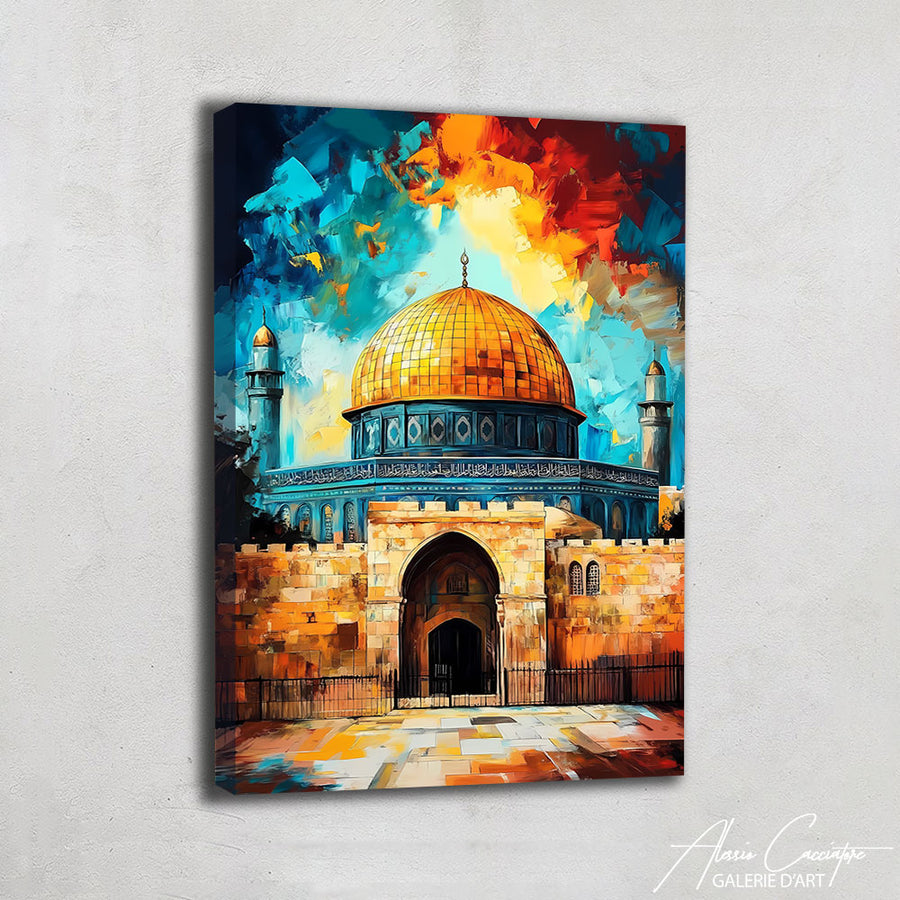
The Prophet's Mosque in Medina and its green dome. The Dome of the Rock and Al-Aqsa Mosque in Jerusalem. The Blue Mosque in Istanbul. The Great Mosque of Cordoba. The mosques of the Maghreb and their square minarets. Our compositions celebrate these places in varied treatments: green dome of Medina, golden Dome of the Rock, blue mosque at dusk, minaret silhouetted against the sky, mosque courtyard in perspective. These artworks are suitable for the living room, the office, and the entrance. To be combined with our blue collection for compositions with domes and blue skies.
Islamic geometry and the arabesque
Sacred geometry is the other great language of Islamic art. Eight-pointed star, twelve-pointed star, infinite interlacing patterns, mosaics, zelliges, muqarnas. The arabesque, tendrils and foliage, evokes the gardens of paradise. Our compositions celebrate this family in varied treatments: golden eight-pointed star, geometric interlacing in black and gold, arabesque on a midnight blue background, mosque motif in an abstract composition. These artworks are suitable for all interiors, including non-Muslim ones, for their beauty alone. To be combined with our geometric collection to explore geometry in other traditions.
Ramadan, Eid, and the crescent moon
The crescent moon, Ramadan lanterns, Ramadan Kareem and Eid Mubarak compositions form a festive family. Our compositions celebrate these moments in varied treatments: golden crescent on a night background, Ramadan lanterns, Eid Mubarak in calligraphy, crescent and star in a minimalist composition. These artworks are suitable for the living room during the holy month and make highly appreciated Eid gifts.
Modern and minimalist Islamic artworks
Islamic art adapts to contemporary interiors. Sleek calligraphy on a beige background. Name of Allah in a fine line. Verse in a minimalist composition. Sober black and gold. Our compositions celebrate this family in varied treatments: modern calligraphy on a solid background, abstract Islamic composition, verse in line art, minimalist crescent. These artworks are suitable for modern apartments and young homes. To be combined with our Arabic collection for Arabic culture in all its expressions.
Which Islamic artwork for which intention
An Islamic artwork is chosen first according to its role in the home. Here are our guidelines.
To protect the home
Ayat al-Kursi, the protective surahs, the Bismillah. To place near the entrance or in the living room. It is the first Islamic artwork hung in a new home.
For daily remembrance
The name of Allah, the invocations, the ninety-nine names. In the living room, the living area, the office. To see and remember several times a day.
For beauty and upliftment
The Kaaba, the mosques, sacred geometry, the arabesque. In the living room, the dining room, the office. To contemplate.
For holidays and occasions
Crescent moon, lanterns, Eid Mubarak, Ramadan Kareem. In the living room during the holy month, or as an Eid gift.
The Islamic artwork, room by room
Each room has its Islamic artwork. Here are our recommendations.
In the living room
This is the preferred location for an Islamic artwork. The living room welcomes the large Islamic artwork of the home: name of Allah in gold, Ayat al-Kursi, Kaaba, Islamic triptych. Format 120x80 cm above the sofa, or triptych on the main wall. In tradition, the artwork is placed high, above the level of seated people, out of respect for the sacred text. Our living room collection offers other subjects to complete this room.
In the entrance
The Bismillah or Ayat al-Kursi at the entrance blesses and protects the home from the door. Vertical format 60x40 cm or 80x60 cm. It is the first artwork guests see and the last the family sees when leaving.
In the bedroom
The verses of protection, the name of Allah in a soothing composition, the evening invocations. Format 80x60 cm. Soft colors: midnight blue and gold, beige and black. In tradition, one avoids placing a sacred text facing the bed or too low.
In the prayer room
A sober Islamic artwork, without distraction: calligraphy alone, pure geometry, Kaaba. On the qibla wall or on a side wall. Format 80x60 cm on matte canvas.
In the kitchen and dining room
The Bismillah before the meal, Alhamdulillah after. Plexiglass in the kitchen for maintenance. Format 60x40 cm.
In the office
A sober calligraphy, a sacred geometry, a mosque. Format 80x60 cm. Remembrance and concentration.
In the child's room
The Bismillah or the name of Allah in soft colors, to teach and to protect. Glossy plexiglass. Hung high.
In a community or professional space
Corporate prayer rooms, associations, schools, halal restaurants, boutiques, Muslim professional offices, Islamic bookstores: the Islamic artwork imposes itself as a natural decoration, in a register adapted to the place.
The choice of format for your Islamic artwork
The format determines the place and readability of the artwork. Our guidelines.
The compact format (60x40 cm) is suitable for the Bismillah, the invocations, and the entrance or kitchen compositions. In a series of three, it composes a wall of invocations: Alhamdulillah, SubhanAllah, Allahu Akbar.
The medium format (80x60 cm) is the all-purpose size. Name of Allah, Ayat al-Kursi, mosque, crescent. Bedroom, office, entrance.
The large format (120x80 cm) is the large Islamic artwork of the living room. Complete and readable Ayat al-Kursi, the ninety-nine names, panoramic Kaaba, large calligraphy.
The square format (60x60 cm or 80x80 cm) is suitable for circular calligraphies, the eight-pointed star, and centered compositions.
The vertical format is suitable for minarets, vertical calligraphies, and entrances.
The Islamic triptych is highly requested for the living room: Allah in the center, Muhammad and a verse on each side; or Kaaba in the center, Medina and Jerusalem on each side; or Ayat al-Kursi spread over three panels. To be combined with our triptych collection for this format in other subjects.
Premium canvas or glossy plexiglass
The support changes the rendering of the calligraphy and the gold.
Printing on premium canvas
Our canvas is stretched by hand on an FSC-certified spruce wood frame 2 cm thick. Its matte texture gives the gold a velvety rendering and the calligraphy a sober and dignified presence. It is suitable for living rooms, bedrooms, prayer rooms, and all classical compositions. It is the choice we recommend for most Islamic artworks.
Printing on glossy plexiglass
Plexiglass makes the gold shine on a black background and the blues of the domes. It is suitable for modern compositions, illuminated Kaabas at night, mosques at dusk, and golden crescents. It imposes itself in the kitchen and the child's room for maintenance.
In both cases, our prints use an odorless and solvent-free high-definition ink, safe even in a child's room. The printing technology we employ preserves the gold and the contrasts for several decades. Each artwork is delivered ready to hang, with its fastening system.
Associating the Islamic artwork with your decoration
Islamic decoration harmonizes with all interiors. Our ideas.
With a classical living room
Sofas, rugs, curtains: the large golden calligraphies, the triptychs, and the majestic Kaabas find their natural place above the main sofa.
With a modern living room
White walls, sleek furniture: minimalist calligraphies, black and gold or beige and black, and pure geometries integrate without rupture.
With a Moroccan living room
Benches, lanterns, zelliges: the arabesques, the mosques of the Maghreb, and the classical calligraphies extend the atmosphere.
With an interior with dark walls
On a midnight blue or deep green wall, a golden calligraphy or an illuminated Kaaba shines.
With a young couple's interior
For a first apartment, a modern Bismillah in the entrance and a sleek name of Allah in the living room are enough to install faith in the home with elegance.
With a non-Muslim interior
Islamic geometry, the arabesque, and the mosques are appreciated for their beauty alone by art lovers of all faiths. To be combined with our religious collection to discover the sacred arts of other traditions.
Frequently asked questions about Islamic artworks
What is the difference between an Islamic artwork and an Arabic calligraphy artwork?
Our Islamic artwork collection brings together Muslim religious decoration: Quranic verses, names of Allah, invocations, Kaaba, mosques, sacred geometry, Ramadan, and Eid. The Arabic calligraphy artwork collection brings together all Arabic writing, religious or not: first names, proverbs, poems, words of love. The Arabic artwork collection covers Arabic culture in a broad sense, and the Oriental artwork collection the decorative imagination of the Orient. If you are looking for an artwork for faith and the home, the Islamic collection is the right one.
Are the texts of your calligraphies accurate?
Yes. Our calligraphies of the Quran, the names of Allah, and the invocations are reproduced with the greatest rigor, letter by letter, dot by dot. We know that an error in a sacred text is unacceptable. If you wish to check a verse before purchase, the enlarged image of each product sheet allows it.
Do your Islamic artworks respect the rules of representation?
Yes. None of our religious compositions represents God, the prophets, or human figures. Our Islamic artworks rest exclusively on calligraphy, geometry, the arabesque, and the architecture of holy places, in accordance with tradition. Holy places are represented with dignity.
Where to place an artwork with a verse of the Quran in the home?
In a clean and dignified place, at a height above the level of seated people. The living room and the entrance are the most common locations. Avoid the toilet and the bathroom, and avoid placing a sacred text too low or facing the bed. Ayat al-Kursi is traditionally placed near the entrance for protection, Bismillah above a door, the name of Allah in the living room.
Are all your Islamic paintings prints?
Yes. They are high-definition prints on premium canvas or glossy plexiglass, made in our workshop in Germany. Each calligraphy is reproduced with gallery quality and total fidelity to the text.
Is the Islamic painting suitable as a gift?
It is one of the most traditional and appreciated gifts in a Muslim family. Ideal for Eid al-Fitr and Eid al. Adha, a wedding (Allah and Muhammad in a diptych, or a verse about the family), a birth (Bismillah for the bedroom), a housewarming (Ayat al-Kursi to protect the new home), a return from pilgrimage (the Kaaba), a conversion, a gift to parents or grandparents. The 60x40 cm format on matte canvas, Bismillah or the name of Allah, is one of our most gifted choices.
At what height should an Islamic painting be hung?
Higher than average: center the painting at 1.60 m or 1.70 m from the floor, so that it is above seated people, out of respect for the text. Above a sofa, leave 25 to 35 cm between the backrest and the bottom of the frame.
How do I maintain my Islamic painting?
A clean, dry or slightly damp cloth is enough for both surfaces. Avoid abrasive products and prolonged direct sunlight to preserve the gold and the contrasts. Handle the painting with care and while clean, as is appropriate for a sacred text.
Questions fréquentes
Quels sont les délais de livraison ?
La livraison est offerte dans le monde entier, sous 4 à 7 jours. Vous pouvez suivre votre colis à tout moment depuis la page « Suivre le colis ».
Le tableau est-il prêt à accrocher ?
Oui, le système d'accroche est inclus. Les toiles sont tendues sur un châssis en bois d'épicéa de 2 cm (4 cm en option) et les plexiglas sont livrés avec des rails d'accroche en aluminium invisibles.
Toile ou plexiglas : quelle différence ?
La toile est une vraie toile tendue sur un châssis en bois. Le plexiglas est incassable, protégé des rayures et du vieillissement, et travaillé à la main par nos artisans en Allemagne.
Puis-je retourner mon tableau ?
Oui, vous avez 30 jours pour changer d'avis : contactez-nous par e-mail ou par le chat. Et si votre œuvre arrive abîmée, nous la réimprimons, sans retour à faire.
Livraison offerte sous 4 à 7 jours
Fabriqué à la main en Allemagne
30 jours pour changer d'avis