
To create a successful Japandi interior, combine the warm simplicity of Scandinavian style with the clean lines of Japanese style: neutral tones, light wood, natural materials, and a few carefully chosen objects. The result should feel calm without looking cold or empty.
In this guide, we explain the color palette, the best materials to use, how to choose a picture, and the correct hanging heights. You will also find room-by-room examples, a size guide based on the width of your furniture, and an FAQ to answer your final questions.
What is Japandi style?
Japandi is an interior design style that combines Japanese aesthetics with Scandinavian design. Its name combines the words "Japan" and "Scandi". Both cultures share a love of simple lines, nature, and functionality, making their combination feel very natural in a contemporary home.
From the Japanese side, Japandi draws on the concept of wabi-sabi, which values the beauty of simple, imperfect objects that show the patina of time. From the Scandinavian side, it incorporates the concept of hygge—the pursuit of everyday comfort—which we explain in detail in our article on the Scandinavian picture and hygge.
A Japandi picture is a piece of wall art with soft colors and motifs inspired by Japanese nature: branches, cranes, mountains, lakes, or foliage. Its composition leaves room for empty space, allowing it to structure a wall without making an already minimalist room feel cluttered.
Which colors should you choose for a Japandi interior?
The Japandi palette is based on warm neutrals, punctuated by a few darker shades to add depth. Pure white, which can look too clinical, is generally replaced by off-whites and beiges that warm the light. The overall look should remain consistent from one room to the next.
- The basics: off-white, linen, sand, beige, and greige for walls and large textiles.
- Wood tones: light oak, ash, or walnut for furniture and flooring.
- Contrasts: matte black, anthracite, or deep brown, used sparingly.
- Accents: sage green, soft terracotta, or deep red, used in limited quantities.
A picture is the perfect place to introduce an accent color without painting the walls. A touch of red on a beige background, for example, evokes Japanese maple trees and creates a focal point. This principle of "inhabited emptiness" is also at the heart of our guide to creating a minimalist interior without making the room feel empty.
Which materials and furniture should you choose?
Natural materials are at the heart of Japandi: wood, linen, cotton, wool, rattan, bamboo, paper, and ceramics. They add texture to an intentionally understated décor. It is better to choose fewer objects, but objects that have a real presence, texture, and purpose.
Japandi furniture is low, with straight or gently rounded lines, slim legs, and a light silhouette. A low linen sofa, a solid wood coffee table, an oak bench, and closed storage are often enough to set the mood. Visible clutter is the enemy of this style.
The right number of objects
The rule is to let each element breathe. Two or three objects are enough on a console table: a stoneware vase, a dried branch, and a stack of books. This carefully controlled emptiness highlights what remains, and it is what gives Japandi its highly sought-after sense of calm.
Which picture should you choose for a Japandi interior?
The right Japandi picture echoes the room's palette and adds a motif inspired by nature. It serves as a visual anchor in a décor where objects are sparse. Three criteria are paramount: the motif, the colors, and the medium, which we explain in detail below.
Nature-inspired motifs
The motifs most suited to Japandi are trees, flowering branches, mountains, lakes, waterfalls, and birds. They extend the connection to the outdoors that this style cultivates through wood and plants. For a more graphic touch, our pictures inspired by Japan feature cranes, waves, and red suns.
Colors that complement the room
Choose a piece whose dominant colors echo those of the walls, textiles, or wood. One or two accent colors are enough, ideally already present in a cushion, vase, or throw. If your interior leans toward a Nordic style, our Scandinavian pictures in soft tones also make the connection.
Canvas or plexiglass?
Canvas stretched over a wooden frame offers a matte, warm finish that is very much in the spirit of Japandi. Plexiglass, supplied with a hanging rail, has a smoother, brighter appearance that suits contemporary interiors. The artworks in the gallery are available in both versions, from €89.
How to adopt Japandi room by room?
The living room
In the living room, Japandi is built around a low sofa in light tones, a natural-fiber rug, and a striking piece of art above the seating area. A horizontal landscape in soft colors structures the wall without overwhelming the room. The Japandi forest picture, with its waterfall surrounded by pink and red flowers, perfectly illustrates this balance.

Japandi forest picture on canvas, available on canvas or plexiglass, from 60x40 cm to 120x80 cm.
The bedroom
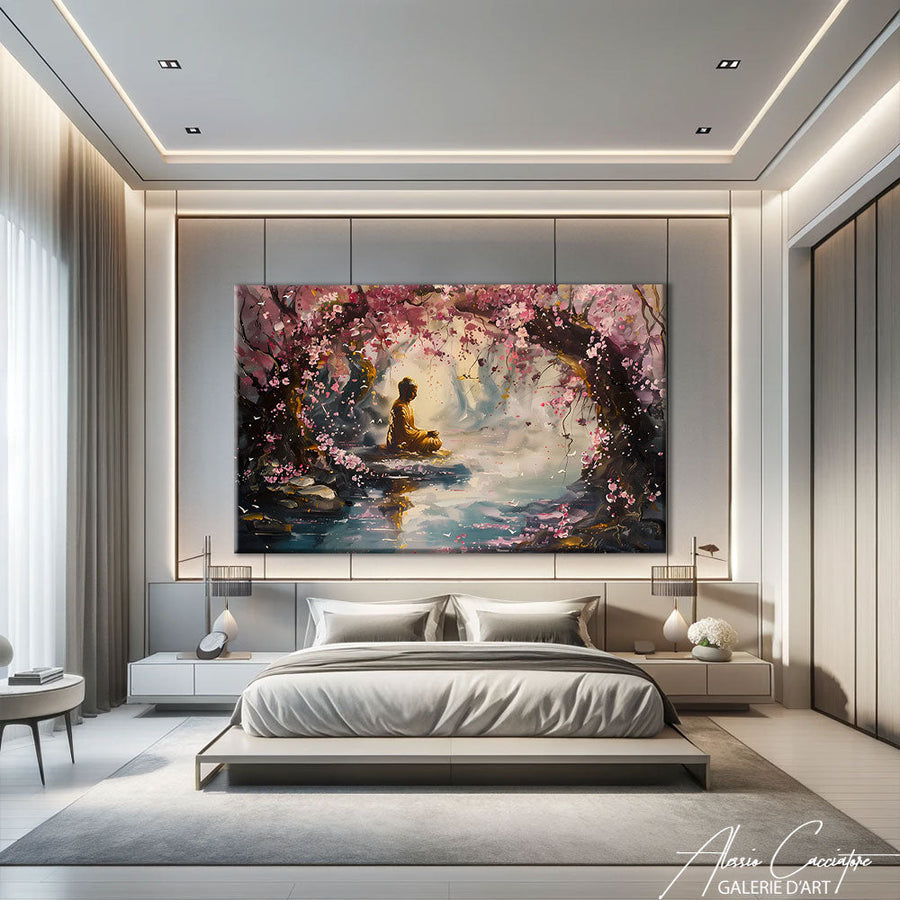
The Japandi bedroom features a low bed, washed linen bedding, and minimalist bedside tables. Above the headboard, a soothing piece of art extends the sense of rest. The Japandi lake landscape picture, with its red trees reflected in the water, pairs naturally with a wall clad in light wood.

Japandi lake landscape picture, available on canvas from €89 and on plexiglass.
The dining room
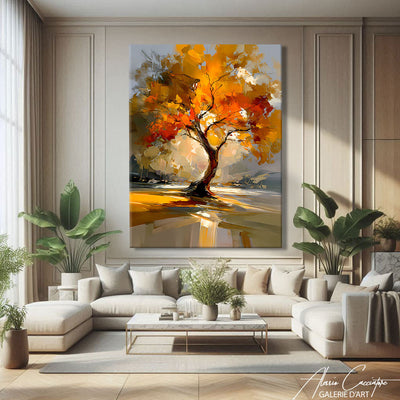
Around a large wooden table, Japandi favors chairs with clean lines and a paper or linen pendant light. A large horizontal format adds grandeur to the main wall. The Japandi tree picture, with its golden reflections and black-and-white contrasts, adds depth to a dining room in neutral tones.

Large-format Japandi tree picture, available in 120x80 cm on canvas or plexiglass.
How to hang a picture in a Japandi interior?
In a Japandi interior, the picture is hung using the usual guidelines, but with more empty space left around it. Place the center of the artwork between 145 and 160 cm from the floor, at eye level. Above a sofa or headboard, leave 20 to 25 cm between the piece of furniture and the bottom of the frame.
In terms of width, the artwork or composition should occupy about two-thirds of the width of the furniture. If you are hanging several canvases, as a diptych or triptych, leave 5 to 8 cm between each panel. The picture below illustrates this rule with the sizes offered on our product pages.
| Furniture width | Recommended size | Example room |
|---|---|---|
| About 90 cm (console table, chest of drawers) | 60x40 cm | Entrance hall, hallway |
| About 120 cm (sideboard, small sofa) | 80x60 cm | Study, guest bedroom |
| About 180 cm (sofa, double bed) | 120x80 cm | Living room, bedroom |
| About 240 cm (large sofa) | Two 80x60 cm canvases spaced 5 to 8 cm apart | Large living room |
Mistakes to avoid
Japandi does not tolerate excess, and hanging a picture is no exception. A few mistakes are common and can easily disrupt the harmony of an otherwise well-designed room. Here are some to watch out for before you drill into the wall, so you can maintain a serene, cohesive look.
- Hanging too many frames on the same wall, which disrupts the sense of calm.
- Hanging the artwork too high, out of sight.
- Choosing a size that is too small above a large sofa.
- Combining bright colors that have no connection to the rest of the room.
FAQ: Japandi décor
What is the difference between Japandi and Scandinavian style?
Japandi adds the clean lines and darker tones of Japanese aesthetics to Scandinavian style. Scandinavian style favors white, light wood, and cozy comfort, while Japandi incorporates more matte black, dark wood, and carefully controlled empty space, for a more mineral and serene look.
Which colors should you avoid in a Japandi interior?
Avoid large areas of bright colors, such as solid red, lemon yellow, or electric blue on an entire wall. Japandi is based on warm neutrals. An intense color is still possible, but only as a small accent, for example in a picture, cushion, or vase, to maintain a soothing overall look.
What picture should you put in a Japandi living room?
A horizontal landscape in soft tones is perfect for a Japandi living room. Motifs of trees, lakes, mountains, or cranes echo the style's connection to nature. Choose a size that covers about two-thirds of the sofa's width and hang it 20 to 25 cm above the backrest.
Is Japandi suitable for a small apartment?
Yes, Japandi is ideal for small spaces because it limits the number of objects and favors light colors. Low furniture makes the ceiling feel higher, and closed storage visually lightens the room. A single well-sized picture on each wall is enough to add character without cluttering the space.
Should you choose canvas or plexiglass for a Japandi interior?
Canvas stretched over a wooden frame pairs naturally with Japandi thanks to its matte, warm finish. Plexiglass, supplied with a hanging rail, suits more contemporary rooms that favor smooth surfaces. Both mediums are available for our artworks, with free delivery.
In summary
- Japandi combines Japanese simplicity with Scandinavian warmth.
- Focus on warm neutrals, wood, and natural materials.
- Choose a picture with a nature motif that echoes the room's palette.
- Center the artwork between 145 and 160 cm from the floor and aim for two-thirds of the furniture's width.
To find the artwork that will set the mood for your home, browse our collection of Japandi pictures, with free delivery and 30 days to change your mind.