
I remember this couple in my studio, frozen in front of a large red and black abstract canvas. He kept saying "it's beautiful," she "but what does it mean?" They left without buying anything. Abstract art has that effect: it fascinates as much as it intimidates. Yet, ever since Kandinsky released his first subject-less watercolor in 1910, abstract art has never stopped speaking—just in a different way. This guide will help you decipher this language and choose an abstract painting that truly resonates with you.
Why abstract art unsettles us (and that's normal)
From childhood, we're taught to find meaning in images. A tree is a tree. An apple is an apple. In front of an abstract painting, this interpretive framework collapses.
What's unsettling is precisely the absence of recognizable subject matter. No landscape, no face, no still life. Just shapes, colors, gestures.
But frankly, that's exactly what makes abstract art powerful.
When Kandinsky painted his first abstract compositions in the early 20th century, he wasn't trying to represent the visible world. He wanted to create a pure emotional resonance, like music. You don't ask "what is this Bach piece about?"—you feel it. Abstract art works the same way.
This unsettling feeling is an invitation: stop trying to understand, start to feel.
The main families of abstract paintings (and what they say)

Not all modern abstract paintings are alike. There are several languages, several approaches, each with its own emotion.
Geometric abstraction: order and harmony
Mondrian, Malevich, Albers. Clean lines, pure forms, primary colors. This is abstract art that structures space.
These works exude a sense of order, of mental clarity. Perfect for an office, an entryway, a space where you want presence without agitation.
Lyrical abstraction: emotion and gesture
Pollock, De Kooning, Hartung. Splashes, broad strokes, texture. This is abstract art that releases energy.
These paintings vibrate, move, breathe. They bring movement to a living room, life to a hallway. They are conversation pieces.
Chromatic abstraction: contemplation and silence
Rothko, Newman, Reinhardt. Large expanses of color, subtle, almost meditative nuances. This is abstract art that invites inner silence.
These pieces function like emotional windows. Ideal for a bedroom, a reading nook, a quiet space.
When a client tells me "I don't know which abstract painting to choose," I first ask them: what feeling do you want in your room?
Decoding the codes: material, color, format
A handmade abstract painting carries three major visual pieces of information: its material, its palette, its format. Learning to read them is learning to choose.
Material tells the story of energy
A smooth, almost glazed canvas? That's control, mastery. A textured surface, with impasto, visible layers? That's gesture, urgency.
I have a painting in my studio, thick acrylic with a palette knife, where you can literally see every pass of the tool. Visitors always touch it (well, technically they shouldn't, but I understand). The material calls to you.
Color dictates the mood
A colorful abstract painting doesn't function like a neutral wall. It sets the tone.
- Reds, oranges: warmth, energy, sometimes tension
- Blues, greens: calm, freshness, breath
- Blacks, greys, whites: sophistication, purity, timelessness
- Yellows, bright pinks: optimism, boldness, movement
Caution: a very colorful painting doesn't mean "too busy." Some multicolored works maintain a true visual coherence.
Format changes the relationship to space
A large horizontal format (e.g., 100x150 cm) stretches the space, opens up the room. Perfect above a sofa.
A vertical format lengthens walls, gives height. Ideal in a narrow entryway.
A square? Balance and quiet presence.
There's no denying it, the format matters as much as the subject.
How to choose a modern abstract painting for your interior

Alright, let's get down to brass tacks. You're in front of several modern abstract paintings, and you don't know which one to choose. Here's my method.
Step 1: Forget the furniture
I know, it seems counter-intuitive. But if you choose based on the sofa first, you risk choosing a "matching" painting rather than one that speaks to you.
Choose emotion first. Furnishings can adapt.
Step 2: Test its presence
If possible, ask for an HD file of the artwork and project it onto your wall (yes, with a projector or even your TV). Or print it in A3.
You'll instantly see if the palette works with your natural light, if the format breathes in the space.
Step 3: Live with it (virtually)
Look at the painting for several days. Not 5 minutes. Do you keep coming back to it? Does it still intrigue you on the third day?
A good modern abstract painting doesn't exhaust itself at first glance.
Step 4: Listen to your initial physical reaction
When you first saw it, what did your body do? Smile? Slower breathing? Excitement?
Abstract works speak to the body before they speak to the mind. If your initial reaction was strong, that's a good sign.
Common mistakes (that I've seen a hundred times)
In my experience, here are the recurring pitfalls.
Choosing "for decor" rather than for yourself
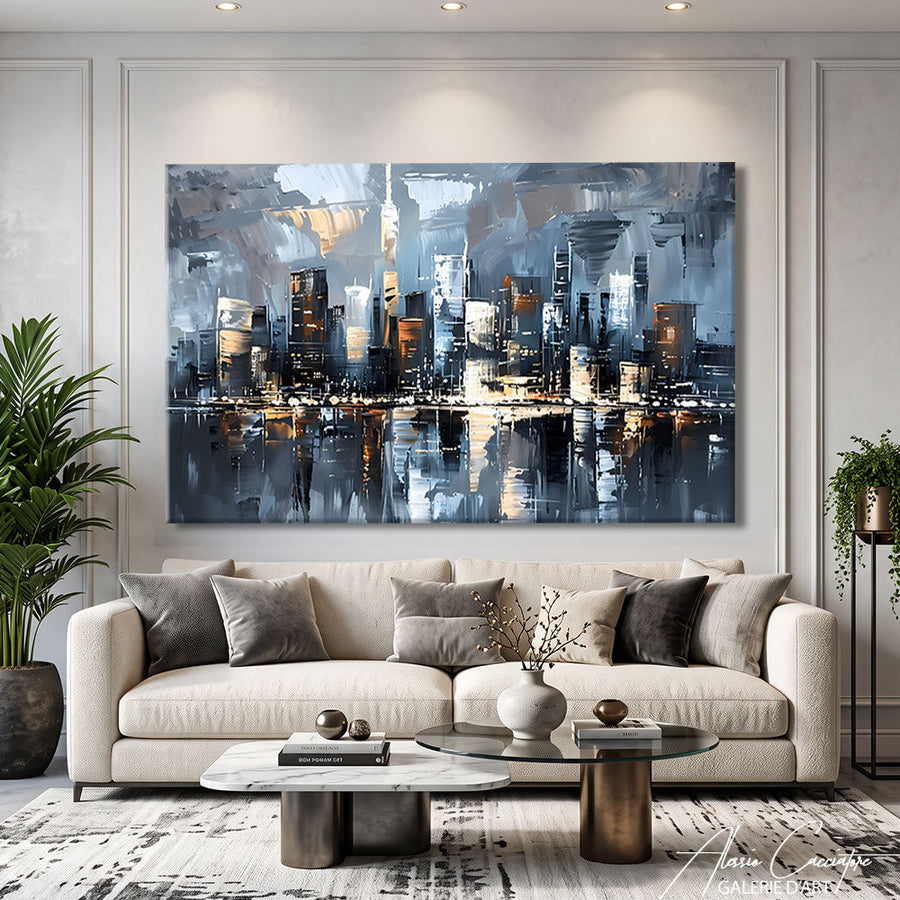
This blue-grey abstract painting goes perfectly with your cushions. Yes. But does it do anything for you?
Art is not an accessory. It's a daily presence. If you don't truly love it, you'll eventually stop seeing it.
Being afraid of large formats
Many people undersize. They get a 60x80 cm for a 3-meter wall. Result: the artwork gets lost.
An abstract painting, especially if it plays on subtle nuances, needs scale to exist.
Absolutely wanting to "understand"
I had a client who spent fifteen minutes asking me "but what did the artist mean?" Frankly, Pollock himself said he didn't always know.
Abstract art is not a riddle. It's a sensory experience.
Neglecting the room's lighting
A colorful abstract painting can completely change depending on whether it receives warm light (classic bulbs) or cool light (LEDs). Always test with your actual lighting.
Combining multiple abstract paintings: does it work?

Yes. But not just any old way.
If you want to create a wall composition with several abstract paintings, respect at least one of these three points of coherence:
- Common palette: the works share at least 2-3 dominant colors
- Similar visual language: all geometric, or all gestural — avoid mixing
- Harmonized format: same height, or logical progression (small-medium-large)
What annoys me is the "patchwork" wall where everything you like is hung without a common thread. That might work in a gallery, rarely in a living room.
My advice: start with a strong piece, then gradually add works that dialogue with it.
Investing in an abstract painting: value and authenticity
Let's talk money, as that's often the underlying question.
A handmade abstract painting by a contemporary artist costs between €200 (small format, emerging artist) and several thousand euros (large format, established artist).
What justifies the price
- Originality: a unique piece, not a reproduction
- Creation time: some works require weeks of labor
- Signature and certification: certificate of authenticity, numbering if limited series
- Artist's reputation: their background, exhibitions, recognition
How to verify authenticity
Always ask for:
- A certificate of authenticity signed by the artist
- Photos of the work in progress (if the artist shares them)
- Provenance: gallery, direct studio, certified platform
Avoid "hand-painted reproductions" sold in bulk on certain platforms. These are not original works.
A true abstract work is a unique gesture, a captured moment. You're buying a presence, not a pattern.
Where to place an abstract painting in your home (room by room)
Living room
The classic territory for a modern abstract painting. Above the sofa, facing the entryway, or on a focal wall.
Favor large formats (horizontal 120x80 cm minimum) and works that can be seen from a distance.
Bedroom
Here, opt for soft chromatic abstractions. Less energetic gesture, more soothing nuances.
Deep blues, warm greys, dusty pinks. Works that invite calm, not stimulation.
Office
Geometric abstraction works very well. It structures mental space without distracting.
A large format behind the desk (visible on video calls!) or facing you for visual breaks.
Kitchen/dining room
Dare to use color. A colorful abstract painting with reds, oranges, yellows awakens the space.
Medium format (70x100 cm), so as not to dominate the room but to assert a presence.
Hallway
Vertical format, 40x120 cm or equivalent. Abstract art works very well in transitional spaces — it catches the eye without demanding a prolonged stop.
Frequently Asked Questions
How to tell if an abstract painting is of quality?
Check three things: the artist's signature (on the back or bottom), the certificate of authenticity, and the quality of the materials (canvas stretched on a wooden frame, professional acrylic or oil paint). A true handmade abstract painting will show variations in material, nuances, controlled "accidents"—never a perfectly smooth and mechanical surface.
What size abstract painting for a 3-meter wall?
For a 3-meter wall, aim for a minimum of 120x80 cm, ideally 150x100 cm. The approximate rule: the painting should occupy between 50% and 75% of the width of the furniture below it (sofa, console), or 40% to 60% of the wall width if no furniture is present. A format that is too small will get lost.
Can abstract and figurative paintings be mixed in the same room?
Yes, but methodically. Maintain consistency in palette or frames. Avoid hanging them side-by-side—separate them with space or a different wall section. Abstract works well as a dominant piece, with figurative as a more discreet complement. The reverse also works.
Do abstract paintings go out of style?
Major abstract movements (Kandinsky, Rothko, Pollock) transcend decades without aging. Pure abstract art, without narrative reference, escapes fashion trends. What can date are certain palettes very typical of the 80s or 2000s. But a well-designed abstract work remains timeless—it doesn't represent an era, it expresses a universal emotion.
How much to invest in a first abstract painting?
For an original quality abstract painting, expect to pay between €300 and €800 for a medium format (80x60 cm) by an emerging artist. This is a reasonable budget for a unique, signed work with a certificate. Below €200, you risk a reproduction or amateur quality. Above €1000, you enter the realm of more established artists or larger formats.
All works mentioned in this article are available on the gallery. Free worldwide shipping, 30-day money-back guarantee.