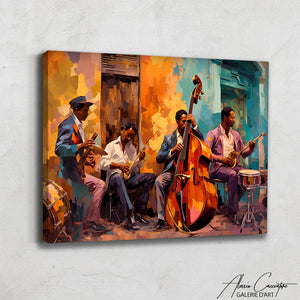

Portraits with an honest gaze, dancer silhouettes, jazz musicians captured in motion: the African painting intrigues as much as it seduces. But what does it really represent, and how do you choose one that will naturally find its place in your home, without turning your living room into a museum gallery? This is a question that comes up constantly with our clients, and it deserves more than a hurried answer. The meaning of motifs, available styles, color palettes, ideal room, and correct size: here is our complete guide, nurtured by years spent hanging African canvases in all types of interiors. And one firm opinion right from the start: it is one of the rare decorative worlds that brings warmth, rhythm, and genuine cultural depth all at once.
What does an African painting represent? A meaning above all human
Contrary to what some clichés might suggest, African art is not limited to masks and sunsets over the savannah. The contemporary African painting celebrates the human above all: community, music, dance, and transmission between generations. A portrait of a woman with a proud carriage tells of dignity; a market or celebration scene tells of social connection; a jazz orchestra evokes the musical bridge born between Africa and the Americas.
It is precisely this narrative dimension that distinguishes an African painting from simple wall decoration: you don't hang it just to fill a wall; you hang it because it tells a story. Our clients often tell us: it is the piece of work that guests stop in front of. If you are passionate about the subject, we have dedicated a complete guide to the modern African painting, which explores the codes of this current aesthetic.
Which style of African painting should you choose?
In our collection of African paintings, three main families emerge, and the choice depends primarily on the atmosphere you want to create.
The portrait: presence
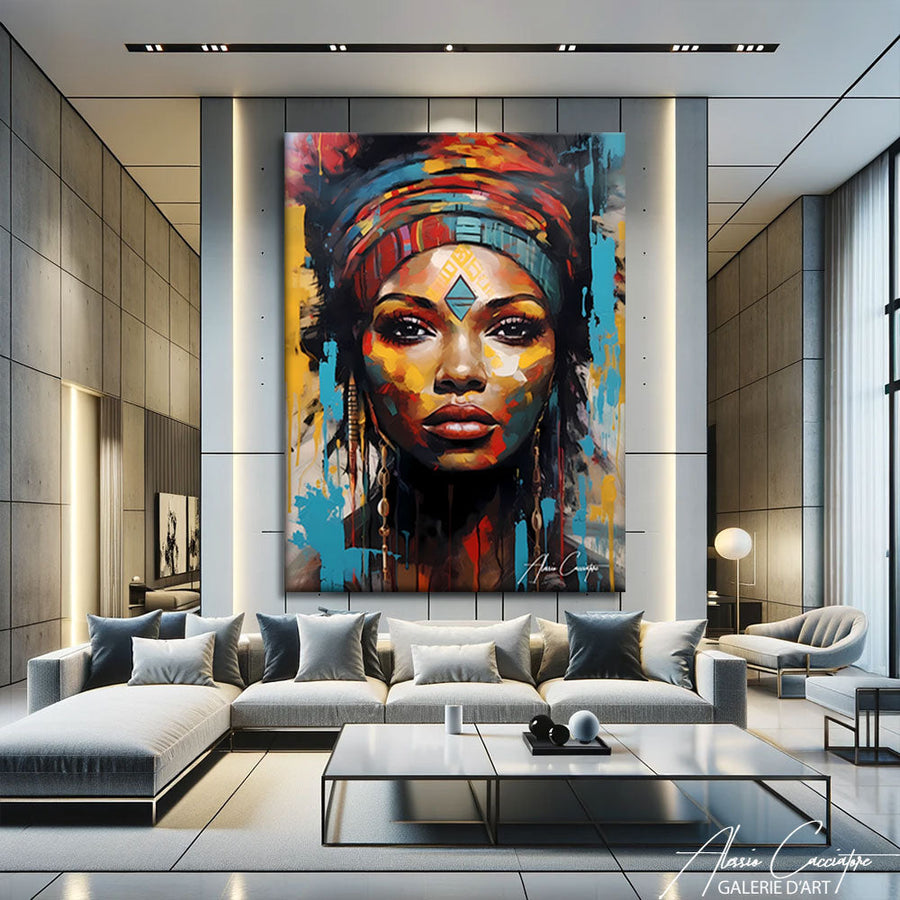
A man's face with a direct gaze, a woman adorned in wax fabrics, a sculptural profile: the African portrait imposes an immediate presence. It is the ideal choice if you want a strong focal point, particularly above a sofa or an entryway console. Our firm advice: one portrait per room. Two gazes facing each other, and it is your guest who will no longer know where to rest their own.
The life scene and music: movement
Dancers in full momentum, musicians, scenes of celebration: these canvases instill an energy that few other subjects can match. They work wonderfully in living areas, especially the dining room.

Abstraction: subtlety
Geometric patterns inspired by bogolan or kente textiles, earthy flat tints, stylized silhouettes: African abstraction allows you to adopt this aesthetic without human figures. An excellent entry point for minimalist interiors.
Which colors for which decor?
The classic African palette — terracotta, ochre, deep brown, touches of gold — instantly warms up an interior. It blends naturally with linen, rattan, white or beige walls: if your decor leans towards the natural or bohemian, you can go for it with your eyes closed.
But there is a second path, more contemporary: African canvases with bold colors — electric blues, solar yellows, colorful backgrounds — that dialogue very well with a modern or even minimalist interior. On a neutral wall, the effect is spectacular: the canvas becomes THE piece of the decor. A small studio anecdote: the canvases we most often see returning in photos from clients are precisely these, hanging in grey or white interiors that they literally wake up.

In which room should you hang your African painting?
- The living room: the prime location, above the sofa or facing the entrance of the room. Choose a large format, alone.
- The dining room: dance and music scenes create a convivial, almost festive atmosphere there.
- The entryway: a portrait sets the tone as soon as you step through the door — it is the visual handshake of your home.
- The office: geometric patterns and abstract canvases stimulate without distracting.
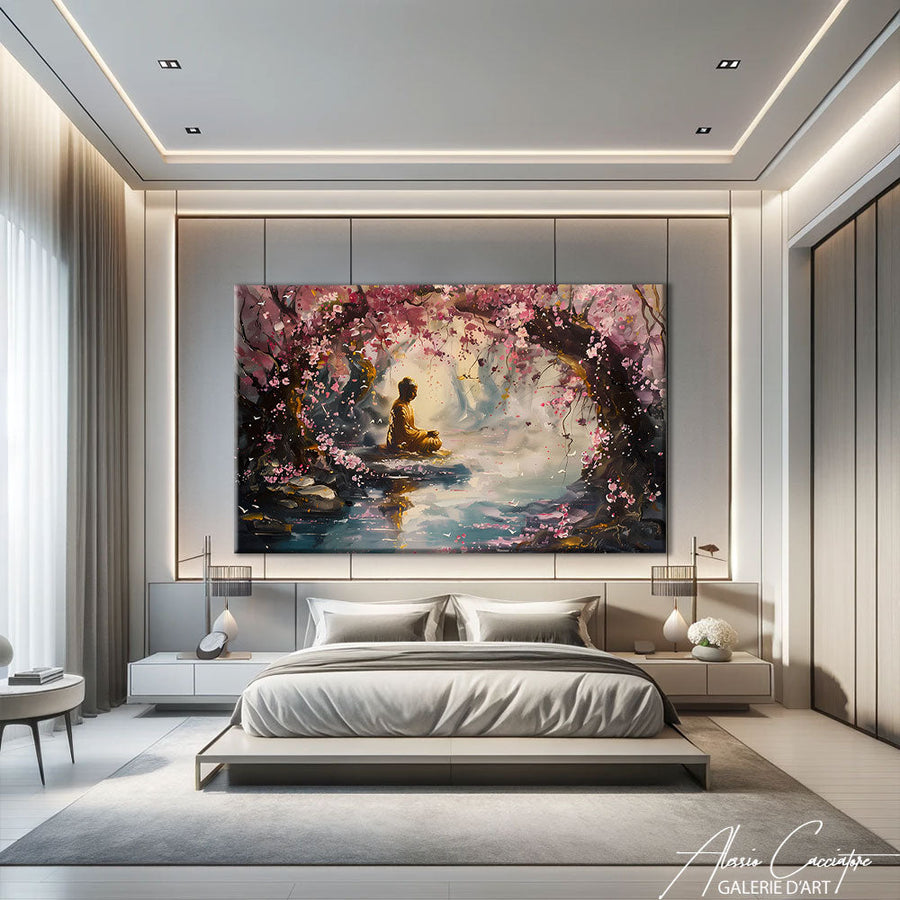
- The bedroom: opt for soft, ochre, and brown palettes rather than bright colors.
Hanging rule applicable everywhere: the center of the artwork should be approximately 1.65 m from the floor, and about two-thirds the width of the piece of furniture located below it.

If you are sensitive to female portraits, know that the female figure extends far beyond the African framework: our collection of women paintings offers this presence in all styles, from pop art to abstract.
What size and finish: canvas or plexiglass?
For a standard living room wall, do not go under 80 cm in width: an African painting that is too small loses all its narrative strength. Large formats (100 to 120 cm and more) are clearly our recommendation for portraits and group scenes.
As for the finish, our works are printed on canvas stretched over a wooden frame: a matte, deep rendering, close to paint, which suits warm African palettes perfectly. The plexiglass option provides a glossy finish and superior color intensity — this is what we advise for highly colorful canvases or bright rooms. Our opinion: for a portrait with earthy tones, choose canvas; for a vibrant and contemporary scene, choose plexiglass.
FAQ: your questions about African paintings
Does an African painting go well with Scandinavian decor?
Yes, and even very well. Scandinavian interiors, which are light and uncluttered, offer an ideal setting for African canvases: the contrast between the Nordic sobriety and the warmth of the ochres creates an elegant visual tension. Limit yourself to one strong work rather than several small ones.
How to combine several African paintings without overcrowding?
Stay within a shared palette (earths, or bright colors, but not both) and space the works at least 8 to 10 cm apart. For a successful duo, combine a portrait and an abstract work rather than two portraits. Our article on the African female painting details how to compose around a female portrait.
Is an African painting suitable for a small room?
Absolutely, provided you reverse the logic: in a small room, a single medium-sized painting with bold colors visually expands the space, whereas several small frames make it shrink.
In conclusion: a work that tells a story, not just decorates
Choosing an African painting means choosing a work that has something to say: a presence, a rhythm, a story. First, define the atmosphere you are looking for — the presence of a portrait, the energy of a music scene, the subtlety of an abstract motif — then let your room's palette guide your color choice. To find the canvas that will stop you in your tracks, browse our African paintings: if one of them makes you slow down, it is probably the one.