
In almost every home, the stairwell wall is the largest stretch of bare wall in the house. And the most ignored. You walk past it ten times a day without looking at it, until the day a guest blurts out: "Something's missing, isn't it?" Yet, choosing a staircase wall art piece raises very specific questions that the living room doesn't: the wall is sloped, you never look at it head-on, and you see it from up close while going up and from a distance from the bottom. What format to choose, what height to hang it at, one canvas or several, what subject? Here are my answers, forged from the many staircases I've seen (and sometimes failed) in my clients' homes.
What makes a staircase wall art piece different from a living room piece?
Three things, and they change everything. First, your gaze is in motion: no one sits down in front of a staircase to contemplate a canvas. The artwork must therefore work at a glance, with a readable motif and bold colors, rather than details to be deciphered. Second, the wall is oblique: the line of the steps rises, and everything you hang will be judged in relation to this diagonal. A canvas hung at the same height as in the living room will look crooked. Finally, the distance varies: from the bottom, you see the entire wall from four or five meters away; while going up, you brush against the canvas from thirty centimeters away. A good staircase piece holds up at both scales, which argues for high-quality canvas printing, where the texture remains beautiful up close.
If you are discovering our advice, our article on the eight criteria for a truly contemporary painting will give you the basics before tackling the specific case of the staircase.
What format of artwork to choose for a staircase?
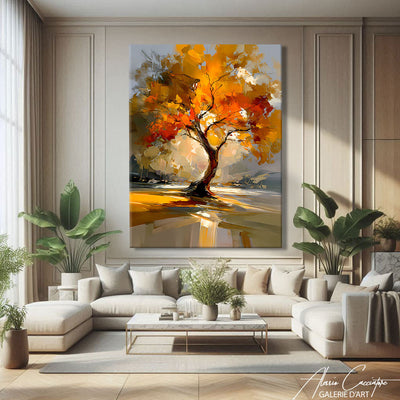
My opinion is firm: in a staircase, the vertical format almost always wins. It follows the height of the wall, accompanies the movement of the ascent, and does not "block" the diagonal of the steps the way a large horizontal format would. A 60 x 90 cm or 80 x 120 cm in portrait orientation, hung on the intermediate landing wall or one-third of the way up, is enough to dress up a straight staircase in a townhouse.
Three configurations that work
- The single canvas on the landing. The landing is the only place where you pause: that's where the statement piece goes, a large vertical with a striking subject. It is the most elegant solution and the easiest to hang.
- The series of canvases in a diagonal. Two to four canvases of the same format (40 x 60 cm or 50 x 70 cm), hung following the slope of the steps. The effect is graphic, very "architect-designed home," provided the series is consistent: same style, same palette, same orientation. Our guide to composing a mural triptych explains this logic of series, which adapts perfectly to a staircase.
- The large format on the background wall. In an open stairwell, with a high wall visible from both the floor above and the ground floor, a vertical XXL 100 x 150 cm canvas becomes the backbone of the house. This specific case is covered in our article on the size of an XXL painting according to the room.

What I advise against: the family gallery wall style, with fifteen small formats of different sizes. On a sloped wall, it's a nightmare to align, and the result quickly looks cluttered. If you like the idea of multiple images, stick to a regular series.
At what height should you hang a painting in a staircase?
This is the question that makes nine out of ten staircases fail. The rule is simple to state and a bit delicate to apply: the center of each canvas should be approximately 1.55 m above the step directly beneath it. Not above the ground floor, but above the step. This way, while going up, each painting is at eye level at the moment you pass by it.
The step-by-step method
- Using a pencil, draw a line on the wall parallel to the nose of the steps, at a height of 1.55 m. A long ruler and a level are sufficient; otherwise, measure 1.55 m above three different steps and connect the points.
- Place the center of each canvas on this line. For a series, space the canvases 8 to 12 cm apart, keeping the same gap between each one.
- Check the arrangement from the bottom of the staircase, then from the top. It is from these two points of view that you judge the installation, never head-on.
On the landing, however, you go back to the classic rule: center of the canvas 1.55 m from the landing floor. And for anything regarding fasteners, wall anchors, and load capacity on a stairwell wall that is often made of drywall, I refer you to our guide for hanging a heavy painting safely, where every tip applies here, with one additional precaution: do not hang anything at arm's length over the steps. Use a stable step stool placed on the landing or a ladder with levelers, and have a second person below to guide you.

What subjects and colors for staircase wall art?
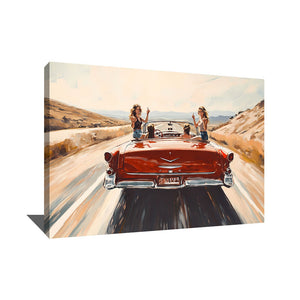
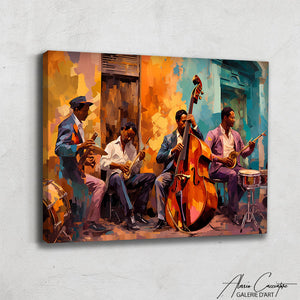
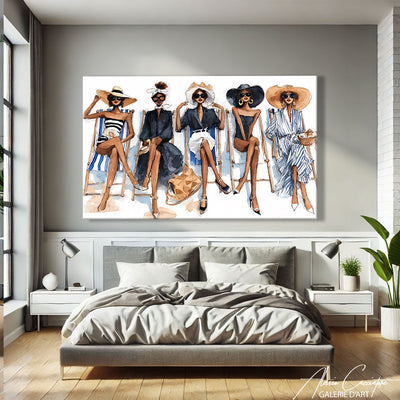
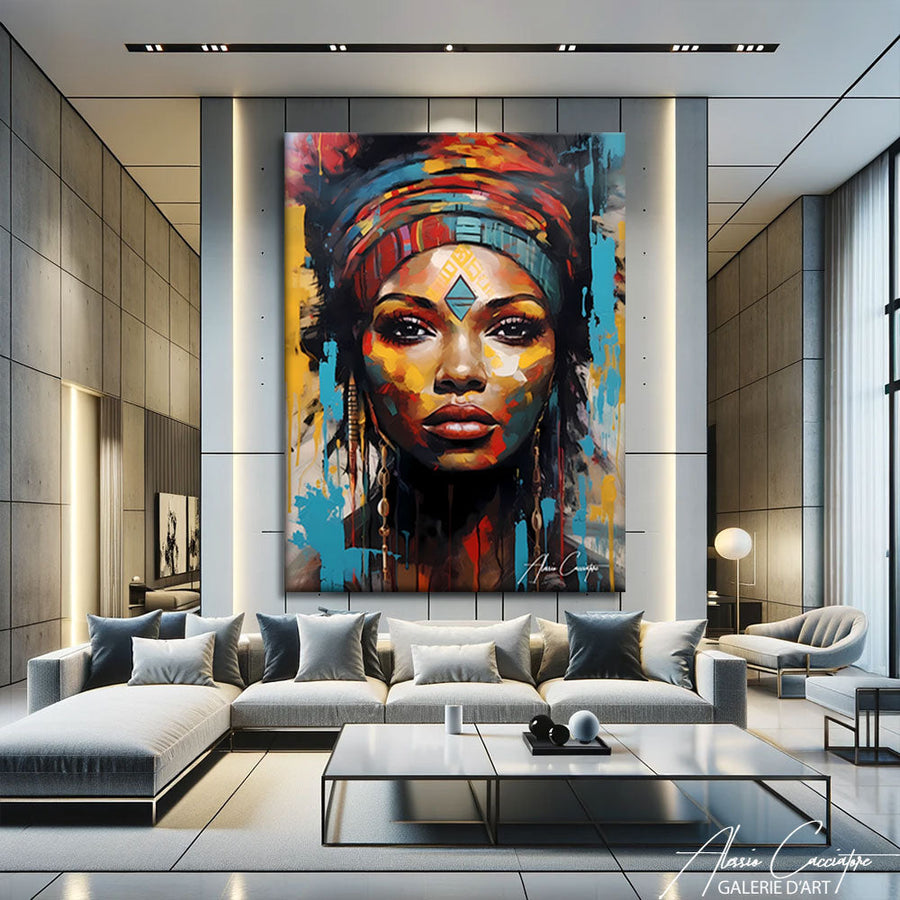
Since the gaze does not linger, the subject must have presence. A portrait with a direct gaze, a close-up of an animal, a graphic city, an abstraction with clear shapes: this is what works. Conversely, a misty landscape or a very fine composition will dissolve into the often sparse light of a stairwell.
Speaking of light, a staircase is rarely well lit: a high window, a wall lamp, sometimes nothing at all. Therefore, choose bright or contrasting canvases, with a generous portion of white, beige, or vibrant colors. A dark painting in a dark staircase disappears. True story: a client from Nantes had chosen a superb black and midnight blue canvas for her stairwell; three weeks later, she moved it to the living room and got a colorful portrait for the stairs. Ever since, her guests stop on the steps.
Regarding harmony, the staircase connects two floors: the painting must speak to both. Pick up a color present downstairs (the sofa, a rug) and one present upstairs (a bedroom door, a headboard). A colorful canvas that pulls from both palettes creates the link naturally, which is also what we advise in our ten inspirations for personalizing your spaces.

Stretched canvas or plexiglass finish in a staircase?
Our paintings are printed on canvas stretched over wooden frames, without a frame, and this is a real asset in a staircase: the canvas is lightweight, which is reassuring when fixing it above steps, and its matte surface does not cast reflections from a window or a nearby wall lamp. For a stairwell wall, raw canvas is my first choice.
However, the plexiglass option has two arguments here. The first is light: in a dark stairwell, the shine of the plexiglass captures the little light available and brings out the colors. The second is maintenance: a staircase is a high-traffic area where you brush against the wall and where children touch it; a smooth surface can be cleaned with a quick wipe. If your staircase is narrow and frequently used, plexiglass is a reasonable choice. To learn more about the format suitable for this type of wall, our article on the choice of a modern vertical painting details the proportions to respect.
FAQ: your questions about staircase wall art
How many paintings should you put in a staircase?
One large vertical on the landing, or a series of two to four identical canvases along the slope. Beyond that, the wall becomes cluttered and alignment becomes difficult. In a small house, one well-placed painting is worth more than three medium ones.
Can you put a horizontal painting in a staircase?
Yes, but only on a landing or on the back wall of an open stairwell, where the floor is flat. Along the steps, horizontal orientation contradicts the diagonal and always gives the impression of being poorly hung, even if it is perfectly level.
Should you light staircase wall art?
It is not essential, but an adjustable wall lamp or a spotlight directed at the canvas transforms a mundane staircase into a small gallery. If you don't want to wire anything, choose a bright and contrasting canvas: it will be sufficient with ambient light.
In summary: a vertical piece, at step height, with bold colors
A successful staircase painting relies on three decisions: a vertical format (or a regular series) rather than a large horizontal one, hanging at 1.55 m above each step and not the floor, and a readable subject with bright or contrasting colors that connects the two floors. To find the canvas that will finally give you a reason to look up in the stairwell, browse our collection of modern paintings, printed on canvas stretched over wooden frames with a plexiglass option. And if format is your primary concern, our collection of vertical paintings brings together the ideal proportions for a staircase wall.