
The black and white abstract painting is arguably the safest decor purchase you can make for your walls. No color that goes out of style, no pattern that grows tiresome: just a play on contrasts, shapes, and textures that stands the test of time without aging a day. But "safe" doesn't mean "easy to choose." Between minimalist compositions, figurative subjects treated in abstraction, and large-scale graphic formats, how do you know which one will suit your room, your wall, and your lighting? After years of advising our customers, here are the concrete answers to the questions we are asked most often — along with some strong opinions, because that's also why you are here.
Why the black and white abstract painting transcends all trends
The answer can be summed up in one word: contrast. Where a colorful canvas dialogues (or argues) with your sofa, your curtains, and your rug, a black and white work relies solely on the strength of its composition. It works in a Scandinavian living room just as well as in an industrial interior, and that is precisely why our black and white painting collection is one of the most visited in the gallery, season after season.
Abstraction adds a second layer of timelessness. A face, a landscape, or an object anchors the work in a specific style; an abstract composition, however, leaves the interpretation open. A little gallery owner's secret: the works that combine both — an animal or a silhouette treated with abstract strokes, drips, and flat tints — are the ones that please for the longest time. We keep coming back to them, always discovering a new detail.
Technically, insist on a print on canvas stretched over a wooden frame: the matte finish of the canvas absorbs light and gives depth to the blacks, whereas a glossy medium flattens them. For a more contemporary finish and sharper contrasts, the plexiglass option is an excellent alternative.
What size and format should you choose?
This is THE question, and the answer is almost mathematical: your painting should occupy between half and two-thirds of the width of the piece of furniture it hangs above. Above a 220 cm sofa, aim for 120 to 150 cm in width. If it's too small, the painting drifts and the wall seems empty; that is the number one mistake we see.
- Large living room wall: a panoramic or XXL format in a single piece, for an immediate gallery effect.
- Hallway or entryway: a vertical format that follows the flow of traffic and makes the ceiling appear higher.
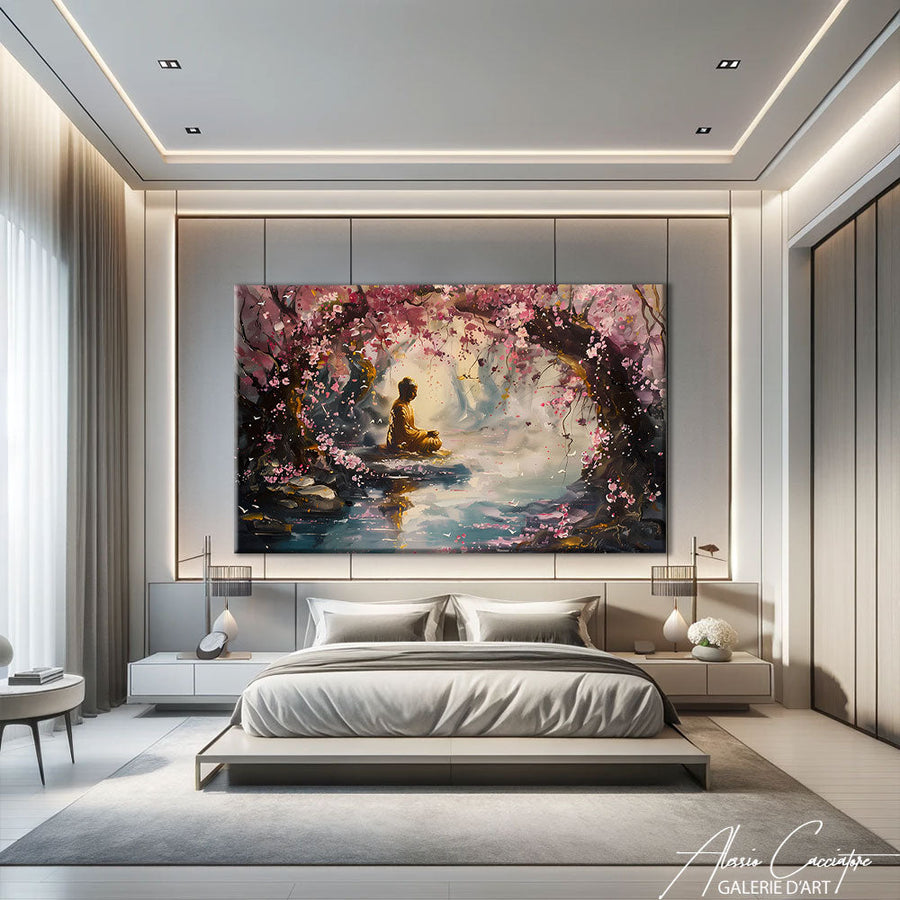
- Above a headboard: a horizontal format slightly narrower than the bed, hung 15-20 cm above it.
- Small wall section: a 50 to 70 cm square, centered at eye level (the center of the work about 1.65 m from the floor).
In black and white, don't be afraid to think big: the absence of color makes even a very large format surprisingly visually light.
Which room should you hang it in?
In the living room: the centerpiece
The living room is the natural showcase for a black and white abstract work. Hung above the sofa or facing the room's entrance, it structures the space without imposing any color. A stylized Japanese wave, for example, brings movement to a living room that might be a bit too subdued — it's the kind of piece that sparks conversation with your guests.

In the bedroom: calm elegance
Contrary to popular belief, black and white is anything but cold in a bedroom — provided you choose a composition with soft lines rather than aggressive graphics. A pair of lions treated in abstraction, for instance, combines powerful symbolism with a soothing palette above a headboard.

In the office: concentration through sobriety
For an office, whether at home or at work, black and white is our standard recommendation: no color interferes with concentration, and abstraction stimulates the imagination during moments of reflection. A deer with antlers rendered in abstract splashes brings exactly the extra bit of character that distinguishes an inspiring office from an impersonal one.

How to pair it with your interior's colors and materials?
The great advantage of black and white is that it goes with everything — but it particularly enhances certain combinations. On a white or light gray wall, the contrast does all the work. On a dark wall (midnight blue, forest green, deep terracotta), the artwork becomes a spectacular point of light: it is our favorite setup, by far. As for materials, light wood, linen, bouclé wool, and brass instantly warm up the rigor of the monochrome.
If you fear austerity, there are two solutions: choose a composition where the gesture dominates (drips, splashes, visible brushstrokes), or pair your artwork with a second, more colorful canvas selected from our collection of abstract paintings. The monochrome + color duo is one of the most effective combinations there is. To delve deeper into the subject, our guide everything you need to know to choose an abstract painting details the main families of compositions.
FAQ: your questions about the black and white abstract painting
Can a black and white abstract painting warm up a room?
Yes, provided you play with texture and gesture. A composition with visible textures, nuanced grays, and organic shapes warms up a space, whereas highly contrasted geometric graphics cool it down. The support also matters: canvas on a wooden frame provides a matte warmth that no other medium can equal.
Black and white or colored monochrome: how to decide?
If your room already contains three colors or more (walls, sofa, rug), black and white will calm things down. If your interior is very neutral, both options work — it all depends on whether you want the painting to blend in or stand out. Our article on the black and white painting, the sobriety that never goes out of style will help you see things more clearly.
Should you frame a black and white abstract painting?
It is not necessary: a canvas stretched on a frame stands on its own and maintains a very contemporary gallery feel. If you insist on a finish, a thin black floating frame remains the only option we endorse without reservation.
In summary: bet on contrast, not on caution
Choosing a black and white abstract painting is a commitment to timelessness — but not to timidity. Think big on the format, prioritize compositions where the artist's hand is visible, and dare to use a dark wall if your room is suitable. All our works are printed on canvas stretched on wooden frames, with a plexiglass option for lovers of contemporary finishes. Browse our black and white painting collection: the piece that will structure your interior for the next ten years is likely already there.