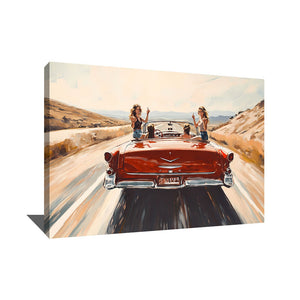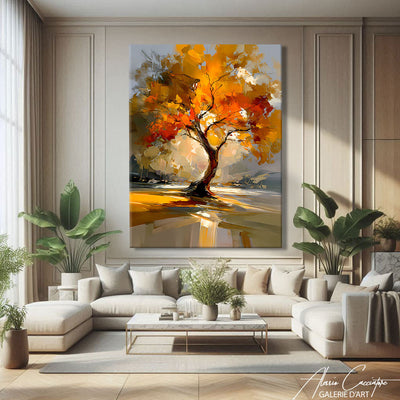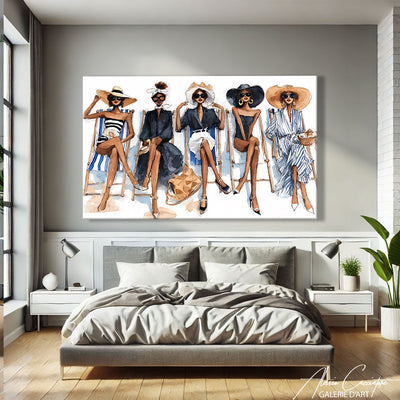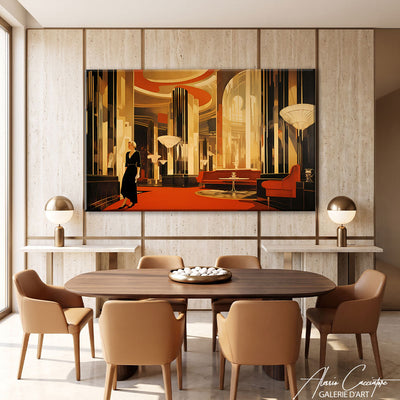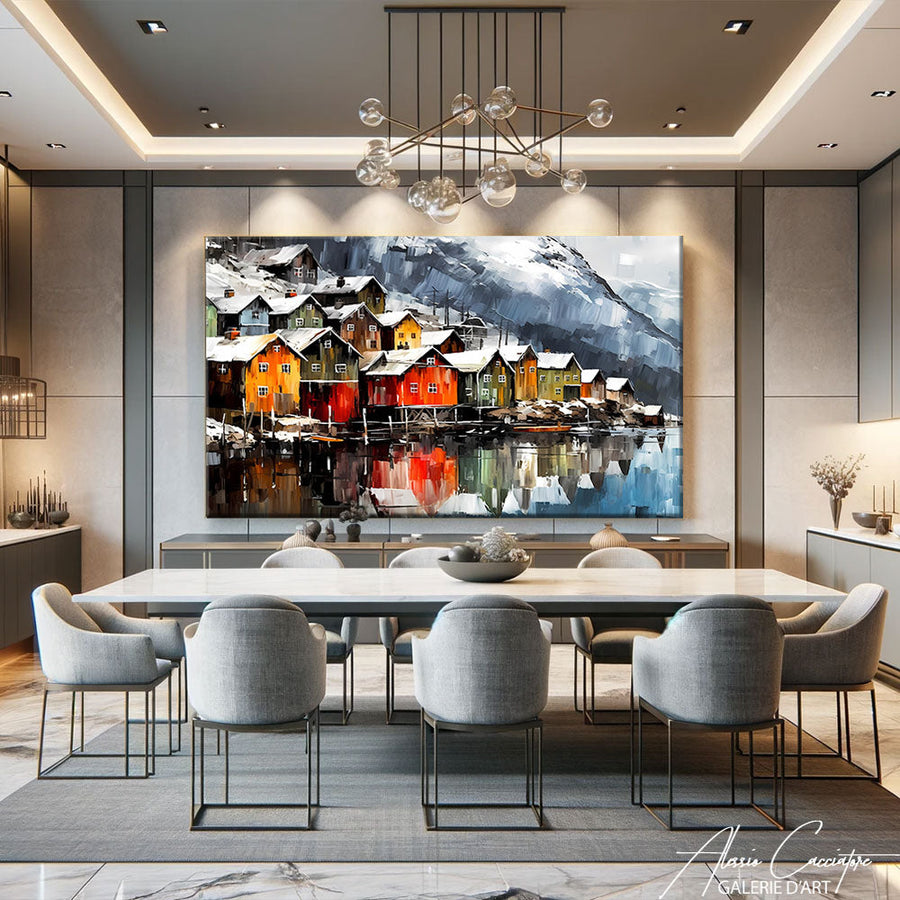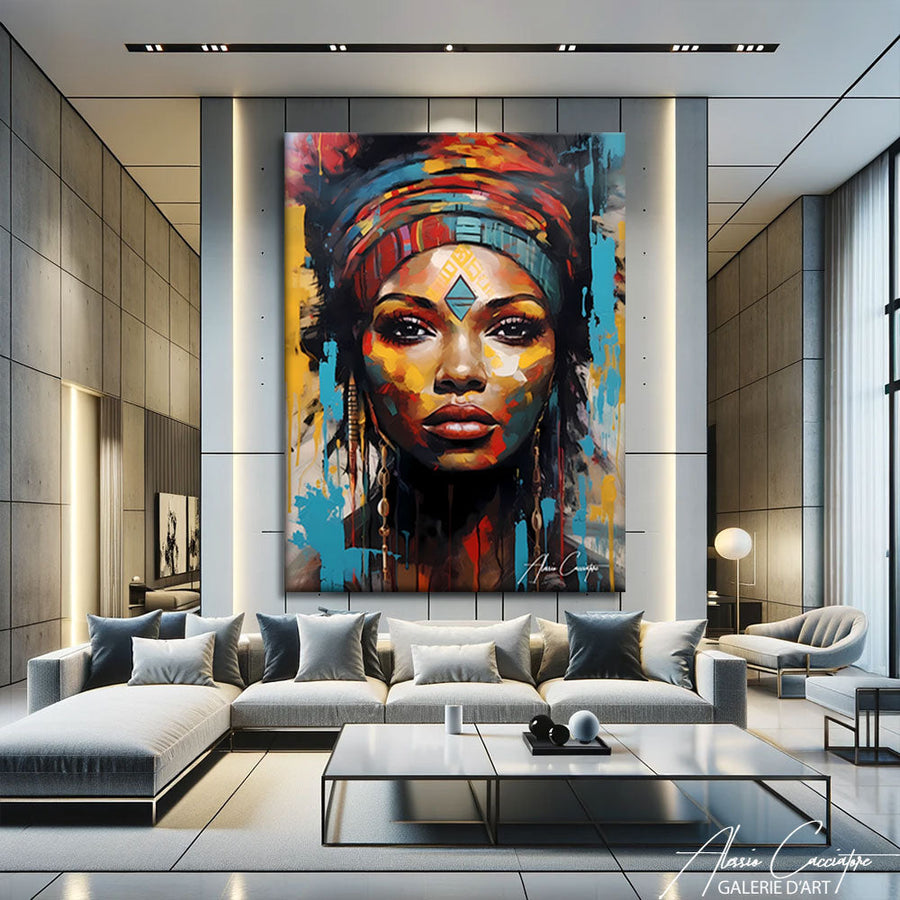

To pair modern abstract paintings, choose a single common thread—a palette, a brushstroke, or a contrast—and maintain it across all the canvases on a single wall. Then, the sizes, spacing, and hanging height will transform several artworks into a cohesive composition rather than a mere accumulation.
In this guide, we provide the complete method: how to define this common thread, which canvases to group in the living room or bedroom, which layout to choose, and what width to aim for based on your furniture. A size chart and FAQ will then help you take action without hesitation.
What is a modern abstract painting?
A modern abstract painting is a work that does not seek to faithfully reproduce reality: it stylizes or transcends it, retaining only shapes, colors, lines, and brushstrokes. Some canvases remain purely non-figurative, while others hint at a silhouette, a face, or an object beneath the drips and flat areas of color.
This freedom explains why abstraction lends itself so well to pairing. Without a repeating narrative subject, two canvases can communicate through their hues or energy without telling the same story twice. The eye moves from one to the other, spotting echoes, and the wall gains a depth that an isolated artwork rarely offers.
Which common thread should you choose among several abstract paintings?
The common thread is the visible commonality that connects all the canvases in a composition, and it is best to choose only one. Without it, even very beautiful artworks can appear randomly juxtaposed. Four options work in most interiors, from the simplest to the most daring:
- The palette. Two or three dominant hues repeated from one canvas to another, for example red, gray, and white, or blue, ochre, and cream.
- The brushstroke. Artworks that share the same style: expressive drips, geometric flat areas, or fluid lines.
- The contrast. A series in black, white, and gray, the simplest solution for a calm and graphic ensemble.
- The stylized subject. Several abstract silhouettes—a dancer, a couple, or movement—united by the same energy.
The most common mistake is mixing three different saturated palettes on the same wall. Each canvas then demands attention, and the overall look appears cluttered. If you like very different artworks, spread them across different walls or rooms instead, and reserve the composition for canvases that truly share a commonality.
How to pair modern abstract paintings in the living room?
The living room is the room where an abstract composition can be the most generous, as there is often plenty of space to step back. Build it around a master canvas above the sofa, then add one or two secondary artworks on an adjacent wall that incorporate a color from the first. The abstract dancer painting, with its red silhouette on a light background, plays this role of a pivotal piece very well.

Abstract dancer painting on canvas, available on canvas or plexiglass, from 60 x 40 cm to 120 x 80 cm.
Above a sofa, leave 20 to 25 cm between the top of the backrest and the bottom of the frame, and aim for a composition that occupies about two-thirds of the width of the furniture. If you pair two or three canvases side by side, space them 5 to 8 cm apart: beyond that, the eye no longer perceives a cohesive whole but isolated paintings.
How to pair them in the bedroom and other rooms?
In more intimate rooms, an abstract composition benefits from being softer and more tightly arranged than in the living room. The principle remains the same: a common thread and regular spacing, but we often reduce the number of canvases and choose broader, less restless brushstrokes so as not to agitate the eye when it is time to rest.
In the bedroom
Above the headboard, a single vertical canvas or a diptych is generally sufficient. The multicolored abstract couple painting, with its embracing faces and touches of color on a gray background, brings warmth without overwhelming a simple decor. A small format that incorporates one of its hues, placed near a dresser, completes the ensemble with discretion.

Multicolored abstract couple painting, available on canvas or plexiglass in 60 x 40, 80 x 60, or 120 x 80 cm.
In a light living room or office
In a bright room or workspace, a more dynamic abstraction easily finds its place. The abstract bicycle painting, with its turquoise and orange pastel tones, creates movement while remaining light. Paired with a calmer canvas in the same hues, it forms a balanced duo, energetic on one side and soothing on the other.

Abstract bicycle painting on canvas, available on canvas or plexiglass, from €89.
Which layout should you choose to hang several abstract paintings?
The ideal layout depends on the number of canvases and the shape of the wall, but four patterns cover most situations. Regardless of your choice, keep one common rule: the center of the composition should be between 145 and 160 cm from the floor, just like a single canvas, so that the whole remains at eye level.
- The diptych or triptych. Two or three canvases of the same size, aligned and spaced 5 to 8 cm apart, for a clean look above a sofa or bed.
- The line. Different sizes whose centers are aligned at the same height, ideal above a long sideboard.
- The grid. Four or six identical canvases arranged in a square or rectangle, for a very graphic look.
- The gallery wall. Mixed sizes around a pivotal artwork, more free-form but more demanding.
For the gallery wall, prepare the composition on the floor or cut out paper templates to attach to the wall before drilling. Always start with the largest canvas, then arrange the others around it. Our guide to creating a gallery wall details this method step by step, including mistakes to avoid.
What size composition based on the width of the furniture?
The size of an abstract composition is calculated based on the piece of furniture it hangs above, not the wall alone. Aim for about two-thirds of the width of the sofa, bed, or sideboard, including spacing. The three canvases presented in this article come in 60 x 40, 80 x 60, and 120 x 80 cm, which opens up many combinations.
| Furniture width | Target width (approximately two-thirds) | Example composition |
|---|---|---|
| 150 cm | approximately 100 cm | one 80 x 60 cm canvas, or two vertical 60 x 40 cm canvases spaced 5 to 8 cm apart |
| 180 cm | approximately 120 cm | one horizontal 120 x 80 cm canvas, or two vertical 80 x 60 cm canvases |
| 210 cm | approximately 140 cm | three vertical 60 x 40 cm canvases in a triptych |
| 240 cm | approximately 160 cm | two vertical 120 x 80 cm canvases in a diptych |
These guidelines remain indicative: a very high wall or low ceiling may justify slightly adjusting the composition. If in doubt, prefer one large canvas and two smaller ones over a series of small formats, which often looks timid on a large wall. To evaluate each new canvas, our guide to choosing an abstract painting provides the essential criteria.
FAQ: pairing modern abstract paintings
How many abstract paintings can you hang in the same room?
In a medium-sized living room, three to five canvases spread across two walls offer a good balance. The important thing is that each artwork has room to breathe: a main composition above the sofa, then one or two canvases echoing it elsewhere. Beyond that, simply embrace the gallery wall logic around a pivotal artwork.
Can you mix abstract and figurative paintings?
Yes, provided the two styles share a common palette. A portrait with hues close to your abstractions integrates very well between two abstract canvases. However, maintain a dominant style on each wall so that the composition remains readable and the eye immediately understands what connects the artworks.
Do the paintings need to be the same size to pair them?
No, but identical sizes make hanging much easier. A diptych or triptych of the same size gives a clean and reassuring look. If you mix sizes, align the centers on the same line or arrange them around a master canvas, maintaining regular spacing of 5 to 8 cm.
Canvas or plexiglass for an abstract composition?
Both supports work, and the choice depends mainly on the desired effect. Canvas stretched over a wooden frame offers a matte and warm finish. Plexiglass, delivered with its hanging rail, provides a glossy and very contemporary finish. For the same composition, preferably use the same support for all the canvases.
At what height should you hang a composition of several paintings?
Consider the composition as a single block: its center should be between 145 and 160 cm from the floor. Above a sofa or headboard, leave 20 to 25 cm between the furniture and the bottom of the frames. This way, the whole remains at eye level and interacts with the furniture.
In summary
- Choose a single common thread: palette, brushstroke, contrast, or stylized subject.
- Build each composition around a master canvas.
- Space the canvases 5 to 8 cm apart and place the center of the whole between 145 and 160 cm from the floor.
- Aim for about two-thirds of the width of the furniture, including spacing.
To create your own ensemble, browse our collection of abstract paintings or expand the selection with our collection of modern paintings, with free delivery and 30 days to change your mind.