
An ethnic painting is chosen first for its graphic treatment, its colors and its scale, much more than for its motif. To avoid a cliché effect, opt for a single striking canvas per room, a palette coordinated with your materials and a format proportional to the piece of furniture it hangs above.
In this guide, we first define what the term covers. We then detail the selection criteria, the colors to pair, the most suitable rooms, the right formats and the hanging height, with examples from our gallery.
What is an ethnic painting?
An ethnic painting is a decorative artwork that draws its subjects, motifs or colors from a specific culture: village scenes, portraits adorned with jewelry, stylized masks or tribal geometries. The term is broad and includes African, Native American, Indian or Oceanian inspirations. In decoration, it mainly refers to a canvas with a strong graphic character, which brings warmth and narrative to a wall.
In fact, the majority of ethnic canvases are inspired by Africa, whose stylized silhouettes, fabrics with graphic motifs and earth tones have become classics of contemporary decoration. Our collection of African paintings brings together a wide selection. To decipher the most common symbols, read our article on the meaning of an African painting.
Native American inspirations form the other major family, with their feathers, their profile portraits and their geometric motifs. Our article on Native American motifs in decor explains their symbolism, and our collection of Indian paintings presents many interpretations.
How to choose an ethnic painting without falling into cliché?
An ethnic painting avoids cliché when it is chosen for its composition and not for the exoticism of its subject. Three simple criteria help to sort between a canvas that dresses an interior and a canvas that disguises it.
Look at the treatment before the motif
Two canvases showing the same scene can produce opposite effects. Observe the finesse of the contours, the richness of the palette and the framing: a structured composition, with clean flat colors, ages better than an assembly of symbols placed side by side. Ask yourself if you will still want to look at this canvas in five years.
Choose a subject that speaks to you
A portrait, a scene of life or an abstract motif do not send the same message. The portrait establishes a presence and a gaze, the scene tells a story, abstraction remains more discreet. Start from the atmosphere desired in the room rather than a style to check on a list.
Limit yourself to one striking canvas per room
Overcrowding is the main cause of the "souvenir shop" effect. A striking ethnic canvas, surrounded by simple materials like linen, light wood, rattan or wool, is enough to set the tone. The decorative objects that accompany it must extend its colors without repeating its motifs.
The African ethnic painting with traditional scenes illustrates this approach well: its stylized silhouettes stand out against an orange-red background, with a very readable graphic rhythm. Above a light sofa, it becomes the only strong point of the room and needs no other motif around it.

African ethnic painting with traditional scenes, available on canvas or plexiglass, from 60 x 40 cm to 120 x 80 cm.
What colors to pair with an ethnic painting?
An ethnic painting pairs most easily with natural tones and raw materials. The principle is to take one or two colors from the canvas in the rest of the room, in small touches, to create a dialogue without saturating the space.
- Ochres, sienna and browns: to pair with light wood, linen and beige or off-white walls.
- Reds and oranges: one canvas is enough, surrounded by white, light gray or sand to let the color breathe.
- Deep blues and indigo: sharp contrast with a white wall, a gray sofa or cognac leather.
- Black and gold: a more graphic and chic effect, ideal with brass, marble or velvet.
If your walls are already colored, choose a canvas whose dominant shade recalls that of the wall, then add a contrasting accent on a cushion or a throw. A terracotta wall welcomes an ochre and black canvas very well, while a sage green wall highlights the reds and oranges.
In which room to hang an ethnic painting?
The living room is the most natural room for an ethnic painting, because it offers a large wall and an obvious focal point above the sofa. A horizontal canvas there establishes a warm atmosphere from entering the room, especially surrounded by green plants and natural textiles.
The bedroom
In a bedroom, favor a soothing portrait or a softer palette, with sand, gold and blue tones. The ethnic woman painting, with her face adorned with gold jewelry and her blue garment, works very well above a light headboard, in a bedroom with beige woodwork.

Ethnic woman painting, available on canvas stretched on a wooden frame or on plexiglass.
The entrance, the hallway and the office
The entrance and the hallway readily welcome a vertical portrait, which sets the tone of the house from the door. In an office, a graphic scene in black and ochre brings character without distracting. Avoid, however, very narrow walls, where a canvas with a busy motif quickly appears cramped.
What size of ethnic painting to choose?
The right size is calculated from the piece of furniture placed below: the artwork must occupy about two-thirds of its width. This simple guideline avoids both the canvas lost in the middle of a large wall and the canvas that overflows the sofa.
| Furniture width | Recommended format | Suitable rooms |
|---|---|---|
| About 90 cm (console, dresser) | 60 x 40 cm | Entrance, hallway, office |
| About 120 cm (sideboard, two-seater sofa) | 80 x 60 cm | Bedroom, dining room |
| About 180 cm (three-seater sofa) | 120 x 80 cm | Living room |
For a very large wall, you can also compose a diptych or a triptych with several canvases of the same format, spaced 5 to 8 cm apart. The entire composition then respects the two-thirds rule. Choose canvases that share the same palette to maintain an overall reading.
Canvas or plexiglass?
Our artworks exist on canvas stretched on a wooden frame or on plexiglass with hanging rail included. The canvas brings a warm finish that suits natural and bohemian interiors, while plexiglass gives a sharper and more contemporary look. Prices start at €89, delivery is free and you have 30 days to change your mind.
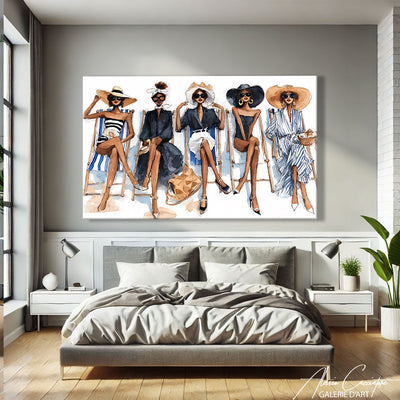
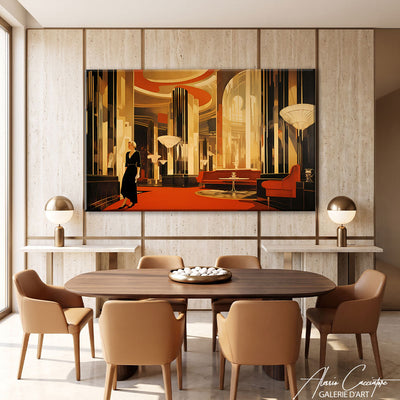
The ethnic art deco painting shows how a cultural subject can take a very current look: a feminine silhouette with a large hat, caught in ochre, cream and teal curves. Above a light gray sofa, its fluid lines soften a minimalist living room.

Ethnic art deco painting, in 60 x 40, 80 x 60 or 120 x 80 cm, on canvas or plexiglass.
At what height to hang an ethnic painting?
An ethnic painting is hung with its center between 145 and 160 cm from the floor, i.e. at the eye level of a standing adult. This rule applies to a free wall, an entrance or a hallway, and it guarantees a comfortable reading of the details of the motif.
Above a sofa or a headboard, leave 20 to 25 cm between the furniture and the bottom of the frame. The canvas and the furniture then form a coherent ensemble, without the artwork appearing to float in the middle of the wall.
In the evening, a warm light directed at the canvas brings out the ochres, the reds and the golds. Place the source slightly higher and to the side to limit reflections, especially on plexiglass. A wall sconce or an adjustable spotlight is enough in most rooms.
FAQ: ethnic painting
Is an ethnic painting necessarily African?
No, an ethnic painting is not necessarily African. The term also includes Native American, Indian, Oceanian or Oriental inspirations. Africa remains, however, the most frequent source in decoration, thanks to its adorned portraits, its village scenes and its earth palettes, very easy to pair with wood and linen.
How to avoid the cliché effect with an ethnic painting?
To avoid the cliché effect, choose a single striking canvas per room and surround it with simple materials. Favor a careful composition rather than an accumulation of symbols, and take one or two colors from the canvas in the textiles. Avoid multiplying masks, figurines and motifs around the painting.
What size of ethnic painting above a sofa?
Above a sofa, the ethnic painting must occupy about two-thirds of the width of the furniture. For a three-seater sofa of about 180 cm, a format of 120 x 80 cm suits well. Then leave 20 to 25 cm between the sofa and the bottom of the frame to maintain a coherent ensemble.
What colors to pair with an ethnic painting?
The colors easiest to pair with an ethnic painting are natural tones: off-white, beige, sand, light wood and plant green. They let the ochres, the reds and the golds of the canvas breathe. For a more graphic effect, black and brass bring a chic touch.
Can several ethnic paintings be hung together?
Yes, several ethnic paintings can be hung together if they share the same palette. Align them at the same height, with 5 to 8 cm between each canvas, and treat the composition as a single artwork. It must then occupy about two-thirds of the width of the furniture placed below.
In summary
- An ethnic painting is chosen for its graphic treatment, its palette and its scale.
- A single striking canvas per room, surrounded by natural materials, avoids the cliché effect.
- The artwork occupies about two-thirds of the width of the furniture placed below.
- Its center is placed between 145 and 160 cm from the floor, and at 20 to 25 cm above a sofa.
To find yours, browse our collection of ethnic paintings, available on canvas or plexiglass from €89.