
The first time a client asked me for “a painting with flowers, but not flowers,” I smiled. She was looking for that beautiful tension: the memory of a garden without the literal drawing of a rose. Abstract flower paintings do exactly that. They capture the essence—the color of a poppy field, the movement of a stem in the wind, the emotion of a bouquet—without worrying about botanical realism. And frankly, that is often much more powerful than a photographic reproduction.
Why floral abstraction resonates so much (especially in 2025)
Abstract flower paintings are seeing a real resurgence. It’s not just a passing trend.
First, they answer a deep need for nature in our urban interiors. When you spend 90% of your time between four walls, a colorful abstract painting inspired by petals or foliage brings life back in. Without falling into the “flowery cottage” decor of our grandmothers.
Next, abstraction allows for total emotional freedom. You don't need to recognize a tulip to feel something. A movement of carmine red, a splash of saffron yellow, a curved green line—your brain makes the connection to nature intuitively. This is what Georgia O'Keeffe understood a century ago: by enlarging, simplifying, and abstracting her flowers, she gave them a universal power.
In my studio, when I work on an abstract floral series, I never start from a reference photo. I keep in mind the impression of a bouquet seen at the florist, or the light in a Japanese garden visited in Kyoto. It’s the emotion that I want to fix on the canvas, not the botanical description.
Finally, these works fit into contemporary interiors much more easily than a classic floral painting. You can hang them in a minimalist loft, a bohemian bedroom, or a designer office. They bring softness and vitality without imposing a specific decorative style.
The major movements that shaped the abstract flower painting

Georgia O'Keeffe: the pioneer of enlarged floral art
It’s impossible to talk about floral abstraction without mentioning Georgia O'Keeffe. In the 1920s, she painted irises, poppies, and calla lilies in extreme close-up. So close that you no longer see the whole flower, just its curves, its textures, its color gradients. It is at once hyper-realistic and totally abstract. Her canvases blur the line between figuration and abstraction—and it’s brilliant.
Lyrical abstraction and spontaneous gesture
In the 1950s-60s, lyrical abstraction in Europe (I’m thinking of artists like Joan Mitchell or Zao Wou-Ki) mixed spontaneous gestures with references to nature. No identifiable patterns, but an energy that recalls a wheat field, an undergrowth, a wild meadow. Modern abstract paintings from this period breathe freedom.
This movement influences me enormously. When I work with a palette knife or a wide brush, I let the color “grow” on the canvas, like a plant. There’s no denying it, it results in work that is more alive than if I controlled every millimeter.
Contemporary floral minimalism
Today, many artists (including myself) explore a more refined path: a few touches of color, plenty of white or neutral space, a suggestion of a stem or a petal. This is the reign of the modern minimalist abstract painting, which works wonderfully in Scandinavian or Japan-inspired interiors.
This minimalism does not mean an absence of emotion. On the contrary: by removing the superfluous, you amplify what remains. A single curved golden line on an off-white background can evoke a bouquet of wheat better than a hyperrealistic still life.
How to choose your abstract flower painting (without going wrong)
A handmade abstract painting is expensive. You might as well choose it well.
1. Start with your interior palette
Look at your walls, your textiles, your furniture. Which colors dominate? If your interior is in neutral tones (gray, beige, white), a colorful abstract painting with bright pinks, oranges, or yellows will create an incredible focal point. If, conversely, you already have a lot of color, opt for a softer abstract flower painting, in pastel or monochrome tones.
In my experience, clients who buy an abstract painting they “fall in love with” without thinking about their decor are often disappointed once they get it home. Take a photo of your wall, place the work there virtually if possible. It helps immensely.
2. Think about size (seriously)
A 40x40 cm abstract flower painting will look lost on a 3-meter wall. Conversely, a 120x100 cm canvas will overwhelm a small living room. Rule of thumb: the work should cover about 2/3 of the width of the furniture it is hung over (sofa, bed, console).
I have clients who have ordered XXL formats for their cathedral-ceiling living rooms, and others who prefer diptychs or triptychs of medium sizes to create rhythm on the wall. Both approaches work, as long as the proportion is thought out.
3. Dare to use texture
The advantage of a handmade abstract painting (compared to a print) is the material. When I work on my floral series, I often use a palette knife to create impasto, reliefs that catch the light differently depending on the time of day. It gives a real physical presence to the work.
If you are hesitating between two modern abstract paintings, choose the one whose surface makes you want to touch it. That’s a good indicator.
4. Trust your emotions (but double-check)
An abstract painting is above all an emotional encounter. If you feel something in front of the work—joy, peace, melancholy, energy—that’s a good sign. But give yourself 24 hours of perspective before buying. Look at the image on your phone the next morning. Is the emotion still there? If so, go for it.
The colors that work best in an abstract flower painting

Some palettes work better than others for floral abstraction. Here is what I have observed for years.
Powder pink + sage green
This is THE favorite combination for my clients. Soft, feminine, timeless. It evokes peonies, antique roses, and English gardens without falling into clichés. Perfect for a bedroom, a dressing room, or a reading corner.
Solar yellows + oranges
To bring energy and warmth. These tones recall sunflowers, nasturtiums, and summer sunsets. They energize a living room, a dark hallway, or an open kitchen. Be careful, however: in large areas, bright yellow can be tiring. I recommend tempering it with off-white or gray.
Deep blues + violets
Less common, but magnificent for evoking irises, lavender, and hydrangeas. These abstract flower paintings have an almost meditative dimension. They are suitable for contemporary masculine interiors, offices, or zen spaces.
Black and white with a touch of color
A brushstroke of red on a black and white background is enough to suggest a poppy. It’s graphic, modern, and striking. This minimalist approach works very well in lofts, artist studios, and industrial interiors.
To my taste, what is annoying about many mass-produced modern abstract paintings is that they use all the colors at once, without harmony. The result: it looks nice in a web thumbnail, but garish in real life. Always favor a restricted palette—3 colors maximum + 1 or 2 neutrals.
Where to hang your abstract flower painting (room by room)
Living room: above the sofa or facing the entrance
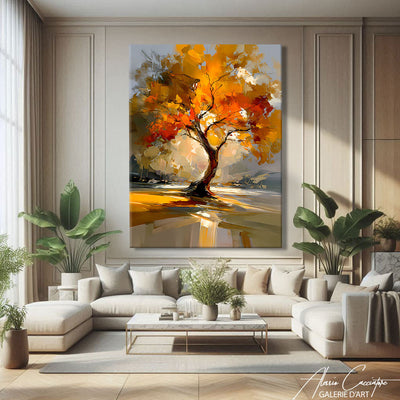
This is the star location. The abstract flower painting becomes the focal point of the room. Choose a generous format (80x100 cm minimum) so it has impact. If your sofa is gray or beige, dare to use bright colors.
Bedroom: at the head of the bed or facing the bed
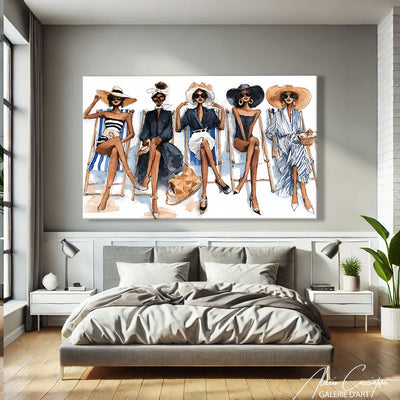
In a bedroom, favor soothing tones: pale pinks, soft greens, lavender blues. Floral abstraction brings a touch of nature conducive to rest, without the “too much” effect of full floral wallpaper. I had a client who hung a large pink and white abstract painting facing her bed—she tells me she falls asleep looking at it every night. Mission accomplished.
Office or workspace
A modern abstract painting with an energizing floral touch (yellow, orange, red) stimulates creativity without being distracting. Avoid overly detailed or figurative works that attract too much attention during video calls.
Entrance or hallway
This is the first space your guests discover. A colorful abstract painting makes an excellent first impression. In a narrow hallway, prefer a vertical format (50x120 cm for example) that visually lengthens the space.
Open kitchen
Less obvious, but it works very well if your kitchen is sleek. A small abstract flower painting (40x40 or 50x50 cm) placed on a shelf or hung near the table brings life without cluttering.
In any case, hang the work at eye level (the center of the painting at about 1.50-1.60 m from the floor). And if you have several paintings, space them 5 to 10 cm apart to create a coherent ensemble.
Handmade abstract painting vs. print: why it changes everything
You can find prints of abstract flower paintings for €50 on decor sites. So why pay €300, €500, or €1000 for a handmade abstract painting?
First, the material.
A print, even of high quality, remains flat. It reproduces the image, not the texture. When I paint with a palette knife, each stroke creates a relief that catches the light differently depending on the viewing angle. The painting “breathes”; it changes throughout the day. A print never does that.
Next, the uniqueness.
Each handmade painting is unique, even in a series. The colors are never exactly the same, the gesture varies. You are buying a work of art, not copy number 347 of a Photoshop file. That has value, both emotional and financial.
Finally, the artist’s energy.
I know that can sound “esoteric,” but a painting created by a human carries something that a machine cannot reproduce. The time spent, the hesitations, the repainting, the moments of grace—all of that remains in the work. My clients often tell me they “feel” this presence.
Afterward, I’m not spitting on prints. They have their place as affordable decor. But if you are looking for a work that will mark your interior over time, which will gain sentimental (and even financial) value, invest in an original.
A handmade modern abstract painting costs more, yes. But it will last your whole life, and you will never get tired of it.
Mistakes to avoid when buying an abstract flower painting
Mistake #1: Buying on a whim without thinking about the global decor
I love impulses. But before clicking “buy,” take a photo of your interior. Picture yourself with the work. A magnificent painting in a gallery can clash in your living room if the colors don’t match.
Mistake #2: Choosing an inappropriate format
Too small, and your painting will drown on the wall. Too big, and it will overwhelm the room. Measure your space before. And if you are hesitating, ask the artist for advice—we are used to giving guidance on formats.
Mistake #3: Neglecting lighting
A colorful abstract painting needs light to reveal all its nuances. If you hang it in a dark corner without dedicated lighting, it will lose 50% of its impact. Install an adjustable spotlight or a wall sconce if necessary.
Mistake #4: Trying to perfectly “match” the painting's colors with the cushions
It’s tempting, but it often results in an interior that is too coordinated, like an IKEA catalog. It is better to create echoes of color: if your painting has pink, integrate a touch of pink elsewhere (a throw, a vase), but not a total match. Art should surprise a little.
Mistake #5: Waiting for “the right moment” to buy
The right moment is when you come across the work that moves you. Handmade abstract paintings are not mass-produced. The one you see today may no longer be available tomorrow. Honestly, I have lost count of clients who came back a week later for a work that was already sold.
How to maintain and preserve your abstract flower painting
A well-maintained handmade abstract painting will last for decades without losing its luster.
Gentle dusting
Once a month, run a very soft feather duster or microfiber cloth over the surface. Never use household products, never use water. If the canvas is varnished (most of mine are), you can use a barely damp cloth, but really barely.
Avoid direct sunlight
UV rays fade pigments in the long term. Do not hang your painting facing a window where it would receive the sun 6 hours a day. If it’s unavoidable, close the shutters during the hottest hours, or install anti-UV film on the glass.
Control humidity
In a very humid bathroom or kitchen, the canvas can loosen or grow mold. If you absolutely insist on hanging a work in these rooms, choose a varnished painting + ensure good ventilation.
Careful handling
When you move the painting, hold it by the frame, never by the stretched canvas. And never touch the painted surface with your fingers—the grease from the skin leaves marks.
Restoration if needed
If the painting is damaged (tear, stain, flaking varnish), contact the artist or a professional restorer. Do not try to repair it yourself; you risk making things worse.
With these precautions, your abstract flower painting will go through the years, the moves, the changes in decoration. It is a durable investment, not a disposable accessory.
Frequently Asked Questions
What is the difference between an abstract flower painting and a classic floral painting?
A classic floral painting depicts flowers in a realistic or stylized, yet identifiable way. An abstract flower painting, on the other hand, evokes floral nature through colors, shapes, and movements, without literally drawing a rose or a sunflower. It is the emotion of the flower rather than its reproduction. This approach offers more freedom of interpretation and fits better into modern interiors.
How much does a handmade abstract flower painting cost?
For an original work by a contemporary artist, expect to pay between €200 (small format 30x40 cm) and €1500 (large format 100x120 cm or more). The price depends on the size, the complexity, the artist's reputation, and the technique used. It’s more expensive than a print, but you are buying a unique piece that will increase in value over time.
What colors should I choose for an abstract flower painting in a gray and white living room?
On a neutral gray-white base, you have two options: either bring softness with powder pinks, beiges, and sage greens, or create a strong contrast with bright yellows, oranges, or reds. Both work, it all depends on the ambiance you are looking for (soothing vs. dynamic). My advice: take a paint sample of your wall to compare.
Can you hang an abstract flower painting in a child's bedroom?
Absolutely. Favor soft colors (pale pinks, tender greens, sky blues) and a format adapted to the size of the room. Abstraction stimulates children's imagination without imposing a fixed narrative. Just make sure the painting is securely fastened to the wall (not just resting on a shelf) for safety reasons.
How do I know if an abstract flower painting is of good quality?
Check for: (1) the artist’s signature on the back or front, (2) the presence of a certificate of authenticity, (3) the quality of the frame (solid wood, well-stretched canvas), (4) the uniformity of the varnish if applicable, (5) the richness of the textures and colors. A good handmade painting has relief and substance. If everything looks smooth and flat, it might be a print.
Can I order a custom abstract floral painting?
Yes, most contemporary artists accept custom commissions. You choose the size, the dominant colors, and the desired mood. The process generally takes 3 to 6 weeks. It is ideal if you have a specific space and a very precise color palette to match. Contact the artist directly to discuss the project and the budget.
All the works mentioned in this article are available on the gallery. Free worldwide shipping, 30-day money-back guarantee.