
I long believed that Moroccan decor necessarily rhymed with turquoise mosaics and gold calligraphy. Then I visited a riad in Marrakech where a minimalist abstract canvas dialogued perfectly with century-old zellige tiles. The owner told me something that stayed with me: "Moroccan art is first and foremost a matter of light and generosity, not mandatory motifs." Since then, my way of approaching Moroccan living room art has changed radically.
Why Moroccan living room art deserves better than orientalist clichés
Frankly, the "Morocco" paintings found online sometimes make me want to run away. A camel in front of a palm grove, a mosque at sunset, a stylized belly dancer... It's pretty, but it turns your living room into a postcard.
True contemporary Moroccan style, the kind seen in the homes of Casablanca collectors or in design hotels in Marrakech, is something else entirely. It embraces heritage without copying it. It takes the codes — warm colors, rich textures, generous volumes — but transposes them into a modern language.
A successful Moroccan living room painting, in my taste, is one that could hold its own in a Parisian apartment while revealing all its depth in an oriental setting. It creates a bridge.
And that works out well: contemporary art loves these dialogues between tradition and modernity.
Color codes that work (beyond Majorelle blue)

Yes, Yves Saint Laurent’s version of Klein blue is beautiful. But if every Moroccan living room switches to intense blue, we lose the essential: uniqueness.
Ochre, terracotta, saffron: the desert palette
These warm tones naturally dialogue with dark wood (cedar, thuya) and Berber textiles. A painting in these shades brings immediate warmth without cluttering the space. I have a client in Essaouira who hung an abstract ochre and beige canvas above her plum velvet bench. The result: the artwork lets the room breathe instead of saturating it.
Black and white, surprisingly Moroccan
That always comes as a surprise. Yet, some of the most beautiful wall decor I have seen in modern riads was in black and white. Why does it work? Because it creates a sharp contrast with the richness of the surrounding materials. The painting becomes a visual pause. A breath of air.
And besides, black and white is timeless. If you change your cushions or rugs in three years, the artwork will still work.
Emerald green and powder pink: the unexpected duo
I discovered this combination in a contemporary Moroccan living room in Tangier. A large painting with touches of deep green on a pink background, facing off-white walls and copper lanterns. Magnificent. These colors evoke secret gardens and flowery patios, without falling into the folkloric.
Formats and dimensions: adapting scale to generous volumes
Traditional Moroccan living rooms, especially in riads, have high ceilings and wide walls. If you put a small 60x80 cm canvas above a 3-meter bench, the effect is a failure. The artwork gets lost.
My advice: go big. A painting of at least 120x80 cm, ideally 150x100 cm or larger if your main wall allows it. Horizontal (landscape) formats work well above the low seating typical of Moroccan style.
But be careful: big does not mean busy. A clean abstraction 180 cm wide will have more impact than a patchwork of small canvases.
The classic mistake: multiplying small frames. That works in a London gallery spirit, but much less so in an oriental decor where the space needs to breathe.
Artistic styles that dialogue with Moroccan architecture

There is no need to literally represent Morocco for it to work in a Moroccan living room. Certain contemporary styles naturally match oriental architecture.
Geometric abstraction
Geometric patterns are everywhere in Islamic art: zellige, mashrabiya, carved ceilings. A geometric abstract painting creates a natural resonance with these codes, but in a modern language. Piet Mondrian in a riad? It works.
Textural art
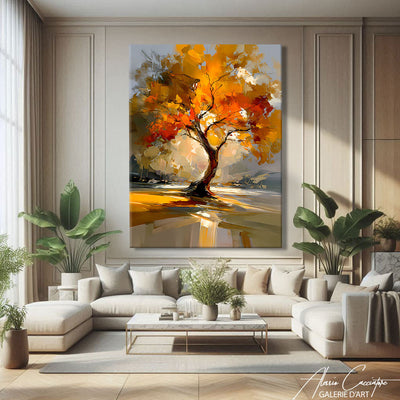
Morocco is also about matter: smooth tadelakt, thick rugs, patinated leather, carved wood. A canvas with relief, thick paint, and textural effects extends this tactile richness. I particularly like works where one can discern the knife strokes or overlapping layers.
Stylized figurative art
If you really insist on a recognizable subject, favor graphic treatment. A palm tree silhouette in flat color rather than a photographic rendering. A stylized portrait rather than dated orientalism. The lines must be clear, almost design-oriented.
Matching the living room painting with traditional elements (rugs, lanterns, mashrabiya)
This is where many people panic. "How do I integrate a contemporary work without it clashing with my copper lanterns and Berber rug?"
The answer is one word: balance.
If your living room is already very visually busy (patterns everywhere, intense colors, numerous objects), your painting should be a zone of calm. Favor monochromes, clean compositions, and neutral tones. The artwork becomes a resting point for the eye.
Conversely, if your decor is sober — white walls, minimalist furniture, just a few oriental touches — you can afford a more expressive, colorful, energetic painting.
A concrete example: six months ago, I delivered a large midnight blue and gold abstract painting to a client who had a Moroccan living room with carved benches and burgundy red rugs. She was afraid it wouldn't work. The result: the cool blue of the painting calmed the heat of the red, and the touches of gold echoed the brass details. Perfect harmony.
The important thing is not to try to match everything perfectly. A little visual tension is what makes an interior feel alive.
Where to place your painting in a traditional or contemporary Moroccan living room

Above the main bench
This is the classic placement and it works very well. The painting becomes the focal point as soon as you enter the room. Just make sure the bottom of the frame is about 20-25 cm above the cushions. Too high, and the artwork floats away from the furniture. Too low, and it stifles it.
On the wall opposite the entrance
In riads, there is often a wall that faces the living room door. This is a strategic location: your painting is the first thing people see when entering. Take advantage of this to choose a strong piece.
Next to a niche or an arch
Moroccan architecture plays a lot with niches, horseshoe arches, and decorative openings. Placing a painting next to one (not inside) creates an interesting dialogue between the structure and the work. It breaks the expected symmetry.
Avoid: above a decorative fireplace
Many Moroccan living rooms have ornamental fireplaces that are already visually strong objects. Adding a painting above one is often too much. Unless the fireplace is very sober, in which case it might work.
Modern living room paintings: my concrete recommendations
I will be direct: rather than looking for a "Moroccan painting," look for a painting that works with your light and your space, then verify that it dialogues well with your oriental elements.
Here are my selection criteria:
- Limited palette: maximum 3-4 dominant colors. This avoids overcrowding.
- Physical presence: the work must have body, material, and relief. Flat prints perform poorly in Moroccan interiors that are all about texture.
- Adapted format: for a 25-30 m² living room, aim for 120x100 cm minimum. For 40 m² and more, don't hesitate to go up to 180x120 cm.
- Discreet framing: if you frame, opt for a thin and sober frame. The painting must breathe, not be enclosed in a large gold molding (unless that is your specific decor choice).
One tip I often give: test virtually. Take a photo of your wall, open the image on your computer, and overlay potential paintings to scale. It spares you from unpleasant surprises.
Trending living room wall decor: what if you dared a diptych or triptych?
Multi-panel compositions work remarkably well in Moroccan living rooms, especially when the walls are long.
A horizontal triptych (three canvases aligned) creates a visual rhythm that recalls the repetitive motifs of Moroccan craftsmanship, but in a contemporary register. It is a subtle way to bridge tradition and modernity.
Be careful with the spacing, however: leave 5 to 8 cm between each panel, no more. Beyond that, you lose the unity of the whole.
Personally, I have a soft spot for vertical diptychs in spaces with very high ceilings. Two large canvases stacked up to 2.50 m: it imposes a verticality that responds well to the architecture of riads.
But there’s no doubt, it takes character to dare. If you are hesitant, start with a single large canvas. You might add a second one later.
Errors to absolutely avoid when choosing a Moroccan living room painting
Before concluding, I must mention the classic traps I regularly see.
Accumulation of symbols: a painting with oriental motifs + a busy rug + sequined cushions + lanterns everywhere = a visual migraine. Choose your battles.
All-gold: yes, gold is magnificent in a Moroccan decor. No, your painting should not be entirely gold. A few touches are enough.
Tiny format: we said it, but I repeat it because it is the number one mistake. A small painting in a large living room is like putting a teaspoon of salt in a pot of couscous. Invisible.
Following a passing trend: "bohemian chic" or "ethnic modern" styles change quickly. Favor a work you truly love, not the one that looks pretty on Pinterest this month.
Neglecting quality: a cheap print on thin canvas, it shows. In a Moroccan interior where materials are often noble (solid wood, leather, brass), a low-end work clashes. Invest in an original piece or, at the very least, a very high-quality reproduction.
Frequently Asked Questions
What type of painting to choose for a modern Moroccan living room?
Favor geometric or textural abstractions in ochre, terracotta, or black and white tones. Avoid orientalist clichés (camels, mosques) and opt for contemporary works that dialogue with your traditional elements without imitating them. A large format (minimum 120x80 cm) will have more impact than an accumulation of small canvases.
Which colors to favor for a painting in an oriental decor?
Beyond Majorelle blue, explore desert palettes (ochre, saffron, terracotta), the unexpected duo of emerald green and powder pink, or even black and white which creates an elegant contrast. The essential is to create either harmony with your existing textiles or a bold contrast that lets the space breathe.
Where to hang a painting in a traditional Moroccan living room?
The ideal location is above the main bench, 20-25 cm above the cushions. You can also choose the wall opposite the entrance to make it the focal point of the room. Avoid overloading a wall already occupied by a fireplace or overly prominent carved niches.
Can a contemporary painting really integrate into a busy Moroccan decor?
Absolutely, provided you create a balance. If your living room is already very visually busy (patterned rugs, numerous lanterns, colorful cushions), opt for a sleek painting that will serve as a visual resting zone. Minimalist contemporary art dialogues very well with the richness of Moroccan craftsmanship.
Is it better to have one large painting or several small ones in a Moroccan living room?
A single large painting (120x80 cm minimum) will always have more impact than several small ones, especially in the generous volumes of Moroccan living rooms. Diptychs or triptychs also work very well if they are correctly spaced (5-8 cm between panels). Avoid the accumulation of small frames which fragments the space.
All the works mentioned in this article are available in the gallery. Free worldwide shipping, 30-day money-back guarantee.